
Practice question
Question
Male sterility refers to:
Explanation
Male sterility defined as failure to produce functional viable pollen capable of germination and fertilization, often while female organ retains normal function receiving pollen. Developmental causes include aberrant tapetum differentiation controlled by transcription factors DYT1 and TDF1 leading to premature programmed cell death, failure of callose dissolution by callase enzyme around tetrads, abnormal Sporopollenin deposition forming defective exine, and anther indehiscence due to lignin deficiency. Genetic determinants comprise mitochondrial chimeric ORFs such as T-urf13 in maize CMS-T causing loss of mitochondrial membrane potential specifically in tapetum, nuclear ms genes like ms1 in tomato encoding bHLH factor, and engineered barnase ribonuclease driven by TA29 promoter ablating tapetum. Phenotypically anthers may appear white shrunken with empty locules, enabling identification for hybrid breeding without manual emasculation. This understanding supports competitive exam preparation for NEET, GATE and CSIR NET concepts linking genotype with phenotype through molecular pathways involving transcription factors, hormones and metabolic enzymes that regulate development, adaptation and reproductive biology in applied breeding programs.
Related blogs
Guides and insights connected to this topic
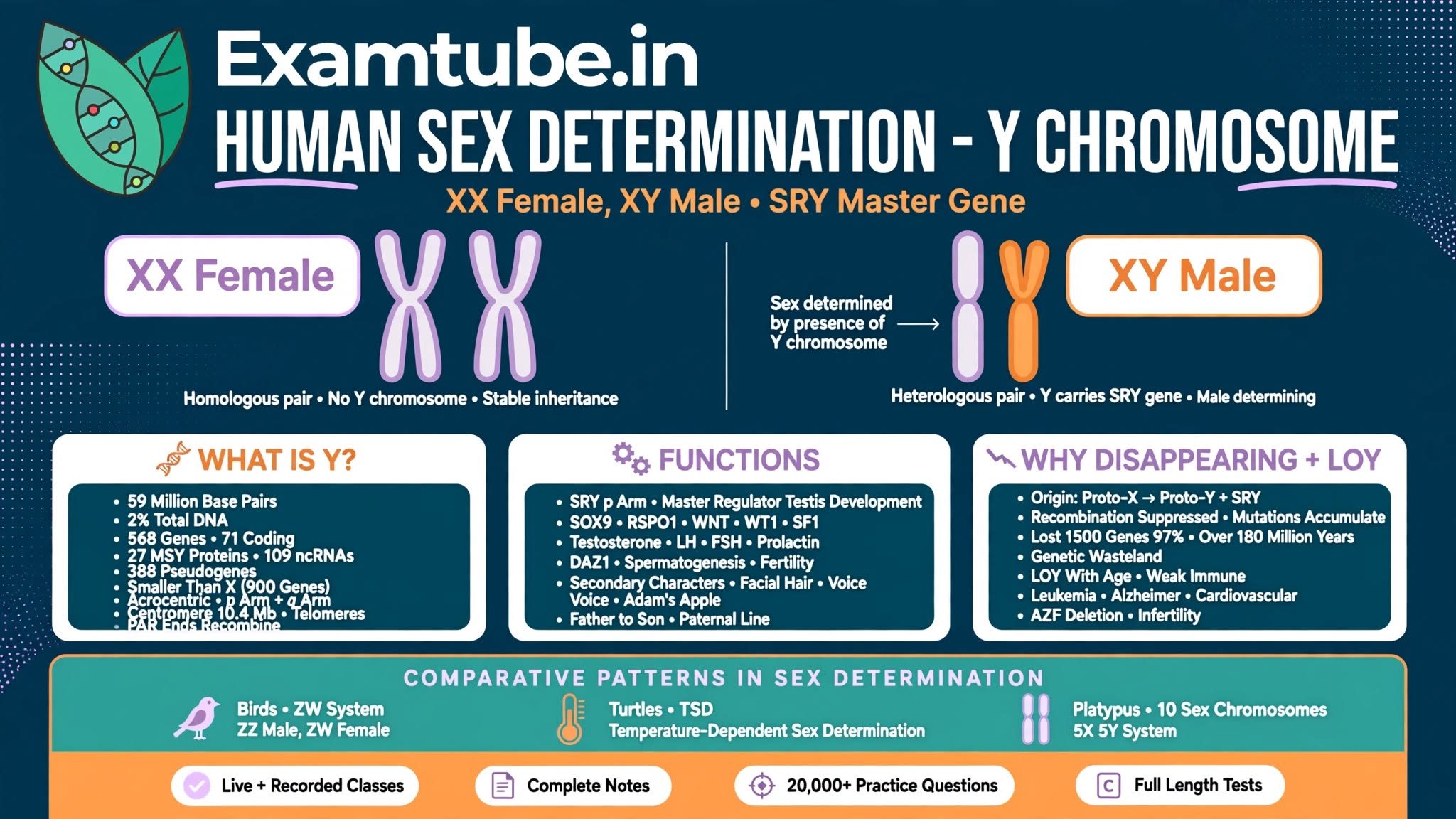
Losing the Y Chromosome: Structure, Functions, Degeneration and Effects of Loss of Y Chromosome (LOY)
Discusses Y chromosome structure, its evolutionary degeneration, and health impacts of loss of Y (LOY) in men.
Human Reproduction Biology Notes - Male Female Reproductive System, Gametogenesis, Fertilization, Implantation and Pregnancy
Detailed notes on the male and female reproductive systems, including testes, ovaries, gametogenesis, fertilization, implantation and pregna...
Egg Cell (Ovum): Structure, Oogenesis, Types, Functions and Disorders
Learn about the egg cell structure, oogenesis process, and its role in reproduction. Understand the layers, functions, and disorders of the ovum.

Discussion
Comments
Please log in to join the discussion.
Login to commentNo comments yet. Be the first to start the discussion.