
Practice question
Question
A gas at 3 atm and 300 K has a volume of 10 litres. If the temperature rises to 900 K at constant pressure, what is the new volume?
Explanation
**Collision frequency** Z = n σ v_rel, σ = π d² cross-section, v_rel = √2 v_avg, so Z ∝ n, for air at STP n≈2.5×10²⁵ m⁻³ d≈3×10⁻¹⁰ m λ≈68 nm, collision frequency ~10⁹ s⁻¹, illustrating frequent collisions at atmospheric pressure. Charles’ law: (V₁)/(T₁) = (V₂)/(T₂).V₁ = 10 litres, T₁ = 300 K, T₂ = 900 K.V₂ = V₁ × (T₂)/(T₁) = 10 × (900)/(300) = 30 litres. Substituting values gives 30 litres, which matches expected kinetic theory result, confirming mean free path λ = 1/(√2 n π d²), ideal gas law P V = n R T and v_rms = √(3 R T/M) relations.
Related blogs
Guides and insights connected to this topic
HtrA Gene and Protein - Structure, Dual Functions, Apoptosis Mechanism and Disease | Pointwise Notes with Maroon Highlights
HtrA proteins are serine proteases with PDZ domains that regulate mitochondrial quality control and trigger apoptosis. Human members HTRA1‑4 are linked to Parkinson’s
Exploration Notes - Scientific Models, Laws, Theories, Estimates and Interdisciplinary Science
Learn how scientists turn observations into measurements, use symbols, build models, and revise ideas in physics, chemistry, biology and earth science.
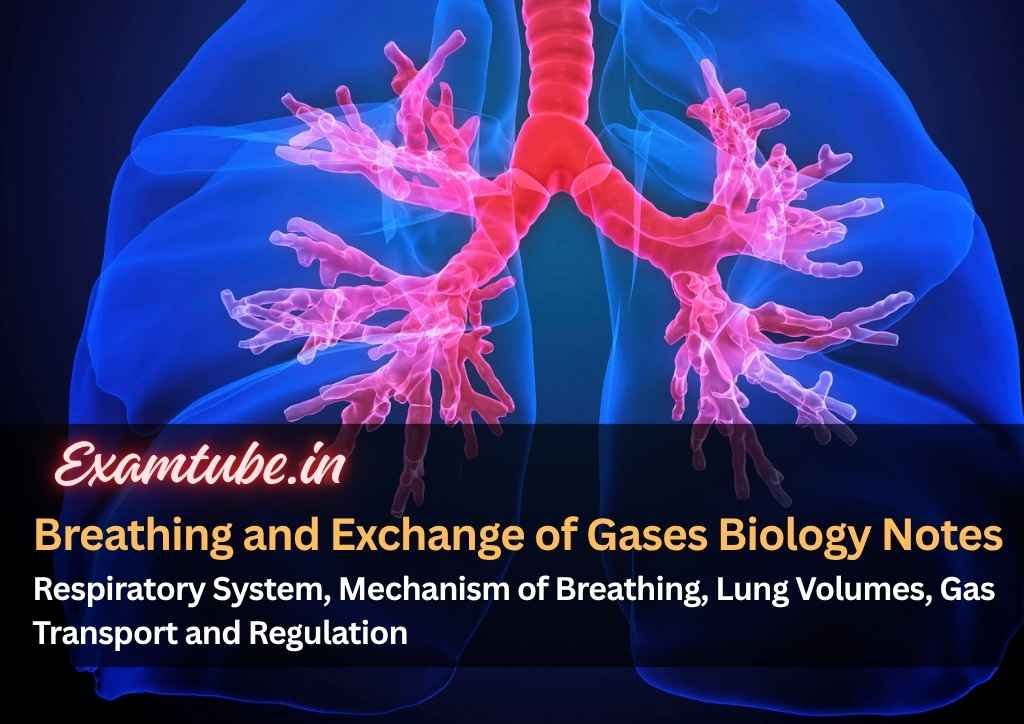
Breathing and Exchange of Gases Biology Notes - Respiratory System, Mechanism of Breathing, Lung Volumes, Gas Transport and Regulation
Clear biology notes on breathing and gas exchange. Learn human respiratory organs, breathing mechanics, and pulmonary gas transport.

Discussion
Comments
Please log in to join the discussion.
Login to commentNo comments yet. Be the first to start the discussion.