
Practice question
Question
A compound microscope has an objective of focal length \( 1.25 \, \text{cm} \) and eyepiece of focal
length \( 5 \, \text{cm} \) with a tube length of \( 15 \, \text{cm} \). What is the magnification at
infinity?
Explanation
**Two lenses in contact** behave as single lens with power sum, magnification product m = m₁×m₂. For f₁=20 cm (P₁=5 D), f₂=-20 cm (P₂=-5 D) in contact, P=0, F infinite, afocal system, beam emerges parallel, principle of corrective lenses for myopia/hypermetropia. Objective magnification: m_o = (L/f_o) = (15/1.25) = 12 . Eyepiece magnification: m_e = (D/f_e) = (25/5) = 5 . Total magnification: m = m_o × m_e = 12 × 5 = 60 . Substituting values gives 60, which matches expected image position and magnification from mirror/lens formula 1/f = 1/v - 1/u (lens) or 1/f = 1/v + 1/u (mirror), confirming sign conventions and refraction principles.
Related blogs
Guides and insights connected to this topic
Telomeres - Structure, Functions, End Replication Problem, Telomerase, Aging, Disease and Factors Affecting Length
Explore telomere structure, their role in chromosome stability, the end‑replication problem, telomerase activity, aging and disease factors.
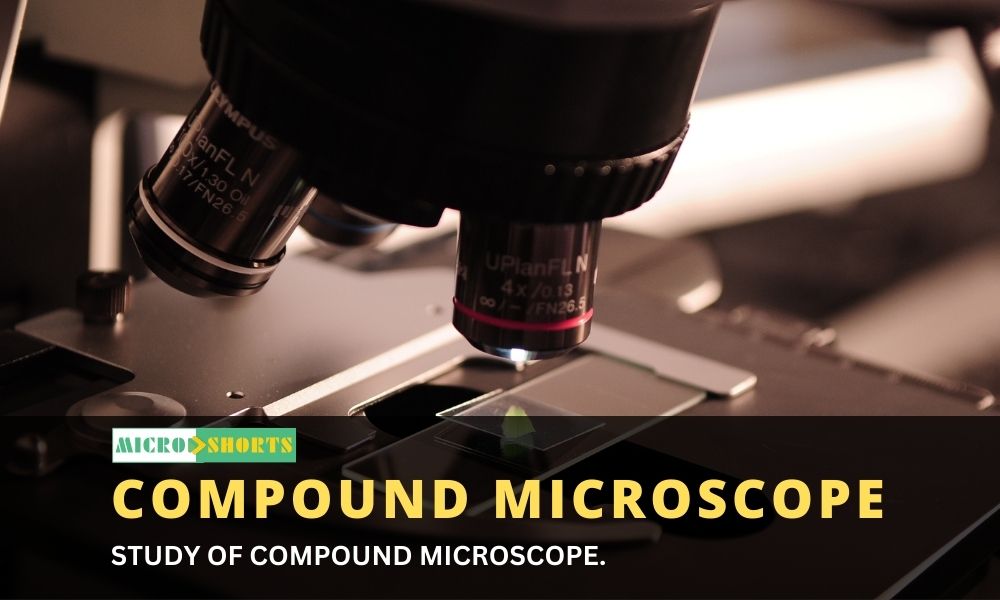
STUDY OF COMPOUND MICROSCOPE
INTRODUCTION The word microscope is derived from two Greek words ‘micro’ meaning small and ‘scope” meaning to view. In other words a microsc...

DNA Fingerprinting- Principle, Methods, Applications
DNA fingerprinting or DNA profiling is a process used to determine the nucleotide sequence at a certain part of the DNA that is un...

Discussion
Comments
Please log in to join the discussion.
Login to commentNo comments yet. Be the first to start the discussion.