
Practice question
Question
The export of proteins from the nucleus requires:
Explanation
Export of proteins from the nucleus depends on recognition of leucine-rich nuclear export signals that provide dominant cue for exit to the cytoplasm. Canonical NES consists of short amphipathic alpha-helix with regularly spaced large hydrophobic residues, typically leucine, isoleucine, valine or phenylalanine, arranged in pattern Φ-X2-3-Φ-X2-3-Φ-X-Φ where Φ denotes hydrophobic. This motif docks into hydrophobic groove formed by HEAT repeats 11 and 12 of chromosome region maintenance 1, CRM1, also called Exportin-1 or XPO1, stabilized only when Ran is in GTP-bound state present at high concentration in nucleoplasm due to chromatin-bound RCC1 guanine exchange factor. Formation of trimeric cargo-CRM1-RanGTP complex enables translocation through FG nucleoporins via transient hydrophobic interactions. On cytoplasmic side, RanGAP1 anchored to RanBP2 and RanBP1 co-activator accelerate GTP hydrolysis, causing conformational opening that releases cargo and recycles receptor. Adapter proteins bridge RNAs and pre-ribosomal subunits to CRM1, including NMD3 for 60S subunit and PHAX for U snRNAs. Clathrin coats, dynein motors and SRP act in endocytosis, microtubule movement and ER targeting, not nuclear envelope crossing, underscoring specificity of leucine-rich NES-CRM1 system for maintaining compartmental proteome and preventing nuclear retention of signaling regulators.
Related blogs
Guides and insights connected to this topic

Biomolecules Biology Notes - Chemical Composition, Amino Acids, Lipids, Proteins, Nucleic Acids, Enzymes and Cofactors
Detailed biology notes on biomolecules. Learn chemical tissue analysis, amino acids, proteins, lipids, nucleic acids, and enzyme action.
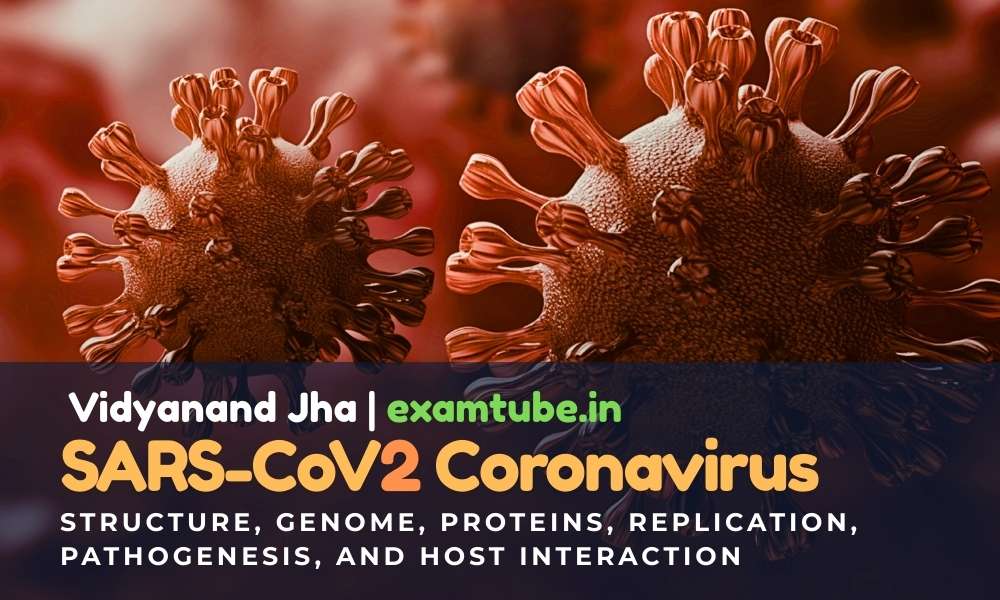
SARS-CoV-2 Coronavirus: Structure, Genome, Proteins, Replication, Pathogenesis, and Host Interaction
Coronavirus Overview Coronaviruses (CoVs) are enveloped viruses (surrounded by a lipid membrane derived from host cells), belonging to the s...

Coronavirus Structure, Genome, Replication, Symptoms, Pathogenesis, and Prevention
Structure of Coronavirus Coronaviruses (enveloped RNA viruses) fall in the virus family Coronaviridae, order Nidovirales. They are enveloped...
Discussion
Comments
Please log in to join the discussion.
Login to commentNo comments yet. Be the first to start the discussion.