
Practice question
Question
Who established the basis of ecological energetics?
Explanation
Raymond Lindeman established the trophic-dynamic foundation of ecological energetics by analyzing ecosystems as sequences of energy transfers among trophic levels. His 1942 synthesis linked productivity, respiration, and trophic efficiency and helped replace purely descriptive food-chain diagrams with quantitative budgets. Later ecosystem ecologists, especially Eugene and Howard Odum, expanded energy-flow modeling and systems analysis. Lindeman’s contribution was foundational because it connected thermodynamic constraints with community organization and emphasized that transfer efficiency limits food-chain length. The amount reaching a consumer level depends jointly on resource production, the fraction consumed, assimilation efficiency, and conversion of assimilates into new biomass. Food-web structure also reflects population persistence: upper levels need enough total production and sufficiently stable prey populations to avoid demographic extinction. Detrital and grazing channels continually exchange material, because waste and mortality feed decomposers while microbial and detritivore biomass supports predators. Quantitative interpretation requires explicit system boundaries and time scales; otherwise export, migration, storage, or seasonal turnover can appear to violate energy balance.
Related blogs
Guides and insights connected to this topic

Cucumber Mosaic Virus (CMV): Structure, Genome, Symptoms, Disease Cycle and Management
Cucumber Mosaic Virus (CMV): Introduction and Importance Cucumber Mosaic Virus (CMV) (plant-infecting RNA virus) is one of the most economic...
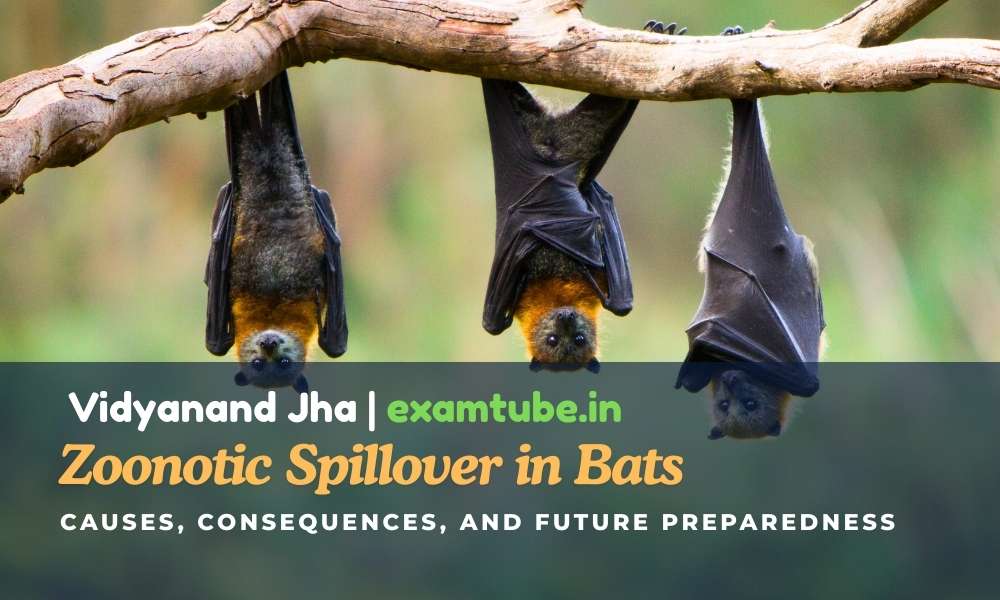
Zoonotic Spillover in Bats: Causes, Consequences, and Future Preparedness
Bats: General Characteristics and Classification Bats are small mammals capable of true sustained flight. They belong to the second-largest...

Human Astrovirus- An Introduction
Structure of Human Astrovirus Human astrovirus (virus causing gastroenteritis in humans) falls under Astroviridae (virus family) and genus M...