
What is DNA Extraction?
Deoxyribonucleic
acid (DNA) extraction
is the process by which DNA is separated from proteins, membranes, and other
cellular components present inside a cell from which it is recovered.
In
eukaryotic cells (such as human and plant cells), DNA is
organized into chromosomes and enclosed within a membrane-bound
organelle called the nucleus. These cells also possess:
- A
lipid bilayer outer membrane
- Cytoplasm containing proteins, sugars,
lipids, and inorganic ions
- Other
membrane-enclosed organelles
Therefore,
isolating DNA from eukaryotic cells requires breaking multiple protective
barriers.
Basic Steps of Eukaryotic DNA Isolation
The
isolation of DNA from eukaryotic cells involves three essential steps:
- Lysis (breaking open the cell and
nucleus)
- Precipitation (separating DNA from other
biomolecules)
- Purification (obtaining clean DNA free from
contaminants)
Principle of Eukaryotic DNA Isolation
The
first and most crucial step in DNA isolation is cell lysis,
during which the cell membrane and nuclear membrane are disrupted to
release DNA.
Methods
of Cell Lysis
Cell
lysis can be achieved by:
Mechanical
disruption
(using a tissue homogenizer (small blender), mortar and pestle,
or cutting tissue into small pieces)
Chemical
and enzymatic lysis
(using detergents and enzymes like Proteinase K (enzyme that
digests proteins))
Extraction Buffer Used
An
extraction buffer is commonly used and contains:
- 50
mM Tris (pH 8)
- 25
mM EDTA
- 200
mM NaCl
- 1%
SDS
Each
component has a specific role:
Tris
buffer
Maintains a stable pH, which is essential for DNA stability.
EDTA
(Ethylenediaminetetraacetic acid)
Binds divalent metal ions (Ca²⁺, Mg²⁺, Mn²⁺) (metal ions needed by
DNases), preventing:
- DNA
degradation by DNases (DNA-cutting enzymes)
- Formation
of salts with the *phosphate (PO₄³⁻) group of DNA
- DNA
precipitation It also destabilizes the cell membrane.
NaCl
(Sodium chloride)
Helps:
- Loosen
the cell wall
- Increase
DNA solubility and stability
- Shield
the negative phosphate groups of DNA, allowing DNA strands to come
closer and precipitate efficiently in alcohol
SDS
(Sodium dodecyl sulfate)
An anionic detergent that:
Disrupts
ionic interactions between proteins
Breaks
down cell membranes by emulsifying lipids and proteins
Causes
proteins and lipids to precipitate out of solution
DNA Precipitation
- DNA
is soluble in detergent solution
- DNA
is insoluble in alcohol
- Adding cold absolute ethanol or isopropanol causes DNA to precipitate, while other components remain dissolved
- DNA appears as white thread-like strands
Materials and Reagents Required for Eukaryotic DNA Isolation
- 5
mL microcentrifuge tubes
- Water
bath (80°C)
- Isopropanol
(room temperature)
- 70%
ethanol (room temperature)
- Lysis
solution
- RNase
solution (removes
RNA)
- Protein
precipitation solution
- Absorbent
paper
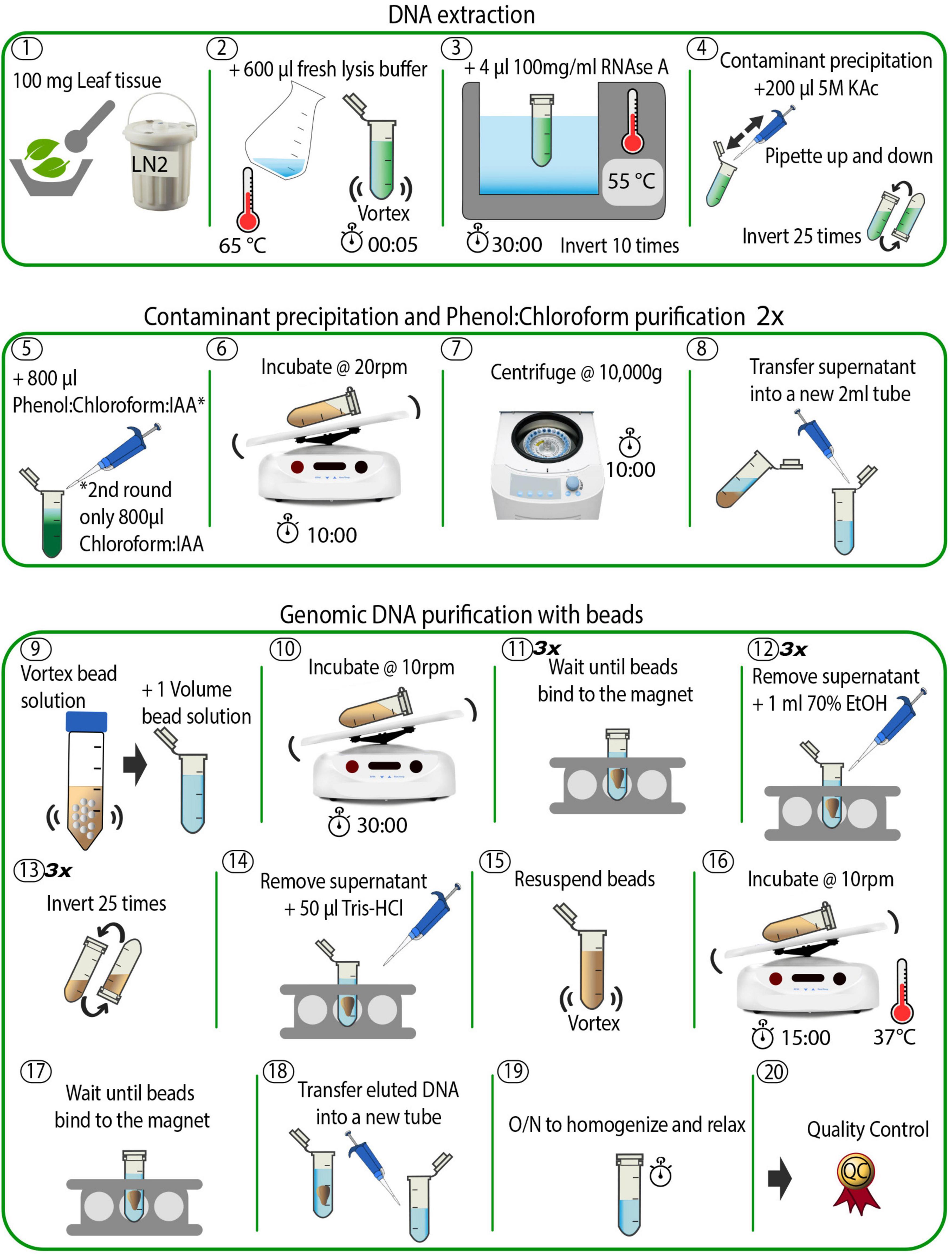
Procedure of Eukaryotic DNA Isolation
- Depending
on the sample (animal cell or plant cell), perform cell lysis
- Add
3 µL of RNase solution to the lysate
- Invert
the tube 2–5 times to mix
- Incubate
at 37°C for 15–30 minutes
- Cool
to room temperature for 5 minutes
- Add
200 µL of protein precipitation solution
- Vortex
at high speed for 20 seconds
- Chill
the sample for 5 minutes
- Centrifuge
at 13,000–16,000 × g for 4 minutes
- A
white protein pellet forms; carefully remove the supernatant
- Transfer
the supernatant to a 1.5 mL microcentrifuge tube
- Add
600 µL of room temperature isopropanol
- Gently
invert the tube to mix
- White
thread-like DNA strands
become visible
- Centrifuge
at 13,000–16,000 × g for 1 minute
- Decant
the supernatant after a small white DNA pellet forms
- Add
100 µL of 70% ethanol
- Invert
several times to wash the DNA
- Centrifuge
at 13,000–16,000 × g for 1 minute
- Aspirate
the ethanol carefully
- Invert
the tube on clean absorbent paper
- Air-dry
the DNA pellet for
10–15 minutes
- Add
100 µL of DNA rehydration solution
- Incubate
at 65°C for 1 hour (rehydration of DNA)
- Store
DNA at 2–8°C
DNA Quantification by Spectrophotometry
- DNA
concentration is determined by measuring absorbance using a
spectrophotometer
- DNA
absorbs UV light at 260 nm
- Proteins
absorb UV light at 280 nm
- Purity
of DNA is assessed using the A260/A280 ratio
Interpretation
- Pure
DNA → 1.8
- DNA
contaminated with protein
→ < 1.8
Expected
Results of Eukaryotic DNA Isolation
- White
thread-like strands
or a white DNA pellet
- Clear separation of DNA from proteins and other cellular debris