Coronaviruses
(CoVs) are enveloped viruses (surrounded by a lipid membrane
derived from host cells), belonging to the subfamily Coronavirinae,
family Coronaviridae, order Nidovirales.
They
are positive-sense, single-stranded RNA viruses (ssRNA(+),
meaning their RNA can directly act as mRNA for translation).
Coronaviruses
are divided into four genera:
Alphacoronavirus
(αCoV) – typically found in bats and rodents, some cause human
respiratory infections.
Betacoronavirus
(βCoV) – includes SARS-CoV, MERS-CoV, SARS-CoV-2.
Deltacoronavirus
(δCoV) – mainly in avian species.
Gammacoronavirus
(γCoV) – also predominantly avian.
Most
CoVs are zoonotic, meaning they originate in animals and can
jump to humans, which makes them a major concern for emerging
infectious diseases.
Structure of SARS-CoV-2
SARS-CoV-2
is a betacoronavirus, an enveloped, positive-sense,
single-stranded RNA virus.
Virions
are spherical to pleomorphic, measuring 80–160 nm in diameter.
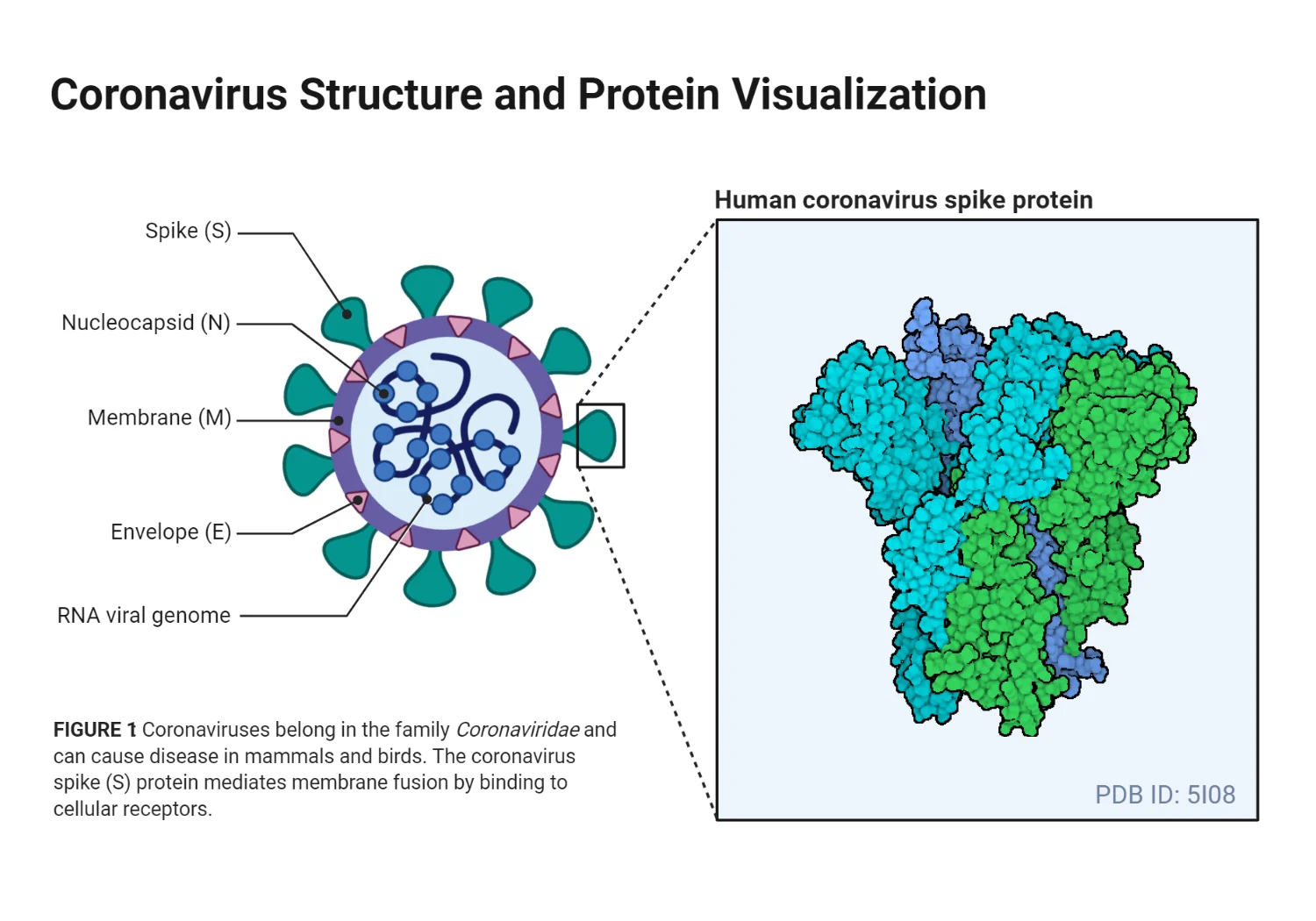
Major structural
proteins:
Spike
(S) protein – a glycoprotein that protrudes from the viral
envelope, forming the characteristic crown-like appearance (corona)
and mediating *host cell entry.
Membrane
(M) protein – the most abundant structural protein, defines
the shape of the viral envelope, and interacts with the nucleocapsid
(N) protein to organize assembly.
Envelope
(E) protein – the smallest structural protein, involved in viral
assembly, budding, and pathogenesis, and acts as an ion channel
(viroporin).
Nucleocapsid
(N) protein – binds to viral RNA to form the helical nucleocapsid,
assists in viral RNA packaging, transcription regulation, and
modulates host immune response.
Transmembrane
proteins (S and M) help the virus anchor into the lipid envelope and
facilitate virus assembly during replication.
Spike Glycoprotein (S protein)
Comprised
of S1 and S2 subunits:
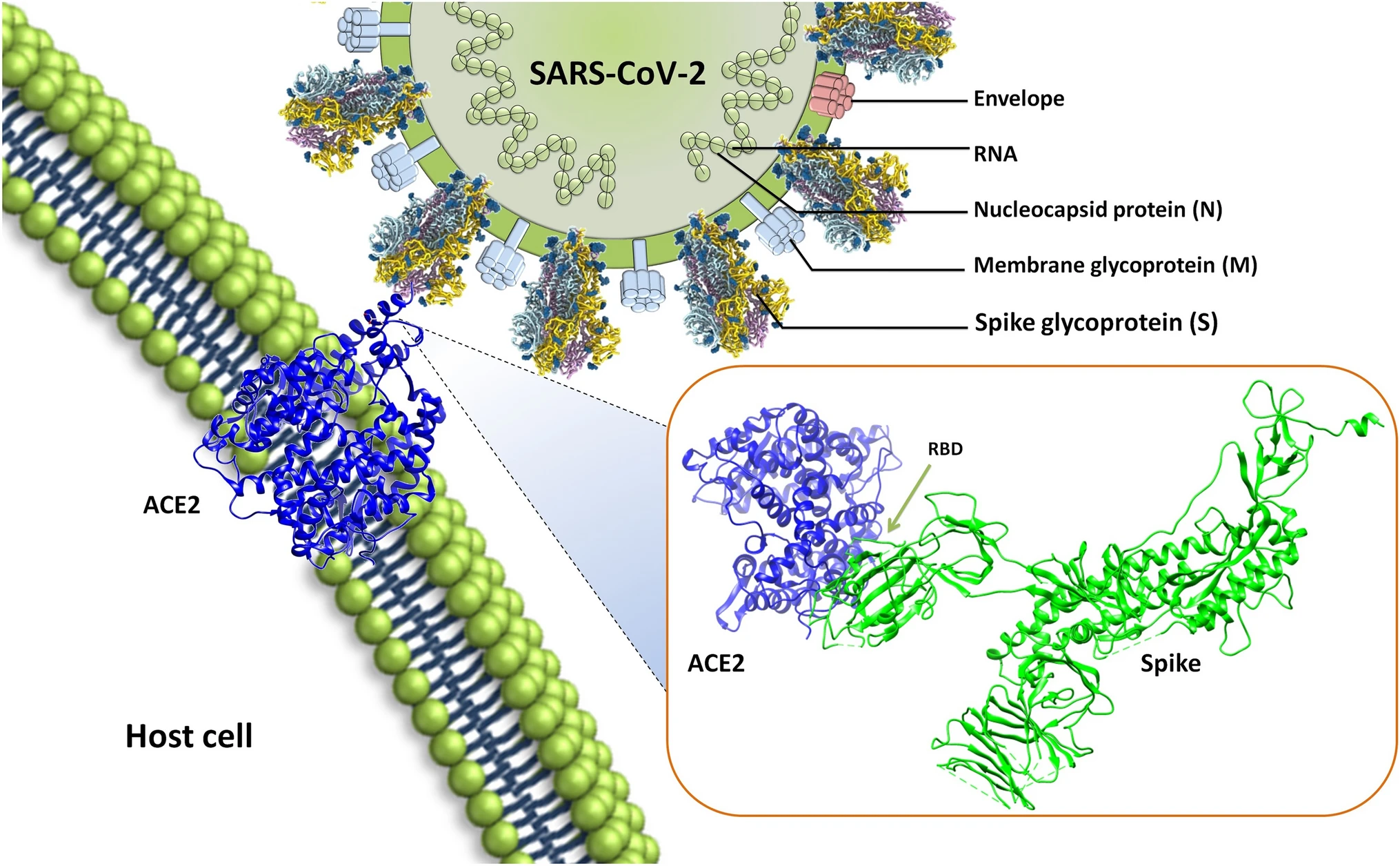
S1
subunit: contains a signal peptide, N-terminal domain (NTD),
and receptor-binding domain (RBD). The RBD binds specifically
to ACE2 receptors (Angiotensin-converting enzyme 2) on human
respiratory epithelial cells.
S2
subunit: contains the fusion peptide, heptad repeats (HR1
& HR2), transmembrane domain, and cytoplasmic tail,
essential for fusion of viral and host membranes.
Function:
Spike protein mediates host recognition, attachment, and entry,
which is critical for viral infectivity.
Host
receptor binding: SARS-CoV-2 binds ACE2 with higher affinity
than SARS-CoV, explaining its enhanced transmission.
After
binding, the viral envelope fuses with the host membrane, releasing
the viral RNA genome into the cytoplasm.
Genomic Organization
SARS-CoV-2
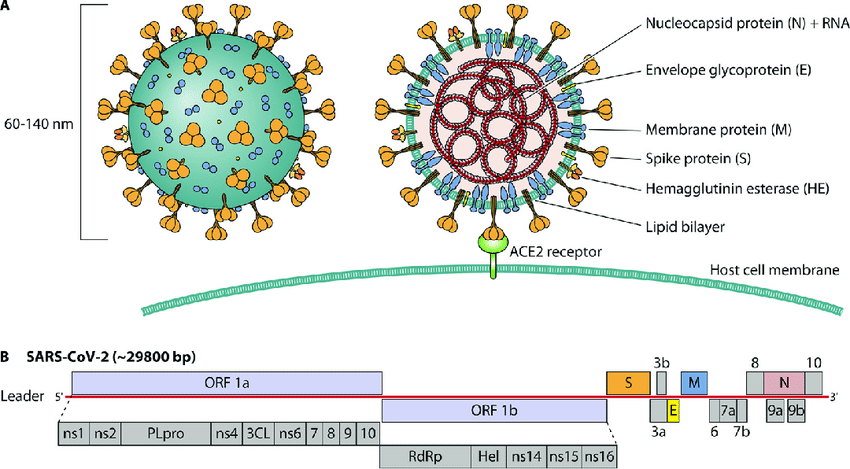
has a positive-sense RNA genome of ~30 kb (29,891 nucleotides),
encoding 9,860 amino acids, with G+C content ~38%.
Genome
features:
12
functional ORFs (open reading frames)
9
subgenomic mRNAs
5′
and 3′ untranslated regions (UTRs) – regulatory regions for
replication and transcription.
Major
ORFs:
ORF1a and ORF1b – encode polyproteins pp1a
and pp1ab, processed into 16 non-structural proteins (NSPs).
Remaining ORFs encode structural
proteins (S, E, M, N) and accessory proteins, which help the virus evade
host immunity.
Key Enzymes and Proteins
NSP3
– Papain-like protease
Function:
Cleaves viral polyproteins into functional NSPs and suppresses host
immune response by deubiquitination.
NSP5
– Main protease (Mpro)
Function:
Processes viral polyproteins at multiple sites; essential for viral
replication.
NSP12
– RNA-dependent RNA polymerase (RdRp)
Function:
Catalyzes replication of viral RNA, synthesizing complementary
negative-sense RNA as a template for progeny genomes.
NSP13
– Helicase
Function:
Unwinds viral RNA secondary structures during replication and
transcription.
Accessory
proteins
Function:
Interfere with host innate immunity, particularly type I
interferon response, facilitating immune evasion.
Replication Cycle
Attachment:
Spike protein binds ACE2 receptor → endocytosis or membrane fusion.
Uncoating:
Release of viral RNA into cytoplasm.
Translation
of ORF1a/1b: Polyproteins pp1a/pp1ab are synthesized and
cleaved by viral proteases (NSP3 & NSP5) into functional NSPs.
Replication:
RdRp (NSP12) synthesizes negative-sense RNA, used as a
template for new positive-sense RNA and subgenomic mRNAs.
Translation
of structural proteins: S, M, E, N are translated and processed
through ER-Golgi network.
Assembly:
Nucleocapsid (RNA + N protein) binds M protein at ERGIC (endoplasmic
reticulum-Golgi intermediate compartment).
Budding
and Release: Virions bud into ERGIC vesicles → transported via Golgi →
released by exocytosis.
Pathogenesis
Transmission:
Respiratory droplets, aerosols, and contact with contaminated surfaces.
I’m an accidental blogger and a microbiologist by education. I have dedicated my past 5+ years of learning to the field of life science. helping numerous individuals and providing useful educational ......