
On this page
We Crossed Nice To Have To Necessity - Grid Cannot Digest More Renewables
- We crossed point where storage is necessity, not nice to have, otherwise we fall.
- Can't add more renewables does not mean law, it means not practical.
- Solar availability looks only 20%, wind uptime low, because grid can't digest it.
- Penalty is not grid wires, penalty is power plants will go boom.
- India majority energy is coal, because it is base load, not because economical.
- Coal sweet spot is 80 to 85%, never 100%, need headroom.
Nice To Have Became Must Have
Hello readres, we're going to talk about why grid needs storage. Meaning we have crossed a point where it's like nice to have to necessity. Like we have to have it, otherwise we fall. So let's understand that, why the heck that happened, why grid needs storage.
So necessity is that we have already reached a point where we can't add more renewables now. Let that be clear. When I say you can't add more renewables, it does not mean there is a law that you can't. It's just that you will be shocked that it won't be practical. As in, you must have seen that people say, oh, the uptime of wind is not that high, or you know, availability is very low, like solars have only like 20%.
I'm like, how the heck? I'm pretty sure in India, the solar availability should be more than that, like more than 20% of the day there is sun out there. Like I know it's not 50%, but I'm pretty damn sure it's not only 20%. Why grid can't digest it? So, and there is a penalty. Why can't you just force it? Like, you know, just like, well, it will destroy all other power plants.
Grid Can't Take It Means Power Plants Will Go Boom
When people say, oh, grid can't take it. It's not that grid can't take it. Grid is just conductors. It's just that what is on the other end, not the customer, the power producers will go boom, as in all power plants. Now India has majority of its energy coming from coal. Not because it's economical, because it's the foundation, basically it's the base load of India.
So you may like, okay, why can't we just throttle them down and up when we need to? Here's the deal, they can, that's why they are base load, but they have a sweet spot. Meaning generally, let's just say it's 80 to 85%, where they're like, if they are at 85% of their capacity, they are burning the least amount of coal, producing the most amount of electricity. That's their like, print money baby, they want to be there.
Now again, it's never wise to stay at 100%, because again, if you do need even a little bit more, you collapse. So it's like 80-85%, you're good. And you have some upper room. Now there are other scenarios where like, you know, downturn will happen, but you also have to go down. So generally most coal power plants will go from 50 to 100%.
Some can go even deeper, like some newer designs apparently can go as low as 40%. But they will never go like, okay, 5%. Why? It will be enormous waste of coal. Like you will be burning 10 megawatt hour of coal just to produce 1 megawatt. Like it will be so wasteful. Like if he has to go so down, they will decide, turn off two generators and keep one running at optimum zone.
That's why generally we'll see coal power plants, they will have multiple units. That's another reason for that. It's like, hey, if that is happening, like if often you are needing a scenario where you have to go down very low, like just almost off, just turn those, keep this at like optimum spot. So that's limits us, like how much we can ask coal power plant to go down.
Coal Has Priority, Dispatcher Has Rule Book
And be mindful, coal power plant, because they can stand back up, they have higher priority. Meaning if they are at 50%, they can ask the dispatcher, it's like, yeah, we can't throttle down more unless emergency is cleared. Emergency is like, you know, priority, they have priority tier list. You have to talk to the energy dispatcher, there's a whole rule book for that, procedure for that, like it's a mess. So again, that's why it's a mess.
And what happens if you keep forcing it? It will just shut off, generally. SCADA system will just say, nope. If you operate the turbines in a position where it is not meant to be, it's like, yeah, no, it will just shut it off. And cold start, like let's just say you turn it off. Cold start could take 5 to 10 hours. So it's literally like, oh, okay, in the morning we turn it off. You have to work full day just to turn it on, by the time evening happens.
And sometimes when you're like, okay, one fire is going on, then using that one to, like you know, start the others, almost like how aeroplanes have, like you know, if one turbine is running, you can use that to power others. Same thing can be done, that can be done very quickly in some designs, that we, not all designs, some designs do have that, they can switch on as early as like 3 hours. So yeah, that's not efficient as you would think, like let's turn it down, let's turn it up. No, you can't.
So if right now India wants to add more solar farm, they are looking into a very dark reality where it's like, yeah, availability of all solar farm will go down simply because grid can't digest it. Coal power plants can't digest it.
Hydro Also Has Band - Yellow Zone Vibration Can Collapse Dam
- Hydro is big component, disproportionate inertia, water is incompressible.
- Sluice gate, if you bam it open, you will destroy dam instantaneously.
- Operating band 0 to 500 RPM, sweet spot 450 RPM, optimum.
- Cannot go zero to 450 directly, always go through harmonic ugly yellow band.
- Yellow zone vibrating turns concrete to dust, dams collapsed, do not stay more than 3 hours.
- Ramp rate slow because cavitation, slowly open, slowly close, not Tokyo drift.
Water Is Incompressible, Sluice Gate Cannot Bam
Now other aspect of our energy infrastructure is hydro. Hydro is also a big component and hydro is like almost disproportionately the amount of inertia. Why? It's water, uncompressible. So that also has constraint. Meaning you like, okay, it's a door, right? It's a sluice gate. What if I like bam it? What if I open it? Yeah, you will destroy the dam instantaneously if you do that. So, it also has what you call band.
Now the primary reason for that band is vibrations. Generally, let's just say, let's just go with it. You're supposed to be from 0 to 500 RPM. So, and you're supposed to be operating at let's say 400 up. So, 450 sweet spot. Everything is optimum. Everything is fine and dandy. You good. You got this. But here's the deal. You can't design a magic machine that goes from zero RPM to 450.
It will always go through some harmonic stage, I would say ugly stage, let's just call it yellow band. Computer systems will always monitor it, that how many hours it's there in that, because that uncomfortable spot is vibrating. How vibrating does not matter how strong your concrete, it will turn it into dust. And yes, buildings have fallen apart, as in the actual dams have collapsed, simply because turbines were in the yellow zone for way too long.
Like again, all systems will keep a calculation, it's like, hey, do not stay here for more than 3 hours. It's like, wo, 2 hours detected. It's like, it might even emerge. Nowadays we do that because we have lost dam. So we like, yeah, if it detects it's too long in the yellow zone, shut it down. Force it up, force it down, whatever have you. Do not keep it in that ugly vibration zone.
So that also has an actual penalty. That's what I keep saying, like imagine if everybody flooded a solar, and then it's like, okay, it stays in the bad mode for too long, kaput. Now generally that should not happen. SCADA system should shut it down, but that's a if, and then you also have to worry about ramp rates. Now, steam systems do have a little bit of wiggle room. But when you're talking about water, your ramp rate, because of the water's cavitation properties, you're like, hey, let's relax.
Let's not just go wham wham. It's not Tokyo drift. Let's just slowly open the door. Slowly close it down. Otherwise, bad things happen. So, that's the necessity. That's what we will say, no, you can't just cram energy into the grid. This is what breaks. Now, ideal scenario, everything will shut down before it breaks. But it could break, because one failure could create what we classify as cascade failure.
| Plant | Sweet Spot | Operating Range | Why Cannot Go Low / Fast |
|---|---|---|---|
| Coal | 80 to 85% capacity, least coal, most electricity | Generally 50 to 100%, newer 40%, never 5% | Burn 10 MWh coal for 1 MW, SCADA shuts off, cold start 5 to 10 hours, some designs 3 hours |
| Hydro | 450 RPM, 400 up, 0 to 500 band | Must avoid yellow band, max 3 hours, 2 hours warning | Vibration turns concrete to dust, dams collapsed, cavitation, slow ramp |
Grid Inertia - Hundreds Of Tons Spinning In Sync Is Why Voltage Stays Stable
- All steam, nuclear, coal, hydro have one thing - grid inertia.
- Inverter can power home, cannot power nation.
- Magnetic coupling, hundreds of tons spinning, synced electronically by poles.
- 3,000 RPM 2-pole synced with 1,500 RPM 4-pole, three sine waves in sync.
- Energy comes from rotor via magnetic field, inertia stretches milliseconds to seconds.
- Computer gets time to open steam valve, open coal furnace, throttle down.
- Today 50.5 Hz bad, 49.5 Hz bad, old days 48 to 52 sloppy, worked 200 years without microcontroller.
Why Steam, Nuclear, Coal, Hydro? Inertia
Now why the heck we go through so much hassle, like steam turbine, nuclear power plants, coal power plants, hydro dams? Why? Well, all of these have one thing that makes electrical grid possible. They have grid inertia. Now, can you have an inverter that provides power to your home? Yes. Can you have inverter that provides power to your nation? No. So, how the heck these do? They don't. They utilize a magnetic coupling.
Meaning each of the spinning mass, the turbine, the blade, the rotor, everything, hundreds of tons of mass that is spinning, it's spinning in sync with each other. Now when I say sync, it does not mean RPMs are the same, because the sync here is electronically coupled, as in like how many poles you have. So a 3,000 RPM can be synced with 1,500 RPM if one is two pole, another is four pole. So that's what it means to be synced, meaning everything is working at their synchronous rotation RPM.
And the grid, the sine waves, the three sine waves that you see, all are in sync. So nuclear power plant, everything is in sync. Coal power plant, everything is same. Hydro, everything is sync. Benefit, this is how you can have voltage in your home, and that voltage does not go from like 500 volt to 50 volt. The reason why that voltage is stable, to some extent, is simply because of that.
10 MW Arc Furnace - Where Energy Came From Instantly?
Because here's the deal. Imagine you turned on the switch, now you turned on that 10 megawatt electric arc furnace. That's average thing. But here's the deal. Where the heck that energy came from instantaneously? Like you just turned it on. Where the heck energy came from? It has to come from somewhere. That energy came from transformer. Transformer leached it from its higher side. Higher side leached it from the lines, lines leached from substation.
Substation leached it to connecting substation. Brick by brick. It will keep going. Where will it stop, like what's the final stop? It will always go to generator stator. That's where primary energy production is happening. It will go there. It will leech energy from this rotor. Now here's the deal. Rotor and stator are not physically connected. They are magnetic levels. So it will act, give me more power.
It's like, now, here's the rotor is like, bro, I only have this much torque, but here's the, because it has mass, mass acts as a short-term capacitor which allows it to buffer. It's like, wo, wo. Now that short-term simply means, instead of your turbine going from 1,500 to turn off, it's like, hey, 1,499, hey, 1,490, hey, 1,480. So generally, because of the inertia, the hundreds of tons collectively, each system will get, hey, hey, something is happening, hey, there is something.
And again, this is stretched, 1 second, the impact that should be in millisecond is stretched to few seconds, and in that few seconds, your computer would be like, RPM is dropping, yellow alert, RPM is still dropping, okay, open the steam pressure valve to maximum. Again, that's why you never keep anything to 100%, you always give some headroom. You're like, okay, 100, it's still dropping, okay, open up the coal furnace. So because it took time to act, it gave all the secondary systems time to react.
That's why we always have frequency, like AC people say now, like you know, AC has the ability to transformer, that's good, but because you can do synchronization, that's why you can have a grid. So this whole thing, what do you think energy dispatcher do? They maintain this puppy. And this works in other way also. For example, you turn off the 10 mega system, here fire was like, the steam was like, turbine was going all out. Here's the deal, what happens?
The stator no longer leeches the power, energy cannot be destroyed, what happens? That excess power starts to spin up the RPM. Basically, your RPM, that puppy that is spinning, is going from 1,500 to like 1,511, 1,515, 1,505. Now computer is like, whoa, whoa, whoa, whoa, why, why, why, why, why, why, yellow alert, it's like, okay, 1,515, 1,510, it's like, okay, throttle the steam valve. Like again, that instantaneous reaction is stretched out longer, that is enough for computers to work.
Be mindful, this would work even if you had like, you know, balls spinning, like when you hear the balls to the wall, it actually was balls spinning, ball governor, and literally we kept everything in sync using that.
Now be mindful, this would work even if you had like, you know, balls spinning, like when you hear the balls to the wall, it actually was balls spinning, ball governor, and literally we kept everything in sync using that. Again, it was not as tight as today, like today is like, you know, 50.5 is like bad, 49.5 is bad, back in the days it was like, you know, 48 to 52, it was sloppy, but you could do that. And again, that's why we have been doing this for 200 years, like nothing, you can do everything we are talking about without using a single microcontroller, and everything will be robust, functional.
So there is a necessity for preserving the spinning. Inverters are good, but they are not this, like they are simple, elegant, tonnage. Now what is the penalty? That's the risk. What is the penalty of that risk? Yeah, curtailment.
Curtailment - Irony Of Renewables, We Have Power We Cannot Digest
- First irony: renewables are intermittent, own mood, own flow, solar rain, clouds, wind stops.
- Dispatcher always prioritizes inertia sweet spot, not max renewable extraction, otherwise grid fails.
- Always ask solar farm to turn off, wind farm to turn off, generally wind first, then solar.
- Rooftop solar by every Tom, Dick and Harry stresses grid, cannot ask house owner to shut off.
- Wind turbines stopped is not maintenance, it is curtailment, happens shockingly often.
- Solar can give almost 20 hours with good storage, not 24 yet, plus wind we are good.
Intermittency Forces Renewables To Lower Tier
Meaning the, there is an irony. The first irony of renewables is that they are intermittent. Meaning they have their own mood, their own flow. Solar has their, like even if it's in daytime, you might have rain. Even if it's like supposed to be working, it's like, nope. Clouds are like, nope. Or if you have wind, it's supposed to be flowing, it's like, nope. So there is a what you call intermittency.
But that itself forces renewable to be in lower tier of power supply, because of the priority of inertia and again necessity of it. Every power dispatcher will prioritize making sure those inertia maintains its sweet spot, rather than, let's extract as much renewable as possible, because otherwise the grid fails. So they will always ask solar farm to turn off, wind farm to turn off. Again, if they have to ask wind or solar, they will generally ask wind first, then solar.
Because again, if solar does not generate during daytime, there is no point, and you're like, wait a minute, that's too many variables to manage. Welcome to the job of energy dispatcher. So, and again, every Tom, Dick and Harry is doing rooftop solar, and coal is working at the same time. Hydro is also working at the same time. So all of this is like stressing the grid. And here's the deal. They can't ask a house owner to like, hey, can you please shut off your solar farms?
They're like, bro, I bought this for this, so they won't. But solar farms have to do that. So these spikes that are happening, it's literally stressing the grid so much. It's like, yeah, we have to shut off. And if you see keep seeing wind farms, like some turbines are spinning and others do not have people on them. Yeah, it's not maintenance, it's curtailment. You would be shocked how often that happens.
Like when I say that we are reaching a point where it's like, oh, 【entity-General Electric¦canonical_name=General Electric】 is building a Haliade-X turbine that is like, what, 12 or 16 megawatt, one turbine, it's like, oh, it will have higher uptime, it's like, up to 50%, it's like, yeah, good luck, you can put that on the grid, grid will be like, I can't digest your energy, man, that's happening today. So uptime, like, uptime started to like, okay, put, add more, more, more, now it's like, no, no, no, no, no. So this is a real reality.
So, cuts renewable, wind farm, solar farm, all of that first, and that creates a horrifying reality where it's like, we have power, we can't utilize it. We can't. It's like, we can't digest it. Like solar farms are like, bro, you have no idea how much power we can give you. Like everybody, oh, it's only 2-3 hours. No, like, if you have the grid that can digest it, solar, like, bro, we can provide almost 20 hours of power with good storage. 20 hours, not 24, we are not there yet, but add enough wind, it's like, bro, we good, we good, brother, we good.
So this is curtailment. This is real. This is here. This is affecting economics. This is affecting the actual working of the grid. And if you hear, like, why India passed a law that is like, you know, during daytime you can consume more power, everybody was producing, there is like, what the hell, I'm supposed to do? So first thing people will think of is lithium, okay, and be mindful, lithium is not a new idea.
Lithium And Lead Acid - Great For Small Scale, No Inertia, Costly, Tight Supply Chain
- Electrochemical battery backup is ancient, first lead acid 1988, 10 MW, 10 MWh.
- Submarine batteries, thyristors in 1988, worked, decommissioned, one PDF has one photo.
- Lithium cycle count much higher than lead acid, depth of discharge better.
- Lead: 200 Ah, 12V, Luminous 3-4 years kaput, Exide died, warranty expires, battery caput.
- Round trip: lithium 90-95 out of 100, lead lucky 70-75.
- Size matters for shipping, axle loading, forklift, two strong people for small battery.
- Household lithium gives resilience - Ukraine war, natural disaster, fridge, Wi-Fi, lights.
- Penalty: no inertia, needs sine wave, cannot make own, grid forming inverters 3-5 companies only.
- BMS downgrades 110 to 100, loses size after 10-15 years, costly, 50 MWh 1 year wait, 5 GWh 2-3 years.
First Battery 1988 - Lead Acid 10 MW, 10 MWh
The idea of making an electrochemical battery as a backup is ancient idea. Like the first lead acid battery systems were done in 1988, and that puppy was 10 megawatt, 10 megawatt hour. Now this is like a video, I think I have seen a, what do you call, Future Tomorrow, some documentary like that in 【entity-History Channel¦canonical_name=History Channel】, where this is my childhood memory, like I saw a big battery, I used to think that was so unique, then I realized it is just submarine batteries.
And yes, you like, 10 megawatt hour for submarine lead acid battery is like, bro, like that's reject material, you can easily get that. The only interesting part is, how the heck they had inverter in 1988? Like a semiconductor was barely coming on in 1988, yet, like, were they using thyristors? So that's how we started, and be mindful, it did work. Although it has been completely decommissioned. I don't think you will find even a single photo. One PDF has one photo. That's it. If you find something, please do share.
Now lead acid was an opening door. It's like, it can be done. People did try with nickel also. Now lithium made lot of progress. Now first process is cycle count. Meaning how many times it can work before it self-destructs. That's much higher compared to lead acid. Like I am on my second lead acid battery cycle. Basically, I have a 12V, 200 Ah battery. I had a Luminous batteries. They run like, I think 3-4 years, kaput, throw them away, or basically sell them, and then get, sell them as like reclamation, and then bought an Exide battery that died yesterday.
Then bought a new one today, and now I know for a fact that the moment warranty expires, that battery will caput itself. I'm just hoping, knock on wood, after that, this battery dies out, the end, no more lead. I wanted to do lithium, but it's not ready in Indian market just yet, it needs more time to cook. Companies are announcing it, and let, it's not the chemistry problem, the cell, we good, we got this, we had it for like freaking 10 years, it's the BMS and all the supporting infrastructure, that's the unknown part, untested part.
So there are a lot of progress, meaning if done correctly, I should be able to hit like 10 years easy, rather than 4 years, the end, I should be able to hit 10 years easy. And depth of discharge, meaning, generally lead requires lot of over capacity. For example, on paper, I have 200 amp hours, into 24 volts, two batteries are there, so on paper, that's how much I have, but if I drained all of it, generally my inverter will not allow me to go that low voltage, but if I did, the battery dies, like the end.
And you would have experienced this, there is a very good chance, if you drive cars, you would have noticed that if kept a light bulb on, and, like, off, like, you left the car, light bulb was on, dead. The battery does not regenerate. It's like, it's dead, dead, like dead. You might even, again, older batteries were revivable. Newer ones are just like, throw it away. So why deep discharge is not acceptable for lead acid?
Round Trip, Size, Shipping - Lithium 90-95, Lead 70-75
And round trips, meaning if I put 100 units of energy in, how much I can get out? Lithium, you can get 90 to 95 out, if you put 100, lead, you'll be lucky to get 70-75, and size. Now size may not come as a factor, where you're like, hey, I have the area, is size is a factor when you have to ship the damn thing? For example, like, the most hassle, high hassle part for me today, when I was moving the lead acid battery, is these batteries are heavy, puppy, unless you are 【entity-Arnold Schwarzenegger¦canonical_name=Arnold Schwarzenegger】, trust me, when I say this, you can't just like, lol, like, you will hurt yourself, like two people, strong people, have to work in order to deal with that.
And that's small batteries, if you're talking like submarine batteries, that require forklift to move, now your railway, like, if you load all of them on railway cart, or railway is like, bro, it will exceed our axle loading, so transportation does matter, so shrinking the size does have a tangible advantage. Okay, so we made progress, we have been trying it from 1988, what now? It's great for small scale, meaning for household, giving lithium ion batteries to household is amazing, not only from energy generation point of view, but also from resilience point of view.
For example, if let's just say war happens, let's say you are in Ukraine, war happens, you had solar panels, but if it was grid tie only, you did, grid was down, you did, but if you had lithium ion, you are resilient, which a lot of Ukrainians are doing right now, they have lithium ion battery. Now here's the deal, what if your house goes boom? But here's the deal, nothing can solve against that, it's just that, if everybody had batteries, it's just that the whole community does not panic, that's a tangible advantage.
Again, this not only is affected by human caused war scenario, but also like in natural disaster, a substation failure, like, because again, even if your area is safe, what if the area where the substation that got kaput, then what? It does happen, right? It's a real thing, tsunami happens, it's a tornado happens, these are cyclone happens, these are normal things that do happen. In those sort of scenario, if every household had lithium, again, not for, like, you know, we got this, like, nothing has changed, it's like, just enough that your refrigerators keep working, your communication, aka your Wi-Fi routers keeps working, and like, you know, enough, like, lights are there, you good, brother, you're good.
So this is a very good for lithium, like, this is the optimum, again, this is my future plan, if I ever collect enough money, this is what it will buy, like, so I can run my ACs also, like, and they should last 10 years, they should, on paper, they should last, and you generally want to be under gigawatt hour, can you make it more than that? Of course, you can, it's just unwise, like, at that point in time, it's almost you are chasing a short-term horizon and long-term financial ruin. So, what's the penalty? Penalty does not give inertia.
No Inertia, Grid Forming Inverters I Do Not Like
There is nothing spinning. Nothing. And inverters require there to be a sine wave. It can't make its own sine wave. Some people are trying to make what we call grid generating environment. You know, island inverters, so to say. Island inverter is like midway, like prograde, is like what we classify like grid forming inverters. I do not like that idea. I do not want a foreign company controlling my grid. That's, that's like, no.
I do not want Venezuela, like America just says, yo, f that country. I don't want my freaking power to go out. I do not like grid forming inverters at all. And not to mention, from a, I looked into it, like, they have patents. Why the heck you have patents on something, like, I have full spec analysis on how the heck a turbine generator works, but this grid forming inverter is top secret? It's like, no, no, and there are like three to five companies that can make it, like 【entity-ABB¦canonical_name=ABB】, 【entity-Siemens¦canonical_name=Siemens】, 【entity-General Electric¦canonical_name=General Electric】. These are the only ones that are even trying. And again, I do not like it.
So grid inertia is not there. It's pseudo grid inertia, and it does lose size. For example, even though companies can now actually claim, hey, we're giving you, let's say, 100 megawatt hour, it will be 100 megawatt hour, 10 years. How the heck they are doing it? BMS decree, meaning the actual cell capacity was 110. They just downgraded it, and BMS always behaved in such a, it's a safety thing. BMS supposed to be safe. So, nobody practiced, and you're like, hey, be mindful. That's if you knew about hard drives, you knew the first generation of SSD, they were not long live. They used to do the same thing.
So you do lose size, and it's not, you know, when, it's not if, it's guaranteed, it will happen, even if that, like, you know, over supply, that also has a limit, like, after 10-15 years, you will, and again, at the later phase, everything happens exponentially, so you, instead of losing like little, like, so you will lose size, another, it's costly as hell, and it has very tight supply chain. Early days, because it was a new gimmicky kind of thing, not enough stress, all demand was there.
Now if you're like, hey, I want like 50 megawatt hour, it's like, we got to put you on supply list, and this and all that, might even take 1 year, and if you're like, okay, I want like 5 gigawatt hour, it's like, we can give you, but you have to book it, and like, okay, when will I get it, it's like, 2-3 years. So supply chain constraint is, it's not that companies don't want to build the cells. It's just that they do not have the raw minerals to build themselves. Supply chain is not strong, and God help you if this happens, which again does happen rarely, but does happen.
So lithium, great for small scale, great, like, really, really good idea, like, you might not think it, unless something happens catastrophic, which does happen often, every few years, you'll be like, it was a good investment. So lithium is a good tool, but small scale. Now we come to the robust solution, mechanical solutions.
| Battery | Cycle / Life | Round Trip | Depth / Size |
|---|---|---|---|
| Lead Acid | 3-4 years, Luminous, Exide dies after warranty, 2nd cycle | 70-75 out of 100 | Needs overcapacity, deep discharge kills, heavy, forklift, axle loading |
| Lithium Ion | 10 years easy if done correctly, cycle count much higher | 90-95 out of 100 | Better depth, smaller, shipping advantage, BMS unknown in India |
Mechanical Daddy - Pumped Hydro, 100 Years, 10 To 50 GWh, Black Start
- Pumped hydro oldest, more than one century, working hardware survived.
- 10 GWh minor inconvenience, easily 50 GWh, few hundred needed for nation, not thousand.
- Power easily gigawatt, 2 GW, 4 GW, 3 GW easy, tank vs pipe capacity.
- While discharging and charging, gives pure grid inertia, frequency sync stays.
- Turbines last forever if filtered water, no cavitation stupidity, 15-20 years consumable.
- Started 65% roundtrip in 1970s, now touches 80%, better pump, impeller, motor-generator, substation.
- Expensive, takes more than 5 years, Australia example, regular maintenance is job creation.
- Black start: one small diesel can start it, it can start multiple coal and nuclear plants.
Pumped Hydro - Oldest, Time Tested, We Got This
So mechanical solution, the daddy is pumped hydro. Now pumped hydro is oldest. How old? More than one century, as in actual working hardware survived for more than a century. This is old. This is time tested. We good. We got this. And they are large, like, they can easily, 10 gigawatt hour is a minor inconvenience for those puppies, like, they're like, bro, we good, brother, like, it's your budget that defines how strong these things are, and some amount of geology, but you can easily touch like 50 gigawatt hour.
And here's the deal, to keep a nation functional, only few hundred of these are needed, not even thousand, few hundred, and I mean big countries like China, and again, that's why China is building so much of them. India, we are building few of them. America, they have lost interest, they are like, let's smokey lawn weed, but they had the, the oldest one is from them, non-stop working. So, these are great, and discharger, basically, that's the tank capacity, what is the pipe capacity, as in, like, I told you, the energy, 10 gigawatt hour, what about the power? It can easily be gigawatt, meaning easy 2 gigawatt, 4 gigawatt, why I'm saying, 3, easy, like easy.
And while discharging, while charging, this puppy gives pure grid inertia, meaning nothing drifts out of the frequency sync, everything remains fine, everything is good, everything is dandy, and long lifespan. Now long is inappropriate to say, because it does require maintenance, but it's almost like a living entity, if you maintain it properly, that will last forever. Be mindful, you might look, turbines do wear out, turbines wear out in rivers, because they have silt, they have stuff, sand particles.
When you are talking about water that are like built for, as in, like filtered for this, you'll be shocked, the turbines last forever, unless you do lot of cavitation stupidity, it will last forever. Meaning the turbine that will be almost a consumer, like 15 to 20 years, you have to consume it, he'll be like, bro, we good, brother, we good. They are expensive, that's the penalty. They take time, like, ask Australia, they take time, like, he's like, you start the project, unless you like really fine-tuned it, it will take more than 5 years.
They do require regular maintenance, although at that scale, it's almost like job creation. It's a good thing to have, but they do not have expiry date. Meaning there are some, like, you know, some living creatures, like, it can live forever, is the same thing, nothing in it fundamentally breaks, nothing in it, like, nothing, like, you can repair the concrete, you can repair the, which, mind you, a lot of systems, when they started, they were barely touching 65% roundtrip efficiency, 70, now they're like, okay, now we have better pump geometry, the impeller geometry, swap it out, ta-da, more efficiency, better motor generator unit, better efficiency, better substation, better efficiency.
So literally, you will started, like, oh, back in my days in 1970s, we were barely reaching 65. So how much is now? It's like, yeah, yeah, yeah, we touch 80, we got this. So it is great, too, like, from a nation point of view, this is your guy, and this also has the black start capability, meaning very small, of a small, small amount of power, like one small diesel generator can start this, and this has enough oomph to start multiple coal power plants and nuclear power plants, to bring them into grid synchronization.
That's why the grid inertia matters, this puppy can black start your national grid, if you have 10-20 of these, like, even if, which, again, renewables does make the grid unstable, if it does go down, this is like, bro, and this does can do that, 24 into 7, it's like, bro, we got this, we got this, that's why Israel is building so much of that, so that's one tool.
Thermal Storage For India - Recycle Coal Plant, Graphite 700C To 2300C, 30% Efficiency But 24x7 Stabilizer
- Second tool for India specifically is E2S power, thermal energy storage.
- Recycle old hardware, shut down coal eventually, run out of water or cheap coal.
- Throw away bowl grinder, coal transport, coal bunker, boiler, fire boiler.
- Put black box graphite + insulation, furnace insulation, heat with surplus energy.
- Generally 700C, graphite can handle 1500, 2300C, fiber industry 2000 plus, in argon environment.
- Charging is temperature rising, discharging is boiling water, running turbine.
- Never turn off steam cycle, free spinning acts as synchronous condenser, stabilizer.
- Poor roundtrip 30% vs 70% for others, but cheap, scalable, 10 m cube box gigawatt scale.
- Can use heat for low temperature thermal desalination, get energy + distilled water.
Recycle Coal Plant, Don't Throw It Away
Second tool for India specifically, is E2S power, basically thermal energy storage. The idea is, recycle the old hardware. We have to shut down coal power plants eventually, not because of, like, we want to, it's just that, either we'll run out of water, or we'll run out of coal, cheap coal, so, at that point in time, you put so much money, so much infrastructure, these are big projects. So why throw it away? They are recycle the old hardware. The hardware is there.
So what do you throw away? You throw away the bowl grinder. You throw away the coal transport system, coal bunker, everything. Basically, coal side, you throw it away. The boiler, fire boiler, you throw it away. You put a black box there, which we call graphite and insulation, basically a furnace insulation. That's it. You heat up that system using surplus energy. And that heat increases the temperature. How much? Generally, you're talking about 700C.
Now, let me tell you, you can go higher. That's the good news about graphite. Graphite puppy is like, bro, if you can handle the thermal flux, I can handle the temperature. How high? Like 1500, minor inconvenience. 2,300C, fiber industry will like, bro, like, that we extrude a fiber from. Yeah, that puppy is 2,000 plus, not an issue. Graphite is like, I can do this all day. Now, of course, assuming you are smart enough to put graphite in an argon environment. But it can be done, super easy.
You heat it up, the temperature rising is your charging, discharging, it's boiling the water, running the turbine. Now the good news about it is that it has grid inertia, 24 into 7, like, how, you never turn off the grid. Basically, never turn off the steam cycle. Even though when it's just free spinning, it's acting like a stabilizer, what we call synchronous condenser. Europe did that, like, they had a lot of coal power plants.
Like, okay, throw away the turbine, throw away the steam, put flywheel there, and that's how they able to digest wind energy. So here, it's like, okay, don't throw away the turbine, put the steam cycle, and you have the battery, it's not just a stabilizer, daytime it's acting as a stabilizer, in night time, it is providing the energy, so to say. Penalty does have poor roundtrip efficiency, meaning, this puppy can easily start at 70, this puppy will start at 30, so yeah, it is inefficient, but again, it is cheap.
It does give you 24 into 7, meaning it makes everything else stable. Meaning, hey, we want more wind turbine. This puppy's like, I got this. We want more solar. I got this. That's the good part about it. So, the poor energy efficiency alone would be bad, if it that's all it had. But the fact that it is recycled hardware, the fact that it is working 24 into 7 for a stability point of view, and again, scalable, that you can keep making the box bigger and bigger, like 10 m cube box, which, again, there are lot of buildings that are bigger than that, would be powerful, like gigawatt scale, now, not hundreds of gigawatt, but, like, you can touch gigawatt hour, although roundtrip efficiency is bad.
You could use heat for something else, like, if I were smart, if I were in India, I would just use this for low temperature thermal desalination, and voila, you'll get energy, and you'll get distilled water. So that is there.
Energy Dome CO2 Battery - 70% Claim, Tent, Membrane I Don't Trust Yet
- New one coming to India soon, Energy Dome CO2 battery, covered 4 years ago.
- Claim 70% roundtrip efficiency, gorgeous, same territory as pumped hydro.
- Not sure longevity, pumped hydro and thermal I can trust lasts forever.
- Not everything solid state, tent for CO2 storage at atmospheric pressure.
- Membrane inside, air and CO2 inside membrane, expand and contract.
- Could be geometry lasts forever, or consumable part, wear out, throw away, put new one.
- They show stitching, never show what it is made of, need deep discussion to trust long term.
- Mechanical tools need no microcontroller, can run on vacuum tube, pumped hydro older than microcontroller.
Tent, Membrane, Expand And Contract
Another option, new one that is coming to India soon, that is Energy Dome CO2 battery. I covered this puppy 4 years ago. Now their claim, their claim is that they can give you 70% roundtrip efficiency. That's gorgeous. That's like same territory. Although I am not sure about their longevity. I can buy this lasting forever. I can know that this lasts forever. I have doubt about this. Why? Not everything is solid state. Here, everything is solid state, or what is water? We know how it works.
They have a tent. The big tent you see, that is for carbon dioxide storage at atmospheric pressure. So they have a tarpaulin inside it, where air and you have CO2 inside the membrane, so to say, and you expand it and you contract it, expand it and contract it. I'm like, I don't trust that membrane. Again, it could be built, dealt with two way. You have figured out a geometry that allows it to last forever, or you have figured out it's a consumable part, like, you use it, you wear it out, you throw it away, then you put new one in.
They are showing the membrane that they are stitching and all that, but they never show what it is made out of, like, I need very deep discussion about the membrane to trust this long term. I will trust this long-term, this, not sure, again, maybe they have solved the membrane problem. I have not seen it. Pump, like, all the problems are solved, like, we good. So these are mechanical tools. No microcontroller needed. Like, if you want to run these things on vacuum tube, you can. That's the amazing part of it.
And yes, pumped hydro is older than a microcontroller. So mechanical tools are really good. And few hundreds of these, you good, like, your nation is like, I got this.
| Storage Tool | Roundtrip Efficiency | Grid Inertia | Lifespan / Penalty |
|---|---|---|---|
| Lithium Ion - Household / Small | 90-95% | No, pseudo only, needs sine wave | 10 years, BMS downgrade 110 to 100, costly, supply chain 1-3 years wait |
| Pumped Hydro - Nation | 65% in 1970s, 70%, now touches 80% | Yes, pure, 24x7, black start | Forever if maintained, 10-50 GWh, expensive, 5+ years to build |
| E2S Thermal - Recycled Coal Plant | Starts at 30%, others 70% | Yes, 24x7, synchronous condenser | Cheap, scalable, 10 m cube box GW scale, plus desalination |
| Energy Dome CO2 Battery | Claim 70% | Mechanical, no microcontroller needed | Membrane doubt, geometry vs consumable unknown |
Future - Cheap And Abundant Done, Available 24x7 Must Come From Storage, Toolkit Not One Tool
- 2005-2010 solar wind were joke, cuckoo people middle of nowhere, nobody believed generation.
- Now 100+ GW farms in India, 500 MW to 5 GW plant, budget defines, cheapest form energy.
- Saudi Arabia with largest oil reserve builds solar farm, cheaper than oil.
- India behind in wind, happy with solar, infrastructure weak link, 20% uptime shock.
- Do not fall for one solution to rule them all, salesman or brain damage.
- Body needs many organs, mix solar, wind, hydro, biogas, toolkit multiple toolkits.
- Mark 1 biofuel farm land, Mark 2 algae 700 L water per liter fuel, Mark 3 seaweed can scale.
- India 1.5 billion people poop alone can make biogas, export gas, plus cattle, food waste, agriculture.
- Small biogas 100 cows geometry does not work, need 10,000 cows in one place, mega bioplants.
- Three criteria: cheap, abundant, available 24x7, cheap abundant done, available must come from storage.
Solar Was Joke In 2010, Now Cheapest Energy
So what can we expect in the future? Now this is one thing you have to understand. I'm old enough where I remember like certain snippets from my childhood, 200, I would say, 10 to 15 era, where solar and wind were coming up, but everybody was looking at as a joke, where it's like, eh, it's fun, like, you know, some cuckoo people doing some cuckoo things at the middle of nowhere. It's just that nobody was taking it serious. You can watch the interviews and documentaries, like, it's there.
It's just that, generation part, nobody believed it, like, people, like, oh, you can generate few kilowatts, like, you know, solar watch and something like that, but, like, running a nation, like, having gigawatt of power, like, that's, that's not possible, now that has completely, you must have paid, nobody talks about that, how much power can be generated, like, how much power, that's, like, how much is your budget, like, it's almost like coal, it's like, you can have a plant that is, like, you know, 500 megawatt, you can have a plant that is 5 gigawatt, do you have the money for it?
So we have crossed that threshold, and it happened rapidly. It's almost like people forgot that nobody was buying, like, if I told, back then, like, 2005 to 2010 time frame, to somebody, it's like, India has farms, 100 plus gigawatt, they will laugh at you. It's like, bro, pass the joint, my man. But it is here. It is the cheapest form of energy. As in, it is so goddamn cheap that you can be in goddamn Saudi Arabia, and you're like, bro, we have the world's largest oil reserve. Still would be cheaper for you to build a solar farm. And they are building solar farm.
So it is amazing, magnificent. Like we crossed this threshold so quickly that you, I was born, there was no solar, and I'm here. Solar is like, we got this, brother. Wind is like, we got this, brother. Like India is behind in wind. Let me be very clear. I'm like, I'm happy with the solar progress. Wind is like, we are not even touching it. So it's amazing. It's just that our infrastructure is the weak link. Like it fundamentally can't digest. Like I was shocked, like, 20% uptime on a solar farm in goddamn India, WTF. It's just that our grid can't digest it. So we do need solutions for it.
One Solution To Rule Them All Never Works
Now another aspect, do not fall into nuclear damage, where it's like, one solution to rule them all. That never works. Anybody who's selling you that is a salesman or brain damage. There is nothing more than that. Like your body requires so many organs. Why? Everything is tuned for one thing. For example, solar, GG. Wind, GG. One, no one know. So mix them now. Mix hydro, mixed biogas. Like this is the most tragic thing to me in India, is that our country willingly decided to kill itself, where it's like, okay, what if we throw away the farmable land for making fuel?
Which Rudolf Diesel and Henry Ford both tried to do, both learned the hard way that this is dumb idea. That was Mark 1 biofuel. Then we jump to Mark 2 biofuel, which we realized was an even dumb idea, to use algae to make biofuel. Why? We do not have enough fresh water to satiate planet's need. It was looking at, like, 700 L per liter of fuel, that was undigestible. And then we reached to third gen biofuel, which is seaweed bio, which can actually scale up. But we like, but, but, we have to work hard for it. It's like, yeah, don't work and die.
And India is like, what if, what if, hear me out, hear, what if we kill the younglings? What if we sell the farming lands so we can grow fuel on it? And I'm like, India has 150 million, damn. I keep confusing this units. 1.5 billion people. That's so much people that if you collect poop from this many people, it has enough biogas generation ability. We good, brother. We will sell, we'll export gas. We'll, we'll, we good. We good. We got this. And that's just human. Not for the cattles, not from the food waste, not from agriculture. Like we know how to do this.
And there was a spark in India in 1990s. Like my school books have that. There was, like, you know, we have, like, what we call guala, basically, these people manage cows, dairy farm, small scale, like, you know, 100 cows, small scale, and they were like, okay, these small scale owners will build their own, what you call, biogas plant, that does not work, geometry does not work that way, like, it's always better to have, like, 10,000 cows in one place, like, again, I do not mean 10,000 cow physically being, like, their poops in physical place. And again, only recently we have started to make these so-called bio mega bioplants, which, again, we have so much untapped potential.
Like, why waste food to make ethanol, and then destroy people. What if you use their poop to make gas, get fertilizer as a byproduct, and make CNG cheap enough in India, where it's like, hey, don't deal with petrol, we have CNG, we good, we got this, but no, we have to destroy our future, because f the country. So this is what happens whenever somebody's like, oh, one tool to solve that, all we need, a tool kit, not one tool, toolkit, multiple toolkits, and again, we only need to match three criteria, cheap, abundant, and available 24 into 7, cheap and abundant has been done.
Like, I have rooftop solar, if I had all other infrastructure that is needed for that, I'm pretty sure I might not even need ginormous, like, I want 10 kilowatt hour setup, I don't think I need it, like, I have only two, and it's like, if I don't run AC, it's like, bro, I got this, like, the biggest problem is my lead acid battery, like, if I had a really big lithium ion battery and a big inverter, it's like, bro, I got this, I got this, that's with two, 2 kilowatt, so this is the whole thing, like, we got this, the cheap and abundant part, we got this, it's just that, available part, available part must come from, basically, storage.
Now this is next step, for, and because again, every time we expand, we create new problems, we solve them, this is our current challenge, like, it is unimaginable, like, sometimes I'll try my best to share, those events, where it's like, oh, solar is just a joke, oh, wind is just a joke, now it's like, oh, yeah, that's providing more than most coal power plants, so, yeah, is an issue, but it can be solved, we have tools, even if you do not want to give your countries a lock and key to ABB or Siemens or General Electric, we got this, we good. So, future is bright, if we work hard for it.
Related posts
More guides connected to this topic
Transverse Flux Motor Explained: One Donut Coil, 100 Poles, And Why It Can Kill The Gearbox But Flux Path Is The Hard Part
Discover the design of transverse flux motors, their single donut coil, high pole count, and why the flux path can stress gearboxes.
Submarine Battery Explained: Why Lead-Acid Still Rules, Why It Self-Destructs, And Why Lithium Titanate Oxide Will Win
Explore why lead‑acid batteries still power submarines, their self‑destruct mechanisms, and how lithium‑titanate oxide promises longer life and safety.
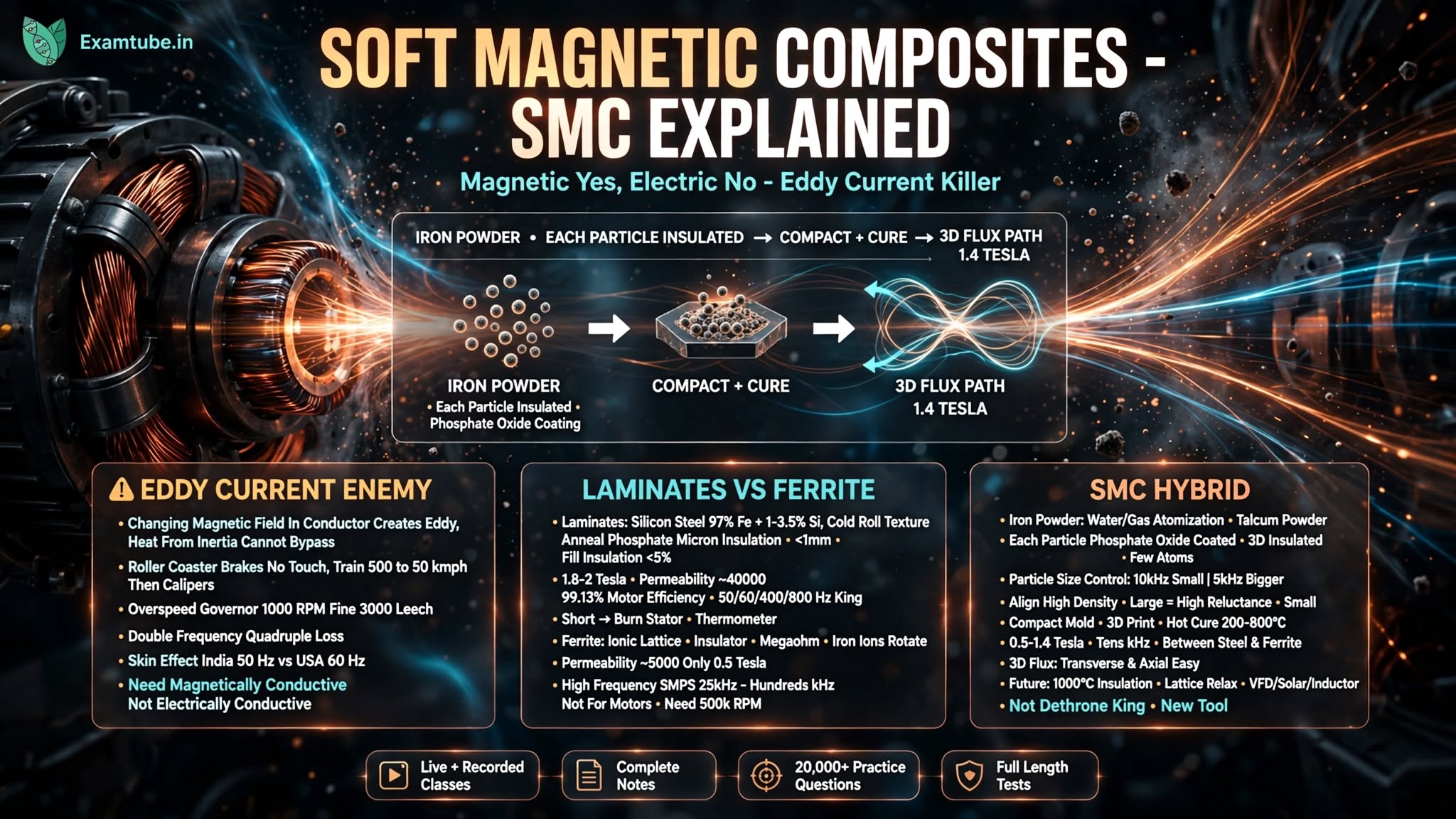
Soft Magnetic Composites SMC Explained: Eddy Currents, Laminates 1.8 Tesla, Ferrites 0.5 Tesla, SMC 1.4 Tesla And 3D Flux Motors
Understand soft magnetic composites, why eddy currents arise, and how different materials like high‑field laminates and ferrites affect moto...

Discussion
Comments
Please log in to join the discussion.
Login to commentNo comments yet. Be the first to start the discussion.