
On this page
Why Motors Are Great But Cannot Do Direct Drive
- Only two things break in a motor - insulation fails or bearing fails.
- Industrial motors, rewound and maintained, can cross 100 years, 50 years is normal.
- Tiny motor has RPM but not torque, so direct drill will stall.
- Gearbox works like transformer - 100 W in, 98-99 W out.
- EVs also have gearbox, motor spins over 20,000 RPM, then 8:1 or 12:1 step down.
- Superconductor is for making motor tiny, not for highest efficiency.
Only Insulation And Bearing Can Break
Hello readers, we're going to talk about transverse flux motor. So let's dive deep into it. Now what exactly is the problem that we are looking into? Electrical motors are great. Okay, they're amazing. Meaning there are only two things that can break inside the motor.
I'm not talking about electronics. Only two things. Either the insulation fails or the bearing fails. Bearing generally will fail if you messed up something like physical impact or inappropriate electrical part. So a lot of pitting happened in the bearing. So those sort of things. So basically it's an amazing device that only requires you to guarantee two things in the end.
These puppies can last a lifetime and that's why some industrial motors that are rewound and maintained can literally cross 100 years of use. There are some of them, 50 is like bro that's normal. So fundamentally they're great. However, they do have a constraint like you can't do what you exactly want to do, you would require some jugaad so to say.
Grinder Motor Will Stall As Direct Drill
And that constraint simply means you can't do direct drive. For example, if you are making a grinder, something like this, it has a tiny motor here, like very tiny. But here's the deal, that motor, if I want to use it as a drill, like a direct hard drill, it will stall. Why? Because it does not have enough torque but it has RPM.
So what do we do? We put a gearbox into it. So if you have seen like proper 【entity-DeWalt¦canonical_name=DeWalt】 or those sort of drill systems, they have a motor which is not that big but they have a gearbox, planetary gearbox that steps it down. Now be mindful, gearboxes are not magic. They are like transformer. So 100 W of power goes in, 100 W of power will not come out. Only 99 will come out, 98 practically or even lower.
But again, the motor that's supposed to stall, how the heck can it do that? Because it's changed it. Basically two components exist in electricity, voltage and amps. Same thing exists in motor, RPM and torque. So they're like, okay, what if we increase the RPM, torque is not that high. Increase the RPM and convert it. So that's how you can drill, like you can have a portable drill that has tiny motors and it can do things simply because of the gearbox.
Direct Drive Motor Would Be This Big
But if you are losing energy, right? Like if 100 is coming out of the motor, gearbox must waste some of the energy and not to mention add mass, stuff, extra stuff. What if we can directly make a motor that can do that? You can't. Can you make a motor that can give you that torque? Of course. Then why can't we do that? It will be this big. So fundamentally that's a fundamental issue with motors that we do not use direct drive in everything.
You might think, oh electric vehicle, it does not have gearbox. It has gearbox. I've linked the video down below. You can see the motor rotor is stupid RPM. Like sometimes some of the new ones can cross 20,000 RPM. Anything that is above 10,000 is stupid. Anything above 20,000 lol. So that sort of RPM is there and then you have a one step down, then you have a second step, like it takes stages, like at least two, like 8 to 1 or sometimes 12 to goddamn 1 in order to give you what you want.
Why can't you throw it away? Be mindful, because you are like, okay, what's the big deal? Bearings, that's the first thing that wears out and you have to have extra bearings simply because you can't handle it, and not to mention lubrication also becomes a hassle. So you can see that, like oh there has a small one, the big one, the big small one and the big one, it's like it's a mess. So motors are very efficient.
99.13% Efficient Motor In India, Superconductor Is For Size
Like this puppy is in India, the world's most efficient motor, as in Guinness Book of World Records, 99.13% efficient. Be mindful, that actually exceeds what you can do with superconductor. Wait, but how can that be? Superconductor is not used to make motor more efficient, it's used to make motor tiny. Like that, be very clear. There is a destroyer in America, apparently, that has superconductor motor, so 100 megawatt or something.
So they're like, why did they do that? It's just that hull fixing became free. That's what happens. Sixth gen fighter jets will have that superconducting motor generator unit because they want to take the what we call APU and throw it away. So the idea is, take the batteries which we have, very high power batteries now, directly start the goddamn jet engine, which if you know anything about jet engine, it's not possible.
It's not that physics stops it. Like, can you have a motor that can spin up a jet engine with enough torque that it can start it? Of course, minor inconvenience. It's just that you can't have that motor onto the jet. It will not fly if you do that. So the idea with superconductor there is shrink it down. Efficiency is not the highest. Highest efficiency is 99.13%. AC brushless synchronous motor, a power factor of one.
So most topologies like high RPM. You're like, hey, I'm making electric vehicle motor. I want it to be small. I want to be compact. I want to be high power. The penalty is like, yeah, it can't be direct drive. Like there were some dreams, like you know what if we had electric motor and it is directly spinning the differential itself and you just have a hollow shaft, which mind you, this has hollow shaft, so one side is there, differential is there, the other side, we can't do that, like we have been dreaming of it, we just can't do that.
So let that be very clear, you can do that, but it will be a very low horsepower car, very slow moving car. So we have to go through like stupid high RPM, then step it down. So high RPM is the easiest way to increase the power budget you have. Now that simply means, if you want to make electric vehicle range longer, throw that away, throw away the gearbox. And low RPM, very high torque density is very hard. It's not impossible, that I'm very clear.
You can buy some industrial motors that are like so powerful, that's like please, but is there, the size is also please. So this is a problem that people are trying to solve.
Poles, Frequency And Why High RPM Wins
- More poles = lower RPM and higher torque, assuming all other things same.
- Synchronous speed = 120 x frequency / number of poles.
- 2-pole motor: 3,000 RPM in India at 50 Hz, 3,600 RPM in America at 60 Hz, 24,000 RPM in aeroplane at 400 Hz.
- Can't increase voltage, insulation breaks. Can't increase amps, cable melts. Only RPM left.
- 60 poles for 800 RPM in radial or axial becomes huge, winding becomes wedge.
- 800 Hz VFDs are now heard, pole count moving from 4 to 8.
More Poles, Lower RPM, Higher Torque
So we utilize mathematics which we call poles. Basically, more poles equal lower RPM and higher torque. Again, assuming all other things are same. So pole itself does not define the RPM. It does need other components. So your synchronization speed is 120 multiplied by frequency divided by number of poles. Frequency matters.
For example, there are a lot of companies, let's say 【entity-General Electric¦canonical_name=General Electric】 or 【entity-ABB¦canonical_name=ABB】, they make pumps, right? That pump is sold worldwide. But here's the deal. If you look at the plate, plate will say 2 pole. Why? Because two-pole motor in India will run at 3,000 RPM. In America, it will run at 3,600 RPM. Why? India grid frequency is 50 Hz. America grid frequency is 60 Hz.
Take the same motor, put it in an aeroplane. Aeroplane, it will run at 24,000 RPM. Assuming it does not burn up instantaneously. Because aeroplanes have 400 Hz electricity. Now why do they have 400 Hz? Because they had the same problem. It's like we want to have so much stuff, right? Motors, pumps, so many things, all of those things will require spinning mass.
Why Aeroplanes Use 400 Hz
And if each of them is not as small as possible, your plane will not take off from the ground, because the motor generator units that you need will be heavy. So the idea was, increase the frequency. You can't increase the voltage because the insulation will break down. You can't increase the amps because cable will melt. So what is the only thing you are left with? RPM. Increase the frequency.
So that's why you can find into some power plant, coal power plant. If it is like, I really want to have inertia, so it might be like two pole only generator, and that puppy will be running at 3,000. Same manufacturer, same hardware, man, like 【entity-Siemens¦canonical_name=Siemens】, same turbo generator, they put it in American grid, it will be spinning at 3,600. Now generally we don't try to spin something that fast.
We generally are like, lower RPM equals lower bearing wear equals longer lifespan. So four pole motors and generators are very common. 1,500 RPM, 1,800 RPM, and that is a very critical aspect. Why the heck, whenever I say motor, right? If you have seen with water pump motors and all that, they are this big, they're barely powerful. Same size, same rotor size, same like everything, like the packaging, and you see a car that is like, you barely have five, this puppy can have 50 or maybe even 100. How?
Frequency, that's another reason why they have to have such a stupid RPM, because they are using stupid VFD frequency. So this is how they are compensating for the size, otherwise it will be huge. So high RPM, pole count low, equals what you want. But here's the deal. Pole counts become stupid. For example, if you want, hey, I would be fine if I can get 600 RPM. Okay, that's only 10 pole, doable. Great.
60 Poles To Get 800 RPM Becomes Huge
But at 400 Hz of VFD, that puppy is 4,800. That's still too high. So you have to go very high RPM. That is like, hey, I need 800 RPM. You are looking at 60 pole to reduce your RPM enough to be like, you know, I got this, like a small motor that does not require those drivetrain. So and be mindful, making it is not impossible, it's just very hard in radial or axial, it will become like this, and even this is like very hard to manufacture.
And because of the coils, right? Electrical resistance has two components, one is the DC resistance, another is impedance, basically AC resistance. Now AC, the more turns you have, the worse it becomes. Ideally, you want like one donut creating the magnetic field. This is bad. So more poles you add, the more difficult it becomes. And that's why you cannot see in-wheel hub motors are not here yet.
We can make it right now. You can pick up a phone, lot of companies will sell you those systems. They'll just tell you, yeah, this is a low power car, like can you do it again? You can, you must, JerryRig has that, like you know, wheelchair that has hub motors. Why don't we have hub motors in electric vehicles? Why do we have like, you know, motor here and then a pulley and belt or things of that nature? It has to do that so it can have RPM high enough to compensate for the torque.
So that 8:1 ratio, that is doing your torque conversion, torque upscaling. Without torque upscaling, can your motor spin you? Of course. Can it give you speed? No. It does not have enough, like the ceiling, the ceiling is not high enough. So this is why, and that's why, if you see very high pole count motors that are used in like pumped hydro or hydro dams, these puppies are huge. They can start with like, oh, we are like very small, very gentle motors, we are like, you know, 48 poles, like these puppies are stupid.
But again, you can see the size, they are stupid, and be mindful, flux actually makes it worse, because of the winding wise, how the heck you have to wind it, because it will become like a wedge at the corner. So it's not that it can't be done, it's just become huge. So now you cannot use it. Like imagine your electric motor that is huge, more bigger size than your goddamn car. What's the point? So 60 pole radial or axial is huge.
Pole mathematics will remain the same whenever you're talking about synchronous speed, 120 multiplied by frequency divided by number of poles. Generally, nowadays, I'm hearing, again, I have no way of actually knowing the OEMs of frequency. If you know, please do share. Some of them are touching 800 Hz, meaning the RPM is stupid. Most likely, that means they are increasing the pole count. They started with four, now they would be at 8.
| Case | Frequency | Poles | Synchronous Speed |
|---|---|---|---|
| India grid, 2-pole motor | 50 Hz | 2 | 3,000 RPM |
| America grid, same motor | 60 Hz | 2 | 3,600 RPM |
| Aeroplane, same motor | 400 Hz | 2 | 24,000 RPM |
| Common 4-pole motor, India | 50 Hz | 4 | 1,500 RPM |
| Common 4-pole motor, America | 60 Hz | 4 | 1,800 RPM |
| Want 600 RPM at 50 Hz | 50 Hz | 10 | 600 RPM, doable |
| Want 800 RPM at 400 Hz VFD | 400 Hz | 60 | 800 RPM, but huge in radial / axial |
What Is Transverse Flux - One Donut To Rule Them All
- Radial flux: magnetic lines 90 degrees to rotation. Axial flux: lines parallel to shaft.
- Transverse flux: electric field is donut coil, ring winding coaxial through shaft.
- Claw pole pinches donut magnetic field into points, those points become poles.
- One coil, how many poles you want? 20, 40, 60, 100 - take it and go.
- Flux becomes 3D, that is why nobody does this easily.
- Magnetic lines seek low reluctance path, that seeking is why motor spins.
Radial, Axial And Transverse - Flux Direction
So this is the pole mathematics which you do. If we can just have high pole count, all our problems would be solved, without making the motor bigger, without making the motor bigger. So transverse flux is a trick. It's like, hey, what if same thing, everything remains the same, as long as you can get a small, smaller motor or electromagnet, we can just have like 20 poles, no problem, 40 poles, no problem, 60 poles, still no problem.
Because again, you have just one ring winding, one donut winding, one donut to rule them all. So how do we know when we are looking into transverse flux motor? Here's the deal, whenever we are talking about radial flux or axial flux, we are just talking about magnetic flux direction. For example, I'm the shaft, I'm spinning like this. Okay, cool. Now here's the magnetic lines, like that. Magnetic lines are going like this.
This is what we call a radial, 90 degrees to rotation, radial. Now here you go. Magnetic lines going like this. Coils are here, magnets are here or electromagnet. And that's how the lines are going parallel to me. This is what we call axial. Now what is basically transverse flux? It's just a coil for electromagnet. Basically, the dimension that you are measuring is electric field dimension.
The electric field is literally going around the pole. Basically, electric fields are going here. That's what electrical, not magnetic, magnetic you can control however you want. Electrical field must be a donut coil. So ring winding, coaxial through the shaft. Ring winding, one winding, one coil, and you have shaft going through it. Now you are like, okay, you can do that, that's not that difficult, but wouldn't that just make a goddamn electromagnet, like it won't make a motor?
Claw Pole Pinches Donut Field Into Poles
Well, to make it from electromagnet to motor is that utilization of magnetic material, aka laminates, aka black magic, those sort of things that will basically leech the magnetic field, the donut magnetic field, leech it and point it. Basically, they are adding the pinching mechanism, so claw pole has the ability to take the magnet, the donut magnetic, concentrate it into the points. That's how you get the pole.
It's all literally like, hey, don't go into free space, come here. Like, okay, how the heck does that work? Thankfully, magnetic flux is like electrical energy. Meaning, if you have an insulator and conductor, electricity will automatically go through conductor. Same thing, magnetic also tries to follow what we call reluctance. Basically, it does not like to go through air. It's like, air conductor, air conductor, it's like, how about conductor? It will do that.
So whenever you are seeing designs like this, how the heck can we control this? How the heck these areas are not getting energy flowing through them? Because they are high reluctance path. We want low reluctance path. Basically, what we want to be is magnetic lines. Magnetic lines will always try to seek lower reluctance, and that seeking is literally why your motor spins. So that claw pole, all it does, it gives the donut magnetic field certain pinch points.
That pinch point becomes your pole counts. That's why you can just like, how many teeth you have in the claw, that's it. You have one coil, how many poles you want? Yes. No. No sir. How many? Yes. It's like, I want 20. Take it and go. I want 40. Take it and go. I want 60. Which here has 100. Take it and go. So let that be. That's why we are looking so much closely into transverse. Meaning this puppy can give you torque. And how much torque? Yes.
So magnetic material requires you to shape the pole. You are complete. You do not need to wind it like you are winding free. Like winding is like done. How much pole? Basically, you can have one winding and you can change the pole count, assuming you're using induction mechanism. That would be easier. If you're using permanent magnet, then you have to change the rotor also. But details. So flux becomes 3D. Now this is why nobody does this.
This is why you can't just buy a motor. You can buy this, you can't buy that. Why? Flux path, whenever you are analyzing, whenever engineers are like, okay, let me sit down, let me design a motor for 【entity-Tesla¦canonical_name=Tesla】 or whatever have you, 【entity-BMW¦canonical_name=BMW】, they are doing this puppy, this puppy, why it is doable? Because it's 2D, computers can like, I got this. And before computers, basically notepads are like, basically actual pen and paper, it's like, bro, we got this, flux path design calculation is super easy when it's in 2D.
The moment you fold it in three dimensions, it's like lol, even supercomputer will be like, come back in like 2-3 years, then I might have a solution for how to make the flux path.
The moment you fold it in three dimensions, it's like lol, even supercomputer will be like, come back in like 2-3 years, then I might have a solution for how to make the flux path. It's complicated.
Why Flux Path Is Hard - 3D, Laminates, Eddy Losses
- 2D flux path is easy, 3D flux path is brutal, even supercomputer struggles.
- 99.13% efficient radial motor vs 50-60% efficient transverse claw, flux wasted.
- Laminates are best, cast is worse, new particle with high-temp insulation is middle path.
- One coil means electrically efficient, impedance manageable, but flux losses kill it.
- Big diameter can do 120 poles, achievable.
- C-shaped twisted laminate is possible, but how to wind coil on closed shape?
99% Vs 50-60% - Flux Wasted
Claw, of course, we can make it, we do use it. It's just that, compared to the efficiency of 99.13% efficient to 50-60% efficient, because magnetic flux is wasted. So simple laminate, which you want, laminates are the best. We have to use cast, something like this, cast are worse. There is a new design which apparently has like particles which have like very high temperature insulation.
So these are grains that you are infusing, and again, insulation to insulation infusion is happening. So fill ratio is not that high, but it is enough that in what you call eddy current losses are low enough, and magnetic conduction, reluctance is low enough, that it is actually useful without creating too much eddy. This is like, very good in terms of magnetic conduction, great, eddy worse. So there's a balance here.
And that's the core reason we know what we can't build. It's just that we haven't figured out how to flow the magnetic path while having the same efficiency as a normal laminate. Laminates are like, bro, I got you, like I got you. Laminates are like very efficient. I literally thought of it like, okay, what if we take it and twist it, and I was like, yo, this is going to be amazing. I can get a patent on it.
Then I realized, wait a minute, how the heck am I going to fold coil around it? You can make a path like C-shaped laminates, like you know, you're punching out the laminates. Laminates have like two teeth that you're going to twist. Great, you can do it. It's just like, how the heck are you winding the coil in there? So you can see that, like magnetic field is going like this, and electrical is going like this. So that's the core hassle.
We want laminate design. We can't just fold the laminates, the 3D pathway. So this is the issue. So right now, can we make a motor that has bonkers high torque because it has bonkers high pole count? Of course. Would it have better efficiency in some regard? Yes. Electrically, it would be more efficient because it's just one coil. The impedance is much more manageable.
Then why don't we do it? Simply because we'll lose all the efficiency if we use claw like this in eddy losses, and if you use some complicated geometry, flux losses, that's the key vector. Everything about this motor is the easiest motor ever built by humans. It's just that, the moment you talk about, okay, what about the flux efficiency, then you will understand why we don't do this. Again, pole count is like stupid, like if you have big diameter, like you know, this big, it's like 120 pole count is achievable.
Where Transverse Flux Already Lives - Alternator And Microwave
- Most common transverse flux rotor is already in your car - alternator.
- Alternator claw is cheap, one donut coil, cast steel claws, DC field, controls voltage.
- At high RPM rotor current goes down, at idle it goes up, maintains 13.5 V, not 35 V.
- Microwave turntable is AC synchronous motor, 5 W, donut coil, sheet metal, low power.
- For 100 years transverse flux targeted low power, high power flux wastage becomes bigger.
- 48 V cars are throwing alternator away, using proper BLDC motor-generator.
Direct Drive For Fans - Throw Away Motor And Gearbox
So what are the uses of it? Well, here's the thing, if done correctly, it would be core of direct drive system. For example, let's say you have a fan, right? Fan is like a big industrial fan, and it's like, okay, I have a big ass motor, and we have a big ass gearbox. Then we are like, you know, 20 to 1 step down. What if you throw away that motor, throw away the gearbox, just have a direct drive, but itself has like exponential amount of pole count?
Like instead of eight, it has 80. Then he's like, I got this. So we want to do that, and is there a reason to that? Not just like want, is there a reason? Yes. Reduce weight. Imagine it's a fan that is hanging up, or imagine it's electric. Reduce weight, improve everything. Waste heat, by removing the gear step down, because no matter how good a gearbox is, it's never, and when I say gearbox, I do not mean Tokyo 25 gearbox.
No, gearbox simply meaning changing the RPM, you will have some heat loss. Generally, they say it's around 3%, but what if you don't have, what if that is zero? So weight elimination, elimination of maintenance, maintenance is a much critical part, because again, motors are perfect devices. As long as you can guarantee the bearings are safe, as long as you can maintain the insulation integrity, you're good, brother. You good. Nothing is going to happen in your motor.
Like nothing. We good. We got this. It's going to last practically forever. And yes, we do have motors that have survived like 50, 60 or 100 years. Of course, they would have done a lot of rewinding because the insulation breaks, but it can be done. And again, if you look into maintenance of the motors, all it means is throw away the bearings. So if you can throw away extra bearings, like you know, you have one primary bearing, and now you buy bigger, beefier, more stronger bearing, now it lasts more longer, instead of having five, six bearings, just two.
Car Alternator Is Transverse Flux
So gear down system elimination, but that all assumes you can figure out how to make flux path as efficient as like, you know, normal laminate. For example, this is the most common rotor of what we call transverse flux. It is already in your car. If you are driving a combustion vehicle, there is a good chance this has an alternator. If you open that alternator up, this is what is there. Now, this is why people are generally not supposed to use alternator to make a generator.
The reason for that is, this claw, while it does have the benefit, because it's electromagnet, you control the field strength, so to say, and that's a very good mechanism. That's why your car uses this. For example, at high RPM, they don't want voltage to become like 35 volt and fry your battery. So rotor current goes down. It's like, and at low RPM, like you are idling, it still needs like that 13.5 volt or whatever the design is, the rotor current will go up. So that's how they can maintain it, that's why it is used, and it is very cheap.
Why is it cheap? Just one donut coil. And what about those claws? Claws are just casted steel, the specific alloy, but they're not that great. Now how could they work? Well, because they are dealing with DC magnetic field. So DC magnetic field does not create that much eddy. But it does heat up whenever you are changing the engine RPM. Now you're like, wait a minute, that's a lot. Yes, that's why, whenever you look into alternator, it always looks like a skeleton, it has to, so they can keep cooling this puppy.
Rotor does not get heat, sorry, stator does not heat up that much. Ironically, it's the rotor that heats up, because of that, like you know, claw, that eddy current losses pile up on it. So if you're like, okay, I'm going to buy this and I put a small engine to it and that's my generator. Yeah, you're throwing your energy away. Like, it's not worth it. We use it because it's cheap.
And again, as cars are moving to 48 volt system, they're throwing this away. Now you have like a proper motor generator. Basically, looking like a BLDC motor. Just put BLDC motor. It's efficient in both directions. For example, energy goes in, torque comes out. More efficient. Torque comes in, energy, voltage goes out. That's also more efficient. And no physical contact. No brush to wear.
And again, brush does not wear like this. If you have a slip ring, not split ring. These are slip rings. They can last like freaking forever. The brushes are this long. So they do wear down, but there is a giant spring behind it. It will last forever, practically. So if you can remove parts for maintenance, that's perfect. But you can understand, this has a current loss. Even though it's dealing with DC, but it's like, okay, what if I want to look into AC?
Microwave Turntable Is 5 Watt Transverse Flux
There is a good chance you have used microwave. There is a good chance microwave has what we call turntable. That turntable is this motor, and it's what we classify as AC synchronous motor, 5 watt power range generally. What it is, is donut coil and flux path, and like, wait a minute, that's just sheet metal. Yes, it's designed for low power. That is designed for low power. This is designed for low power.
Everybody who's using transverse for last 100 years, it's always targeting low power, because at higher power, the flux wastage becomes a bigger issue. So this is one point. Now, okay, how would you make three-phase system? Three donuts, 1, 2, 3, you stack it, and again, if you want, you can cut the metal cups properly and all that, you could, like, you know, stack three of this and have a three-phase motor.
Oh, by the way, this is, for some reason, self starting. That's the most confusing thing to remember. This motor self starts. There is no two-phase, nothing. This motor is a synchronous motor and it bloody starts on single phase AC. I'm like, dam, they said they always have to make multi phase motor simply because that's the only way to control the rotation direction. Meaning this puppy can start sometimes clockwise, sometimes anticlockwise.
I'm like, what? Unless you can guarantee, like, always one of the poles is getting, what do you call, live and neutral, which again, based on how electrical wiring is, it's never guaranteed, even then, it's like, it might start spinning clockwise, might start spinning anticlockwise, so you do need three-phase motors. So car alternator is the same thing, microwave turntable is the same thing.
| Where It Already Lives | What It Is | Why It Works There | Why Not For High Power |
|---|---|---|---|
| Car alternator | Claw pole, one donut coil, cast steel claws, electromagnet | Control field strength, maintain 13.5 V, cheap, DC field low eddy | Rotor heats from eddy losses, not efficient as generator, moving to 48 V BLDC |
| Microwave turntable | AC synchronous motor, 5 W, donut coil, sheet metal flux path | Low power, cheap, self-starting on single phase | Flux wastage becomes bigger at high power |
| Ceiling fan / industrial fan | Direct drive idea, 80 poles vs 8 poles, throw away 20:1 gearbox | Less weight, less maintenance, zero gearbox loss | Needs flux path as efficient as laminate |
Future - Can It Kill The Gearbox, In-Wheel Motors And 95% Vs 98% Tradeoff
- Primary hassle is claw - make it efficient and still castable.
- New metal particle with insulation behaves close to laminate, not perfect 1:1, but close enough.
- Buy microwave turntable motor to see it yourself.
- S-curve upper end: least gain costs most money, millions burned.
- American patent: segmented laminates, discs, Jenga blocks, grain direction changed.
- Even 95% motor can beat 98% motor + gearbox, but 70% cannot.
- EV in-wheel motors possible today, just not high power yet.
- Motor is easy, flux path is hard part.
Claw Has To Be Efficient And Castable
And the primary hassle is this claw. You have to make this claw somehow, which is more efficient with that, and still is like castable. And again, I have heard that now we have some sort of metal particle that has insulation that is strong enough, particle conductive enough, that you compile enough of it at high flux density, it behaves close enough to laminate, not perfect 1:1, but close enough. So these are the utilization part of it.
Again, I would urge you to, if you really want to see, buy a microwave turntable motor. So what can we expect in future? Here's the deal. This is a tool to solve one unique problem of the motor. It's like, everything about electric motor is sorted. It's like, we good, we got this, it's done. And okay, then why are they burning millions of dollars? It happens in S-curve upper end, it's always like that.
The least gain you're going to gain, the most amount of money you're going to burn. It always happens in all fields. This is a new path, so to say. Now flux optimization is not easy. So anytime, oh, I have cracked it, it's like, press X for doubt. Like, this is a patent from an American company that is building the new designs. It's like, oh, we have laminates, and they have segmented laminates, meaning discs like this, then you have disc like this, and then disc like this. So that's how they are making, like, you know, claw.
Segmented Laminates And Jenga Blocks
So that's the whole hassle. Coil, you can make it, I can make it, drive electronics, same. It's just that, whoever cracks how to make the laminate path which is efficient enough. I told you, like, I actually calculated, like, thought about it, like, okay, what if I make a, like, complete C-shape and twist it? Can it be done? Of course, it can be done. Is that, then why does nobody, how the heck you wind a coil to it? Like, it becomes a closed shape, and the more you stack it up, the less space you have. How the heck you wound a coil to it?
So that's hard, and it has to, I'm very doubtful that it will ever reach radial flux. Radial flux has one of the efficiencies that you do not think about, that it is very simple, like coil geometry is simple. Flux geometry is simple. So it is doable that you can make it uber efficient. But would a radial, sorry, axial hit that? Unlikely, close enough, but not hit it. What about this? This is very unlikely. So that is an issue.
However, even if your motor becomes a bit more inefficient, but you can throw away a lot of extra parts, that may be worth it. Even if your total energy efficiency goes down, but the product becomes cheap enough, maintenance goes down, people might be willing to eat up that extra cost. For example, this is the ceiling fan which became the first device that they bought it. Again, industrial large scale, where they used to have like three-phase motors, and that's spinning a gearbox, 20 to 1 reduction. Then they are spinning the blades, in this, it's like, I direct drive this.
95% Motor Can Beat 98% Motor Plus Gearbox
So removing gears in whatever topology you are looking into is always an easy optimization state. Meaning, should we remove gears in electric vehicle? Yes, less component to wear down is always better. The less oil you have to have, less cooling system you would need. Even if your motor requires cooling, the cooling pipelines are simplified. So it is a good thing, even if the motor is not matching one to one, like, if both motors are, for example, 98% efficient, there is no discussion. If one is 98%, another is 95%, it still might be in your best interest to throw away the gearbox, but if it's like 70% efficient versus, yeah, that at that point, nope, nope.
We are in that phase right now. In some location, it makes sense, but others, it does not. So every R&D is going into this, like, how the heck we make flux path that is efficient, so to say. And again, I have seen at least three to four patents. This one was the most intricate, like, it's stamped and stamped in segments, they're not even making a complete segment, and I was like, okay, it makes sense, you don't want all the magnetics to go round and round, you want them to pinch on the system.
So this is like a segment of it, so you have multiple segments, and you have blocks that are changing the grain direction, meaning it's grain like this, like this, then like this, so almost like you, Jenga, they're building like Jenga blocks, but enough people are working on it. And yes, I could see a scenario where we can have electric vehicles that have finally in-wheel motors, rather than motor and then planetary gear, just the motor direct driving it.
It can be done today, only, it's just that it won't be high power, because at high RPM, it will not have enough torque. This puppy is like, torque, yes. And again, if it's a big wheel, it's like, if you have hum wheel, it's like, it will like, bro, I can go 500 km/h, as long because we have electricity to provide it. But it is a very interesting development, and again, the only reason we are looking into it is, there is a probability that we can do the flux path without having the too much inefficiency penalty. So the motor is easy, flux path is the hard part.
Related posts
More guides connected to this topic
Why Grid NEEDs Storage Explained: Coal 80% Sweet Spot, Hydro Yellow Band Vibration, Grid Inertia, Solar Curtailment, Lithium Vs Pumped Hydro Vs Thermal Vs CO2 Battery
Learn why modern grids require storage, the role of coal’s sweet spot, hydro vibrations, solar curtailment, and options like lithium, pumped hydro, and CO₂ batteries.
Submarine Battery Explained: Why Lead-Acid Still Rules, Why It Self-Destructs, And Why Lithium Titanate Oxide Will Win
Explore why lead‑acid batteries still power submarines, their self‑destruct mechanisms, and how lithium‑titanate oxide promises longer life and safety.
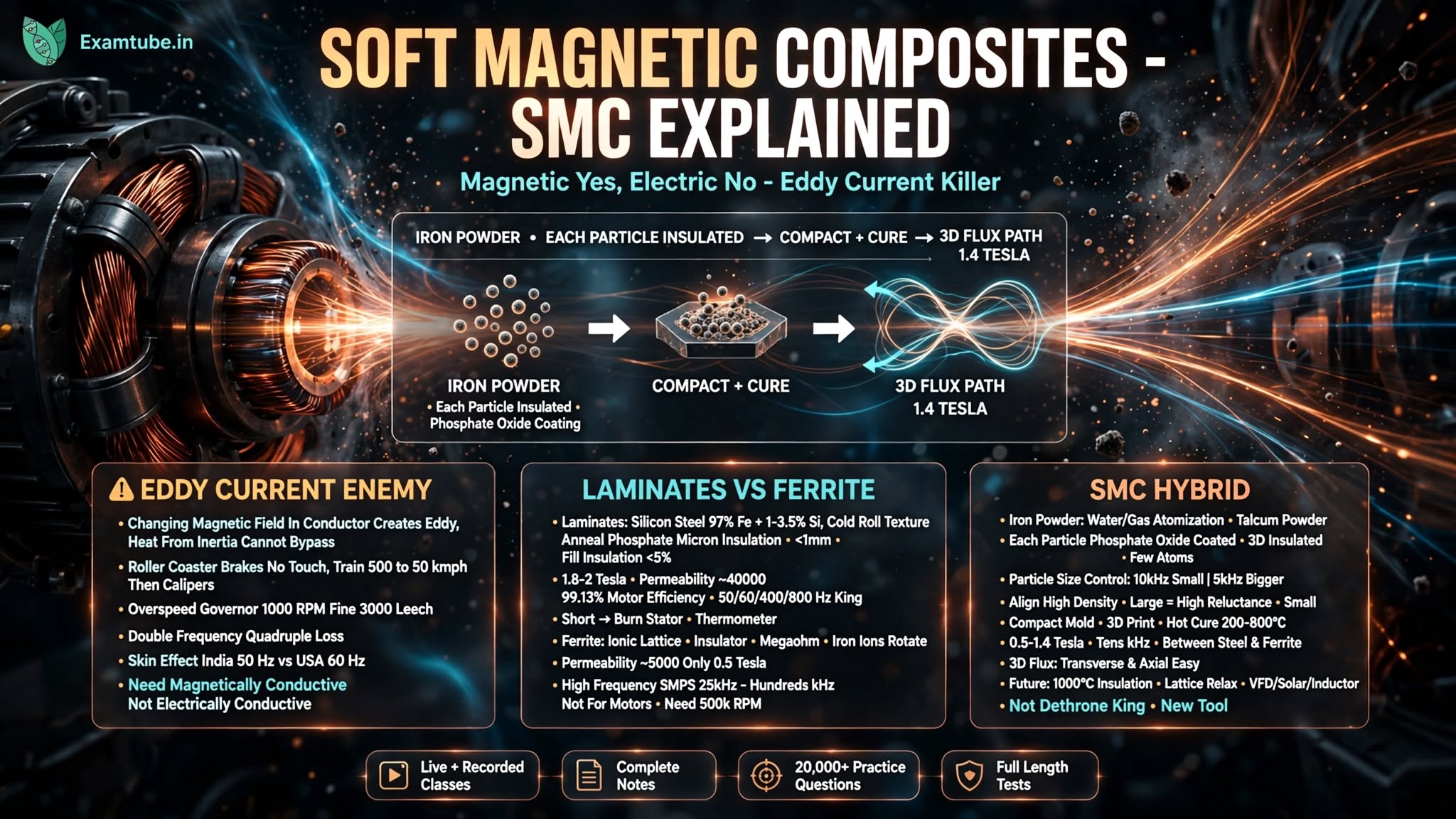
Soft Magnetic Composites SMC Explained: Eddy Currents, Laminates 1.8 Tesla, Ferrites 0.5 Tesla, SMC 1.4 Tesla And 3D Flux Motors
Understand soft magnetic composites, why eddy currents arise, and how different materials like high‑field laminates and ferrites affect moto...

Discussion
Comments
Please log in to join the discussion.
Login to commentNo comments yet. Be the first to start the discussion.