
On this page
What Is A Submarine? No Oxygen, No Supply From Atmosphere
- Submarine is a boat that goes underwater, classified in navy as a boat.
- It is designed to work with no supply from atmosphere.
- Oxygen is needed for metabolism and for engines.
- CO2 must be removed, and propulsion must keep working underwater.
A Boat That Goes Underwater
Hello to reader. we're going to talk about submarine batteries. So, let's dive deep into it. Now, what exactly is submarine? Submarine is basically a boat that goes underwater. Nothing more than that. It's actually classified in navy as a boat. Uh so, what's the deal here?
Well, the deal is it does not take oxygen for things. For example, air is very necessary for us. Why? It does few things for us. First, it allows us oxygen to react basically our fuel carbohydrates burns because there is oxygen. And then it takes our carbon dioxide away. So, that's the whole point. Oxygen is necessary for our metabolism and it's also necessary for engines.
You have jet engine, it requires fuel plus oxygen. Uh you have diesel engine, fuel plus oxygen. Submarines are one of those few things that are like nope. It's specifically designed to handle that. Basically, no supply from atmosphere and it can still work. For metabolism reason, like you can't just like oh I have a nuclear submarine so everything is no, you have to work.
CO2 Removal Is Critical
Uh for example, you have to remove CO2. CO2 is very ugly simply because very little concentration as in as a low as a 9% concentration can cause decision impairment. Basically, you'll be like hi and not comfortable like brain splitting headache and at 13% you die. So, you have to remove CO2. Back in the days, people were using consumable cartridge for it.
And then nuclear submarine was like yeah, this cannot work. It's like oh you can stay under you have to come up to vent CO2. So, they come up with a systems where you have chemical bed that consumes carbon dioxide. You heat it up, it dumps it. Now, where the heck it dumps it? It's under the sea. Where would you dump it? You can't. You dump it into a chamber.
Chamber runs a compressor. Compressor compresses it, puts it into a different vent system. Then it vents out because again, if you have a gas in a chamber and you just open it, it will get compressed and filled with water when you are under sea. So, you can't just like pss leak CO2. You have to pressurize it. So, CO2 removal, that's a critical thing. And provide oxygen.
Uh that is ironically easy because you're surrounded by water, and water is again oxygen and hydrogen. But be mindful, you have to make sure you have to pump out hydrogen safely, otherwise it's a kaboomer gas. So, this is for metabolism. And then you have propulsion. That's the whole thing. If it can't move, it's just like, okay, I'm below water. It's like it's not that useful.
Propulsion, Sonar, HVAC And Pumps
It must have propulsion and all the auxiliary system. Propulsion is the big daddy load, meaning most of the megawatt is being drained by the motor to run the propeller, so to say. And there are a lot of heavy auxiliary systems, which includes sonar. That puppy consumes energy, comms, HVAC. And yes, you would think like, isn't underwater cold and like don't you need heat?
Once you actually make it big enough, surface area to volume ratio makes heat a bigger problem. It's a big-ass problem in basically nuclear submarine because again, whatever your electrical output is, a reactor will have at least two or three times of that power as a heat. So, they have to continuously cool it. So, HVAC is an issue in submarines, specifically nuclear submarine and even in diesel submarines.
Because surface area is big and you have so many people, so much equipment. All of those heat piles up and the outer shell of submarine is covered with a rubber insulator. So, that really makes it difficult. So, you have to make sure the humidity is kept low. Uh you have to make sure the temperature is kept optimum. All of that puts enormous energy strain drain.
And then you have weapon systems. Uh and then you have pumps. Like what is submarine? It's a pump. What does it have? Pumps. Like for pooping water, it needs pump. For floating, it needs pump. Everything. Like submarine equals pump. If you know how to make reliable pumps, you can make reliable submarine. You do not, you die. So, pumps are very critical things.
Submarine equals pump. If you know how to make reliable pumps, you can make reliable submarine.
Nuclear Is Not Cost-Effective
And nuclear is not cost-effective. You're all like, okay, why not just add nuclear to everything? It's not cost-effective. We have been doing it from 1950. We learned it the hard way. Few nuclear submarine is barely possible. Barely. And that's for the largest country with largest economic budget in terms of minds bigger than yours. Uh so, it is not cost-effective.
Meaning, can India make nuclear submarine? Yes, we have nuclear submarine. It's just that can India have like a whole naval fleet, a submarine fleet be nuclear? Yeah, it would be economic disaster for us. So, diesel battery system was there like as early as 1905. It is there in 2026, it will be there in 2050 also. So, it's the backbone technology.
Basically, these puppies, the batteries, the huge batteries and generator. Now, generator could change. There is more chances of generator being changed than batteries to go away. Battery will be there. So, this is the whole point of submarines. Now, why lead-acid?
Why Lead-Acid? 167 Years Old, Four Items, And Dirt Cheap
- Lead-acid was invented in 1859, 167 years old at time of making.
- Only technology older than that is hydrogen.
- It needs only four items: distilled water, lead, lead dioxide, sulfuric acid.
- It can be made with pre-industrial revolution technology, even glass casing.
- It can be made without separator, separator is not ion exchange membrane.
- But this puppy drinks water, that is the penalty.
Ancient Puppy From 1859
Well, lead-acid is ancient puppy. Meaning, this puppy was invented by this gentleman in 1859. The only technology older than that is hydrogen, but like lead-acid battery is 167 years old at the time of making this video. It's ancient. It's not old, it's ancient. And it is very cheap. Now, why it is cheap?
Because fundamentally, like if your country knows how to make four items. Again, I'm not talking packaging. Four items, that's it. You good. You got this. That's why we figured it out in 1859. You need distilled water. We got this. We good. We got this. H2O, basically. You need lead. Ironically, we knew how to have figure out lead surprisingly early.
Surprisingly long ago. Like Roman kind of long ago. We got lead. And lead dioxide. Not that difficult to make. Sulfuric acid. Not that hard. So, all these four items since industrial revolution, like we good. We got this. Uh that's it. Done. Before we even figured out how to make proper hard casings, we were using glass.
We knew how to make glass. So, and glass were very what you call acid resistant. So, that's it. Like, all you need is like pre-industrial revolution technology and like you can make a tangible battery that is like actually usable. So, that is the majesty of lead-acid battery. Four components, the end, go home.
And you can make the whole system without separator if you want to. You can add separator, not necessary. So, again, if you want high density, duh, you will need separator, but it's not ion exchange membrane. So, fundamentally, it is a very simplified system. But, this puppy drinks water.
| Component | Why It Is Easy |
|---|---|
| Distilled water / H2O | We got this, basic. |
| Lead | Known since Roman times, surprisingly long ago. |
| Lead dioxide | Not that difficult to make. |
| Sulfuric acid | Not that hard, available since industrial revolution. |
| Casing - earlier glass | Glass is acid resistant, we knew how to make it. |
Sealed Lead-Acid Is A Compromise
Now, you're like, okay, what about if I buy sealed lead-acid battery? Yeah, that's a compromise. These batteries are fundamentally thirsty batteries, and if you seal them, the hope is that when you have pressurized hydrogen and pressurized oxygen, they will make love to each other and they will become water again. Now, here's the deal. Here's the problem.
Hydrogen leaks before oxygen does. So, slowly, over time, you will have concentration of oxygen and you will not get all the water. Again, it will delay how much quickly you have to refill it, but because of the sealing requirement, you can't refill it, and that creates a problem. Where it's like, yeah, it is what you call I do not have to refill it, but it just delays it.
It will dry out, meaning your amp hour, the capacity, will shrink. The sealed lead-acid battery does not mean give you the magical abilities like, okay, it was 200 amp hour when I bought it, it is 200 amp hour at the end of it. No. It will lose capacity. It will get drier. So, that's the essence of it.
Why Lead-Acid Is Forgiving: No BMS, Tolerates Overcharge And Short Circuit
- Super easy to chain to 200 V DC, 500 V DC, like substation batteries.
- No BMS, no concept of BMS.
- Water acts as thermal buffer, tolerates overcharge by boiling water away.
- Can tank short circuit, can keep working with shorted cell.
- Very forgiving, very simple, four components.
Easy To Chain, No BMS Needed
And the most amazing part of lead-acid battery, this puppy is super easy to chain, meaning you're like, back in the days of like, you know, 1905, you wanted like lead-acid battery. It's like, okay, I have 200 V DC, 500 V DC. It was easy. Like, lead-acid, you can just like it. Like these are what we call substation batteries. They just link it. They just attach it. How many cell you want? Just yes.
There is no BMS. There is no concept of BMS. Why? Well, this topology does have the ability to dump heat safely. Meaning they can tolerate overcharging. Meaning let's just say 100% of the cells are not balanced. Because even if they were perfectly matched, perfectly balanced, they will drift.
Drift will not happen in day one. It will happen on day thousand. So, they will drift and then you have a problem. One cell would be under capacity or over capacity. What happens if one cell is under weak and others are still charging? That cell that is weak and lower capacity, it will overcharge. A lead acid simply can tolerate that.
How? Well, it will boil the water away. So, water acts as a thermal buffer. So, that's where your energy is being dissipated. So, fundamentally it can handle what we classify as you know, overcharging safely without going kaboom. It can handle it. That's why you can have long strings and they can work for 10 years.
Can Tank Short Circuit
And they can also handle short circuit. For example, if you take positive and negative and did this, they can tank it. It will be harmful, but they can tank it. And heck, I had a lead acid battery which I'm pretty sure like six or seven month ago had a shorted cell. Like actual cell went kaput like that. It was still working. It died like few days ago.
That's the whole thing. Meaning there is a scenario where you can go to substation and if they do not have modern battery monitoring system, it might not even detect that one or two cells are kaput long ago and it's still working. So, it is very what you call forgiving. It's like, I got this. I understand you. Like you can count on me, brother.
So, that's the good parts about lead acid battery. Surprisingly simple. Like surprisingly simple. Four component, go home. Now, what about the quality of it? Here's the deal. We had a century to perfect lead acid battery. Meaning I made a recently a short that lead acid batteries cannot have warranty as long as like, you know, the companies that are showing.
If you look into the warranties, like 72-month Exide battery warranty, it's like that's how the heck they are doing that? Well, they are not. What they have is what we call replacement warranty that is barely 4 years or maybe 4.5, maximum 5. And these batteries that are for submarine grade, they can have very long warranty life.
They could have like, you know, 10 years, 15 years. That is possible. But, you have to understand that chemistry is understood, meaning we know how cell degrades. We know what is the reason for that degradation. But, it has what we call self-sabotaging mechanisms as in self-aging. It will self-destruct.
Why Lead-Acid Self-Destructs: Water, Lead Sulfate, Shedding And Tubular Cells
- It will self-destruct, no matter how good you make it.
- Submarine battery thrown away after 10 years, even if could have 30-year warranty.
- First killer: water, electrolysis, off-gassing, hydrogen leaves fast.
- Second killer: lead sulfate expands, sheds material, plate erodes, cell shorts.
- Tubular cells try to reduce shedding, but companies reduce material to save cost.
- Tubular is not good for surface charge, flat plate dumps current like capacitor.
First Killer - Water Is Perishable
That's why no matter how good you make it, even if submarine battery could have 30-year warranty, they're not going to use it for 30 years. They're going to throw it away after 10. Like, they have to. It's a life-critical system. They can't risk it. So, what are these mechanism that destroys the battery from inside and you cannot do anything about it? First is the water.
Why the heck these cells become thirsty? Because it's doing electrolysis. And you're like, oh, but it's distilled water. No, there's hydrochloric acid there. You literally are making a perfect electrolyzer cell, perfect one. And you're like, okay, balancing and all that. Nothing is perfect and hydrogen leaves way too quickly.
So, that creates a scenario where you have off-gassing. And yes, hydrogen is a bigger issue because oxygen has a bit more time to react to things. Hydrogen is like, peace, I'm out. So, basically, you're boiling the water away. And another aspect is, let's say one cell is misbehaving, it will boil the water away as a heat generation.
And that is the reason why these cells can tank overcharging, so to say. Meaning, as long as you can keep refilling the water, it's like, I got this. So, water is a perishable in this design. No matter how much like, I'm going to seal this. I'm going to do that. It's like, no. It will drink water.
And this is another reason if you see any long-life batteries, generally, they are not what you call sealed. They are most of the times they are like no, you have to refill it. Like look into what you call traction battery that are lead acid battery used for go carts, forklift, they generally have water replacement. You can try to replace them but you are buying convenience and shorter lifespan.
It can be done but you are buying shorter lifespan. So water is a consumable item you have to deal with it. That's the penalty of it. That's one thing. Second, the lead and lead dioxide the thing that makes it cheap also makes it very difficult because lead and lead dioxide they both expand.
Second Killer - Lead Sulfate Expansion And Shedding
Why? Lead sulfate. Lead sulfate is physically volume wise is much larger. Which again, lead sulfate does have sulfur there. So it physically sheds material. Basically what is lead acid plate? Whenever you see lead acid it's a grid of metal. Whatever the conductor is generally some type of lead. And then it will have foam lead. So basically a type of lead and then it will have lead dioxide paste basically.
Now here's the deal. As long as the paste is there on the plate you good you got this. Then what happens? Well, because it's going from lead sulfate to lead and lead sulfate to lead oxide it's physically expanding contracting physically. It's like breathing basically. And that sheds material. Basically your plate will literally lose the material.
If it had like 100 g of material over time it will literally lose 50 to 60 and it will start to pile up at the bottom. That's why the cell gets shorted. So and not to mention because you're talking about corrosive environment and because you have electron exchange and all that. This is your positive plate. Itself erodes. It disappears basically.
No matter how hard you work this will disappear. So that's why when people say you will be lucky if you get 1,000 or 2,000 cycles out of it. That's the reason for that. It is self-destructing, physically expanding and contracting too much. Like you know, lithium? No, no, no, no. Lithium got nothing on this. And it's not dendrite formation.
Tubular Cells - Pencils With Plastic Pipes
Uh so, that's why if you keep hearing the word tubular cells, so tubular cell is taking this plate and making them into pencils. And that pencil has some sort of plastic or some sort of material that allows the electrolytes to work. Basically, something that can handle the corrosive environment, but allow things to flow. Almost like plastic pipes. Plastic pipe that is so.
The reason for that plastic pipes on this tubular design is that electrolyte shedding, the material shedding should be reduced. And that's why on paper those batteries should last longer. Then why the heck your modern batteries don't last longer? Company realized they could do that, like you know, go to tubular and have better lifespan. They reduced the material.
So, instead of having like 100 g of material with a tubular that will give you, let's say, 8 year of lifespan. They're like, okay, what if we have the same design, tubular, so we can advertise it legally that it is a tubular cell, newer technology, cool, awesome, but reduce the electrolyte material count. So, instead of going 100 g, what if 80 g only? So, we save 20.
So, that's why in certification guarantees that your cell, no matter what technology is created, no matter what engineer comes up with, it will always have 4 or 5 years of lifespan. And it does come with one penalty, apparently, that it's not good for surface charge. Meaning, when you're talking about flat plate, this puppy can dump current.
That's why your car starter motors are rarely provided by a tubular. This tubular. Never tubular. Why? Your car is basically needs a super capacitor. It's just like why the heck we are using lead acid is beyond me, but we should have super capacitor. And some small lithium ion to keep topping it up in order to make sure the self-discharge does not happen.
It's just a surface capacitor, as in hundreds of amp, and then I'm done. I'm done. I'm go home. Like you leave your headlight on for too long, it dies. Why? Because the surface charge was designed for capacitor behavior rather than deep cycle batteries. So, these are designed for deep cycle batteries.
So, fundamentally we know how to make lead acid battery very last longer. Like for example, if company genuinely wanted it, 5 to 6 year warranty, tangible replacement warranty should be common. We don't get it because companies are like we double our profit. We charge more because we are giving you a new technology.
Legally it is new technology. We are saving more on the material which is the primary cost from a company's point of view. And we are basically where we started. So, if even if you have like, you know, cost is no money, meaning companies building cells for you, you will still be limited because of these physical realities.
Maintenance Is A Nightmare: 24x7 Monitoring, Ventilation, Bypass In War Machine
- Submarine battery is life-critical, not inconvenience like inverter or forklift.
- Monitored 24 into 7 into deployment, daily by someone.
- When charging, monitor voltage, current, temperature, ventilation - charging is most vulnerable.
- Check fluid level, specific gravity, electrolyte density ratio changes with aging.
- One cell poops out, bypass it with bus bar, on 100+ V DC to 500 V DC, oops means deleted.
- Need crawl space, tub, 1 to 2 individuals whose sole job is battery.
- On paper 15 years, in practice toss out every 10 years.
Life-Critical, Monitored Daily
So, what about maintenance? This is very critical because in submarines this battery classifies life critical, meaning if my inverter battery dies, it's inconvenience. If your forklift battery dies, it's inconvenience. But a submarine battery dies when it's under, yeah, it could go kaput. So, fundamentally it is monitored as in 24 into 7 into deployment.
As long as the deployment is long, year, 2 year, whatever have you. Generally they are not that long, but let's say it is that long, somebody will be monitoring the battery daily. And what are you monitoring? Well, when charging you are monitoring the voltage, current, temperature, ventilation. This is critical part. When it's charging it is doing electrolysis.
So, you generally have to make sure the fans are running. Generally lead acid battery chambers are at the bottom of the submarine. So, if the fan stops, the hydrogen will leak through the metal. So, they are like, no. If that happens, let's say the ventilation fan stops, the end. You stop the charging. So, they have somebody has to be like that's all their job is.
Like make sure the pumping systems are working, ventilation is working while charging. And charging is the most vulnerable state. So, somebody is like always there like monitoring everything. All the gauges you see, that's somebody monitoring the lead-acid battery banks. Now, cells are monitored physically for fluid level.
And by the way, you can also check what you call specific gravity. These cells are like actually they will give you a manual. Basically, whatever company manufactured this for you, they will give you a manual. Meaning, for maximum efficiency, based on the aging, your electrolyte density might change.
Whereas like, hey, in the early years, this should be the ratio what the dilute water to sulfuric acid. Sulfuric acid is not leaving the system, but dilute water is. But, you will have some shading materials will shade into the system. So, you might have to change the ratio so it behaves appropriately. So, there would be an individual whose job it is to monitor that.
In older ones, newer one, they might have some electronic system, but in older ones, they had that. So, fluid level will matter and it will be locked. Meaning, if you look into older naval archive videos, where they're like, okay, training videos and all of World War II. It was a job like there was a guy with a clipboard monitoring every single cell. Like, 100 cell, 200 cells, like all of that.
Clipboard, Spreadsheet, And Bypass On DC
Spreadsheet, old school. They have to monitor it. They have to measure all of that. And because this is a war machine, if something happens, like let's just say one cell poops out, they will go there, disconnect it, connect the bus bar in such a way that that cell is bypassed. And you're like, wait a minute, isn't that dangerous?
Yes. This is DC. 100 plus volt DC. 500 volt DC. Meaning, if you have oops event, you will not be hurt, you will be deleted. So, yeah. Not comfortable. Not a safe thing to do. And these sort of watering systems are now nowadays utilized. Again, it's not as simple as you might think.
It's just like, oh, just have pipes and flood the water as much as you need. It's like, you have to balance the electrolyte level. Again, that's the only reason because they have people and this compared to substation battery, substation battery rarely comes online. These things are always online. These things are deep cycled.
So they have to have the maintenance stuff meaning you could have like literally one to two individuals whose sole job it is manage the battery. And if they do not do that kaput submarine goes kaput. This is the problematic part of it meaning it is intensive like you have to pay like again you do not want to give void space in submarines but you have to have a crawl space.
And that's why you will see all the cells are in such a way that always makes a tub. The tub is there so somebody can crawl and manage the cells. And you're like wait that sounds dangerous. It is. It is. So maintenance is a nightmare in a submarine and it has to be done. You can't just like some of them had like a pre-built tanks for what we call distilled water and all that.
And even this letter we get on paper the battery can last like 15 years. They will never push it that much. If they are doing it that's a bad corruption. Generally they're supposed to toss it out every 10 years. So what can we expect in the future?
Lead-Acid Has Reached Maximum Capacity
Reality is lead acid has reached maximum capacity meaning any engineer studying batteries the first thing they will understand is lead acid battery like we good we got this we understand every aspect of it. It is that more money and maintenance will not do anything more like we good. We got this like oh we have this technology we have that no no you don't.
No you don't. You don't. And even if you are single I'm pretty sure Exide has some new technology but I'm pretty sure the battery warranty is exactly the same. So I'm pretty sure they had some new design geometry or something and engineers are like sir we can give double the lifespan is like great remove the electrolyte to compensate. So yeah right now it's like putting money is like mm.
Lithium Is The Future: Three Chemistries And Why LTO Wins For Submarines
- Lithium will happen, how long it will take is different thing.
- Three primary categories: high density NMC, safer LFP, safest LTO.
- High density: oops equals boom, cannot use.
- LFP: safer, half safe, can vent gas, can burst, tolerable.
- LTO: bee safe, drill, cut, puncture, does not care, will not add to fire.
- LTO: low kWh, but 20,000 cycles, tank 1C and 3C, almost like capacitor.
- Penalty: expensive, not manufactured at scale, needs BMS.
- Japan already built lithium-ion submarine March 2020, now on third one.
- EU, India, Australia working on lithium packages.
- Surface charge time 4 hours vs 1.5 hours, underwater 3 days vs 6 days.
Three Primary Categories
Now lithium is the future. It is going to happen how long it will take that's a different thing but it will happen. And there are chemistries that they go oh, lithium burns. Yes. Some lithium chemistry do burn. Like for example, there are generally three primary categories. You have high density capacities which are like used in things like this. Lithium nickel manganese cobalt those sort of things.
High power like they have very high voltage, lot of capacity. Kilowatt hour is awesome. Penalty oops equals boom. So, yeah. And it can't be once it catches on fire, you can't do anything. You have to make sure that it is flooded continuously. So, cells that are surrounded with it does not catch on fire. So, yeah. That is not going to be used and I generally hope nobody is silly enough that they went for that.
Second, more safer option is lithium iron phosphate. LFP batteries. Now, is somebody using LFP lithium iron oxide? Yes. But it is half safe. Meaning compared to manganese and all that, yeah, it is completely safe. But is it truly safe? Then you will find conflicting report.
Safer? Yes. Absolutely safe? Eh. In some designs, it could vent gas out. In some designs, it could burst. It is safer, but not absolutely safe. Now, to be fair, we were coming from a system that was producing hydrogen gas. I think it's tolerable. Lithium iron oxide. But if you're like, no, no, I want safe safe. Like I do not want to think about it safe.
Then you have to go to lithium titanate oxide. These puppies are bee safe. Meaning, what happens if you drill through it? It's like, bitch, I don't care. It just does not care. You cut the cell, it does not care. You puncture the cell, it does not care. This fundamentally is safe safest.
| Chemistry | Safety | Use In Submarine? |
|---|---|---|
| High density - Nickel Manganese Cobalt / NMC | High voltage, high kWh, oops equals boom, once on fire can't do anything, needs flooding | Not going to be used, hope nobody silly enough |
| Lithium Iron Phosphate / LFP | Safer, half safe, can vent gas, can burst in some designs, not absolutely safe | Yes, somebody using, tolerable vs hydrogen system |
| Lithium Titanate Oxide / LTO | Bee safe, drill / cut / puncture does not care, will not add to fire | Best bet, safe safe, do not want to think about it safe |
LTO Can Outlast Any Human
Like at this point in time, the biggest hazard with this is the electrical part, not the battery catching on fire. And in terms of temperature, how much temperature can handle? Basically, if it has hard time starting, I can guarantee you there is no human alive there in the submarine. If it is that cold where it is like, oh, I'm having hard time. It's like, yeah, the people died long ago.
What about hot? Same thing. This can outlast any human any human workable environment. So, you good. You got this. You don't have to worry about it. It does not burn, as in burn as in it will not add to the fire. So, that's the good part. And it can tank physical damage and still be functional somewhat, of course. But, it can remain functional.
As you can see, that's the light is keep running. Then why don't we use it everywhere? It is A, expensive. B, the reason why it is expensive because it's not manufactured. Why it's not manufactured? Kilowatt hour is very less. Meaning, your car, same way magnes will give you, let's say, 30 kilowatt hour. Lithium iron phosphate will give you a 20. This will barely give you 8 to 10.
So, capacity goes down. Benefit? Life cycle is yes. Because it's lower voltage, everything, dendrite formation, everything is just eh. Meaning, how much cycle you are counting. You can buy right now, give money, get the cell, 20,000 cycle. And what about current capacity? These things are brutal in that regard.
Meaning, your conductors will melt before this reaches a point where it's like, oh, I can't dump current. This is like almost like a capacitor. And what about charging? Yeah, the charging is stupid. This can actually tank 1C of charging reliably, safely, without any hassle. And 1C simply means charging in 1 hour.
Generally, we'll never charge a battery in 1 hour. Uh you will always charge it in like, you know, 0.5C, meaning 2 hours. But again, much faster than lead acid. And this puppy can tank 3C, and it's still have like 3 to 5,000 cycle left. As in, you can charge it in 15 minutes, 0 to 100. 0 to 100 in 15 minutes, and it will still have cycle life left.
Still higher cycle life than most systems. So, that's the core essence of this battery. Meaning, yes, you are giving kilowatt hour. Yes, you are buying something that is more expensive. Everything else is penalty does include you do have to have BMS. So, at this point in time chemistry is there and this chemistry is the widest that I know of.
There might be some other top secret one, but this is the one I know. And it will not go boom. That's the most desirable thing and it will last 10 times longer, meaning your propeller would be deleted before this puppy ages out, so to say. And Japan already jumped into it. Let them be very clear, they have quantified openly that we have built lithium-ion submarine.
They are not saying what chemistry. So, they did that in March 2020 and that's not just one piece. They physically made one. That was the trial run and I think in 2 years they got all the data they need. They are launched another one. Right now, if I'm not mistaken, they have they are on their third submarine that has lithium-ion battery.
Shut Up Take Money - 4 Hours Vs 1.5 Hours, 3 Days Vs 6 Days
Now, it will cost more, duh, but it will pay for itself in the war because not only be mindful how long you have to stay on the surface in order to charge your battery. Imagine that to being 4 hours versus 1 and 1/2 hour. That's like shut up take money. And how long you can stay underwater? Imagine 3 days versus 6 days. Shut up take money.
Imagine swapping out battery in every 10 years versus throw out the submarine. So, everybody who has brain is working on it. Like European Union and Indian government both are working to have lithium packages. And Australia apparently is the closest one to have the next generation. I think they have ordered from somewhere.
Hydrogen Idea: Why Don't Smoke Hydrogen
- Hydrogen storage is super easy, submarine needs ballast weight.
- Solid metal hydride powder can exceed 1 kg per liter, stable, safe, high density.
- Problem is you need liquid oxygen, and liquid oxygen sets every metal on fire.
- Someone in World War II tried petrol engine with liquid oxygen underwater.
- Hydrogen is only technology older than lead-acid, that's why we don't use it.
- Hydrogen fuel cell round trip efficiency 30% vs LTO 97%.
- Just use lithium titanate oxide, cheaper, better, more stable.
Ballast Weight And Metal Hydride
Or now like what about submarine damage idea? Somebody thought of hydrogen. Now, again, hydrogen storage under submarine is super easy. Why? Submarine needs ballast weight, meaning it has to be heavy, otherwise it will not be underwater. It will be above water. So, you can use solid metal hydride powder to store hydrogen.
That's the perfect storage and it will exceed like, you know, 1 kg per liter, meaning it will be bonkersly high high density. Stable, safe, high density, everything is great. Then what's the problem? You need liquid hydrogen. As in like sorry, liquid oxygen. Yeah, that's not a good idea.
Be mindful somebody did that in World War where they like okay, what if what if hear me out hear me out. What if you had a petrol engine? I'm not joking somebody built it. It's like what if what if you hear me out. What if we put liquid oxygen to run it under water? It's like no. Don't do that.
What if we put liquid oxygen to run it under water? No. Don't do that.
Like I do not want to lose seamen for oh, why did we lost our naval assets? Yeah, somebody thought like putting liquid oxygen in a metal vessel. Like what why a metal vessel? Yeah, liquid oxygen sets other metal on fire. It sets every metal on fire. No, don't do hydrogen. Don't do hydrogen brain damage.
Be mindful the only technology that is older than lead acid battery is hydrogen. That's why we don't use it. So, I'm like I was like almost sold hey, we can use hydrogen until we wait a minute. That's half component. That's like storing petrol. How the heck are they going to run it? Oh, oxygen. Oh, liquid oxygen.
Yeah, no. No. No. Just use lithium titanate oxide just like cheaper, better, more stable. Oh, round trip efficiency is also better. For example, how much liter of diesel you have to burn in order to charge the let's say 100 megawatt hour. This will be less because again, hydrogen fuel cell is fundamentally inefficient.
If you are lucky, you are going to get round trip efficiency of 30%. This puppy 97%. So, unless you want to destroy your civilization and want to become rich off of your countryman, don't do hydrogen. Don't smoke hydrogen, bad idea. But again, lithium ion will happen. If I'm a betting man, I'll bet on lithium titanate oxide for they can afford it. Like submarines can afford it
Related posts
More guides connected to this topic
Why Grid NEEDs Storage Explained: Coal 80% Sweet Spot, Hydro Yellow Band Vibration, Grid Inertia, Solar Curtailment, Lithium Vs Pumped Hydro Vs Thermal Vs CO2 Battery
Learn why modern grids require storage, the role of coal’s sweet spot, hydro vibrations, solar curtailment, and options like lithium, pumped hydro, and CO₂ batteries.
Transverse Flux Motor Explained: One Donut Coil, 100 Poles, And Why It Can Kill The Gearbox But Flux Path Is The Hard Part
Discover the design of transverse flux motors, their single donut coil, high pole count, and why the flux path can stress gearboxes.
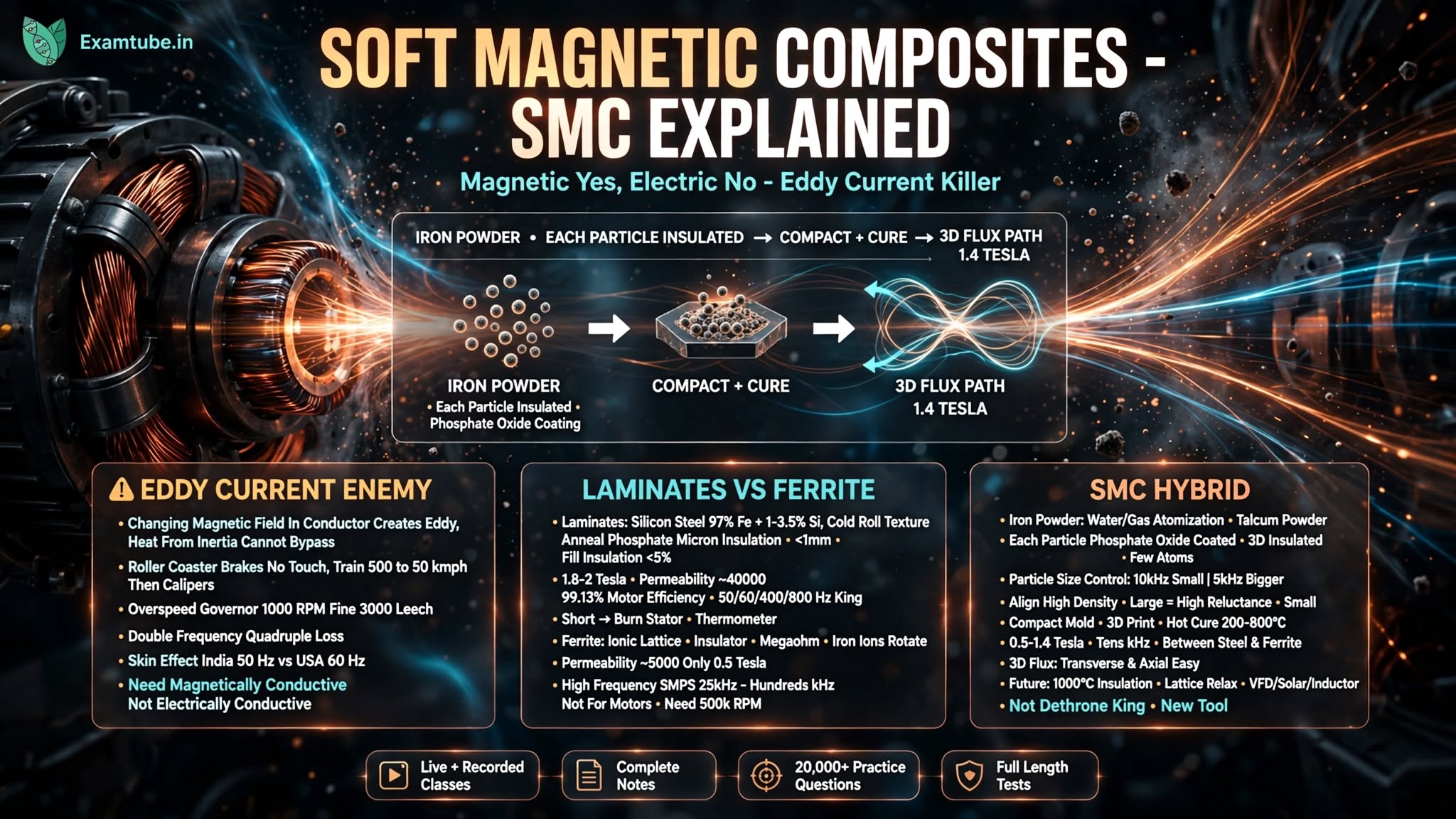
Soft Magnetic Composites SMC Explained: Eddy Currents, Laminates 1.8 Tesla, Ferrites 0.5 Tesla, SMC 1.4 Tesla And 3D Flux Motors
Understand soft magnetic composites, why eddy currents arise, and how different materials like high‑field laminates and ferrites affect moto...

Discussion
Comments
Please log in to join the discussion.
Login to commentNo comments yet. Be the first to start the discussion.