

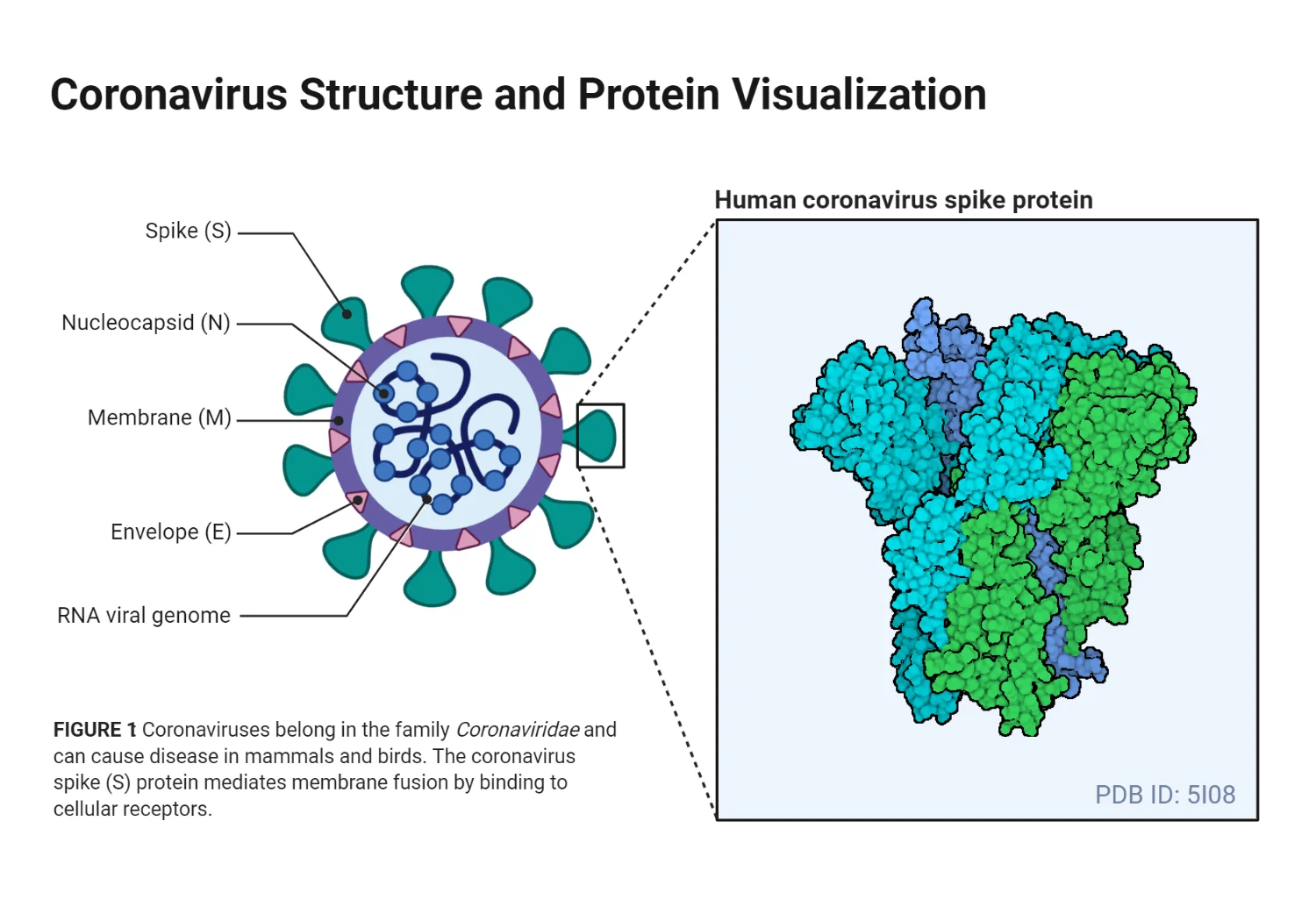
Structure of Coronavirus Coronaviruses (enveloped RNA viruses) fall in the virus family Coronaviridae, order Nidovirales. They are enveloped, 120–160 nm particles containing an unsegmented genome of single-stranded posit...
On this page
Structure of Coronavirus
- Coronaviruses (enveloped RNA viruses) fall in the virus family Coronaviridae, order Nidovirales.
- They are enveloped, 120–160 nm particles containing an unsegmented genome of single-stranded positive-sense RNA (27–32 kb).
- The large plus-stranded RNA genome associates with the N protein (nucleocapsid protein) to form a helical nucleocapsid, 9–11 nm in diameter.
- Spike projections: 20 nm long, club- or petal-shaped, widely spaced on the envelope, giving a “solar corona” appearance.
- Viral structural proteins:
- Nucleocapsid (N) protein (50–60 kDa, phosphorylated)
- Membrane (M) glycoprotein (20–35 kDa, matrix protein, interacts with nucleocapsid)
- Spike (S) glycoprotein (180–220 kDa, forms petal-shaped peplomers)
- Some viruses (e.g., HCoV-OC43) also have HE glycoprotein (65 kDa) causing hemagglutination (clumping of red blood cells) and possessing acetylesterase activity.
Genome of Coronavirus
- Coronavirus genomes are monopartite, single-stranded, positive-sense, polyadenylated, and capped RNAs of 27–32 kb.
- The 5′ end (~20–22 kb) carries the replicase gene, encoding multiple enzymatic activities.
- Replicase gene products: encoded within ORFs 1a and 1b (open reading frames).
- Order of structural genes: Pol-S-E-M-N (Polymerase, Spike, Envelope, Membrane, Nucleocapsid).
- Additional ORFs encode 2–4 nonstructural proteins of unknown function.
- Intergenic sequence (IS): ~7 bases at the 5′ end of each gene, essential for subgenomic RNA formation.
- Infected cells contain overlapping subgenomic, capped, and polyadenylated mRNAs.
- Each subgenomic mRNA and genomic RNA is translated to produce only the protein encoded by the 5′ gene.

Epidemiology of Coronavirus
- Natural outbreaks of coronavirus-caused colds occur mostly in winter.
- Coronaviruses cause 15–30% of all colds.
- HCoV 229E, OC43, NL63 are found worldwide.
- Contribution of each HCoV varies yearly: e.g., 229E can account for 1%–35% of acute respiratory infections.
- Incidence fluctuates: one 3-year study showed 1%–35% infection rates.

Replication of Coronavirus
- Human infection occurs via respiratory secretions.
- Attachment: mediated by S glycoproteins binding to host cell receptors.
- Entry: fusion of viral envelope with host membrane or receptor-mediated endocytosis.
- 229E and NL63 bind aminopeptidase N and ACE-2, respectively.
- Receptors for OC43 and HKU-1 are unknown.
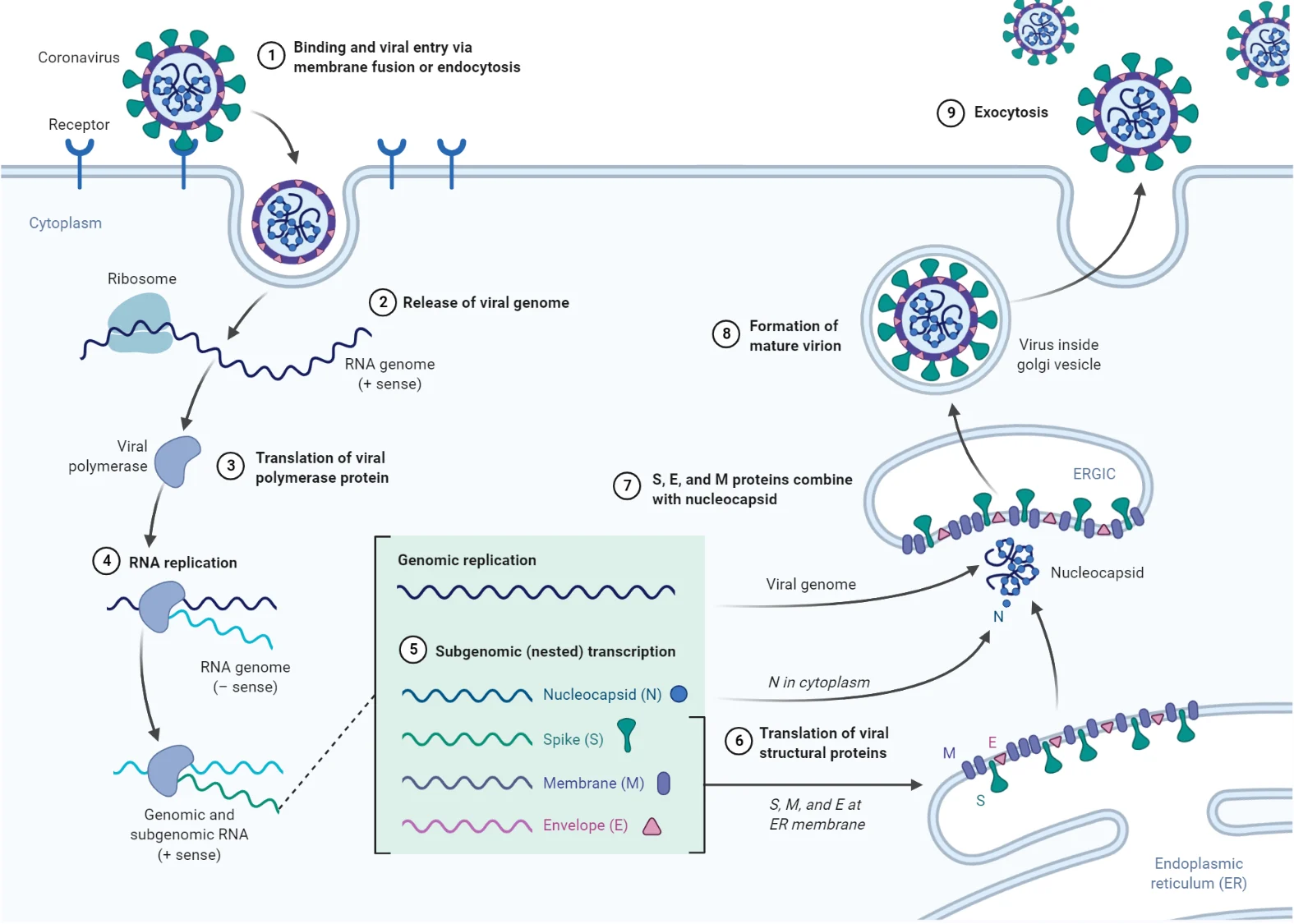
- Fusion: mediated by S2 portion of spike protein (class 1 fusion protein).
- Translation of genomic RNA → large polyprotein → processed into RNA-dependent RNA polymerase (RdRp).
- RdRp synthesizes a negative-strand RNA, template for nested set of subgenomic mRNAs.
- Translation of subgenomic mRNAs → structural proteins.
- N protein + genomic RNA → helical nucleocapsids.
- Membrane glycoprotein M: inserted into ER, anchored in Golgi apparatus.
- Nucleocapsid + M protein assemble at budding compartment (ERGIC).
- E and M proteins trigger virion budding, enclosing nucleocapsid.
Pathogenesis of Coronavirus
- Primary route of transmission: via the respiratory tract, spread by aerosols and large droplets (e.g., sneezes).
- Infection with common-cold coronaviruses causes ciliostasis (loss of ciliary action) and degenerative changes in respiratory epithelial cilia.
- Infection is usually localized to the upper respiratory tract because the optimum viral growth temperature is 33–35°C, though it may extend to the lower respiratory tract in some cases.
- HCoV-OC43 generally causes mild upper respiratory infections, but may exhibit neuroinvasive properties.
Clinical Manifestations of Coronavirus
- HCoVs in the 229E- and OC43-related serogroups cause upper respiratory symptoms in adults and children, varying in frequency and severity.
- Respiratory infections include bronchiolitis and pneumonia; gastroenteritis and neurological disorders can also occur.
- In adults, HCoVs usually cause “common colds”, often afebrile.
- Symptoms: nasal discharge, malaise, rhinorrhea, headache, chills, sore throat, cough.
- Incubation period: 2–5 days.
- Duration of symptoms: mean of 7 days (range 3–18 days).
- Immune response: rise in neutralizing and complement fixation antibodies, which wane over months.
- Lower respiratory tract involvement is rare, but pneumonia may occur.
- Asthmatic children may experience wheezing, and adults with chronic pulmonary disease may have worsened respiratory symptoms.
- HCoV-OC43 can infect neurons, potentially causing encephalitis.
Laboratory Diagnosis of Coronavirus
- Specimens: respiratory secretions, stool (for HKU1).
- Virus isolation:
- HUH7 human hepatoma cell line for OC43, 229E, HKU-1.
- LLC-MK2 and Vero B4 cells for NL63.
- Molecular detection: RT-PCR for viral RNA.
- Electron microscopy (EM): detection in negatively stained stool for enteric coronaviruses.
- Serology: complement fixation, ELISA, immunofluorescence, or virus neutralization tests.
- Passive hemagglutination test: detects antibodies to strain 229E.
- Hemagglutination and acetyl esterase assays: detect HCoV-OC43 virions expressing HE glycoprotein.
Treatment of Coronavirus
- No proven antiviral treatment.
- No vaccine currently available for human coronaviruses.
Prevention and Control of Coronavirus
- Frequent handwashing with soap and water.
- Avoid touching eyes, nose, or mouth with unwashed hands.
- Avoid close contact with sick individuals.
- Cover mouth and nose with a tissue when coughing or sneezing; dispose of the tissue properly and wash hands afterward.
Related posts
More guides connected to this topic

SARS-CoV-2 Coronavirus: Structure, Genome, Proteins, Replication, Pathogenesis, and Host Interaction
Coronavirus Overview Coronaviruses (CoVs) are enveloped viruses (surrounded by a lipid membrane derived from host cells), belonging to the s...

Cucumber Mosaic Virus (CMV): Structure, Genome, Symptoms, Disease Cycle and Management
Cucumber Mosaic Virus (CMV): Introduction and Importance Cucumber Mosaic Virus (CMV) (plant-infecting RNA virus) is one of the most economic...

Zoonotic Spillover in Bats: Causes, Consequences, and Future Preparedness
Bats: General Characteristics and Classification Bats are small mammals capable of true sustained flight. They belong to the second-largest...