
On this page
- Most of the things are made up of compounds of carbon.
- When a carbon compound is burnt, CO2 & water are produced. The presence of CO2 can be confirmed by passing it through lime water which turns milky.
- All living structures and many non-living structures such as food, clothes, medicines, books etc. are carbon-based.
- Earth’s crust has only 0.02% carbon (as minerals like carbonates, hydrogen carbonates, petroleum, coal etc.). The atmosphere has 0.03% CO2. But carbon has immense importance.
BONDING IN CARBON – THE COVALENT BOND
Carbon compounds are poor conductors of electricity. So the bonding does not form ions. They have low melting & boiling points as compared to ionic compounds.
| Carbon Compounds | Melting point (K) | Boiling point (K) |
|---|---|---|
| Acetic acid (CH3COOH) | 290 | 391 |
| Chloroform (CHCl3) | 209 | 334 |
| Ethanol (CH3CH2OH) | 156 | 351 |
| Methane (CH4) | 90 | 111 |
- Atomic number (Z) of Carbon = 6.
- Electronic configuration = 2, 4 (1s2 2s2 2p2).
- Carbon has 4 electrons in the outermost shell. Gaining or losing 4 electrons is not possible to attain noble gas configuration because:
- Gaining 4 electrons (C4– anion) makes it difficult to hold 6 protons and 10 electrons.
- Losing 4 electrons (C4+ cation) needs high energy to leave 6 protons and two electrons.
- This problem is overcome by sharing valence electrons with other atoms of carbon or other elements. Thus both atoms attain noble gas configuration.
- The simplest molecule formed by the sharing of valence electrons is that of hydrogen (Z= 1). It has one electron in K shell and needs one more electron to fill the K shell. So two hydrogen atoms share their electrons to form a hydrogen molecule (H2) and attain the nearest noble gas (helium - 2 electrons in K shell) configuration.
- To represent valence electrons, dots or crosses are used.
- The shared pair of electrons constitute a covalent bond between 2 hydrogen atoms. It is represented by a line.

Electron dot structure of Chlorine:

Atomic number = 17.
Electronic configuration = 2, 8, 7 (7 electrons in valence shell). It forms a diatomic molecule (Cl2).
Electron dot structure of Oxygen:
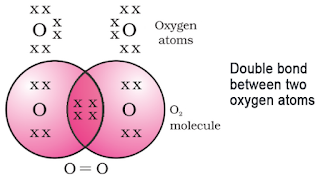
Atomic number = 8. It has 6 electrons in L shell.
It requires two more electrons to complete its octet.
So the oxygen atom shares 2 electrons with another oxygen atom forming a double bond.
Electron dot structure for water (H2O):

H – O – H
Electron dot structure of Nitrogen:

Atomic number = 7. Electronic configuration = 2, 5.
It forms a diatomic molecule (N2).
To attain an octet, each nitrogen atom in a nitrogen molecule contributes 3 electrons forming a triple bond.
Electron dot structure for methane (CH4):

- Methane is one of the simplest compounds of carbon.
- It is used as a fuel and is a major component of biogas and Compressed Natural Gas (CNG).
- Valency of Hydrogen = 1.
- Valency of Carbon = 4.
- Carbon shares these electrons with 4 hydrogen atoms to get a noble gas configuration.
- The bonds formed by sharing of an electron pair between two atoms are called covalent bonds.
- Covalently bonded molecules have strong bonds within the molecule, but intermolecular forces are weak. This gives rise to the low melting & boiling points.
- Since the electrons are shared between atoms and no charged particles are formed, covalent compounds are generally poor conductors of electricity.
Allotropes (different forms) of carbon
- E.g. Diamond, Graphite & Fullerenes.
- In diamond, each carbon atom is bonded to four other carbon atoms forming a rigid three-dimensional structure.
- In graphite, each carbon atom is bonded to three other carbon atoms in the same plane giving a hexagonal array. One bond is a double-bond to satisfy valency. Hexagonal arrays are placed in layers one above the other.
- Diamond & Graphite have different physical properties but same chemical properties.
- Diamond is the hardest substance. Graphite is smooth and slippery and a very good conductor of electricity.
- Synthetic diamonds can be produced by subjecting pure carbon to very high pressure and temperature. These are small but indistinguishable from natural diamonds.
- Fullerenes: The first identified one was C-60 which has carbon atoms arranged as a football. This looked like the geodesic dome designed by US architect Buckminster Fuller. So it was named fullerene.


VERSATILE NATURE OF CARBON
Carbon has two unique properties called Catenation & Tetravalency, enabling it to form millions of compounds, outnumbering compounds formed by all other elements combined.
1. Catenation
- It is the ability of carbon to form bonds with other carbon atoms, creating large molecules.
- They may be long chains, branched chains or ring forms.
- No other element exhibits catenation like carbon. Silicon forms compounds with hydrogen which have chains of up to 7 or 8 atoms, but these are very reactive. Carbon-carbon bond is very strong & stable. This gives large number of compounds.
2. Tetravalency
- Carbon can bond with four other atoms of carbon or some other monovalent elements.
- Carbon compounds are formed with oxygen, hydrogen, nitrogen, sulphur, chlorine etc. giving specific properties.
- Carbon atom is small sized. So the nucleus can hold the shared pairs of electrons strongly. So carbon can make very stable compounds with other elements. The bonds formed by elements having bigger atoms are weaker.
Saturated and Unsaturated Carbon Compounds
Saturated Compounds
Contain only single bonds between carbon atoms; less reactive.
- Example: Ethane (C2H6)
Structure: 
- Example: Propane (C3H8)
Structure: 
Unsaturated Compounds
Contain double or triple bonds between carbon atoms; more reactive.
- Example: Ethene (C2H4)
It needs double bond to satisfy the valency.

- Ethyne (C2H2)
It has triple bond between carbon atoms to satisfy the valency (H – C ≡ C – H).
Electron Dot Structure: 
Chains, Branches, and Rings
Chains
Contain multiple carbon atoms.
| No. of C atoms | Name | Formula | Structure |
|---|---|---|---|
| 1 | Methane | CH4 | [Structure Image] |
| 2 | Ethane | C2H6 | [Structure Image] |
| 3 | Propane | C3H8 | [Structure Image] |
| 4 | Butane | C4H10 | [Structure Image] |
| 5 | Pentane | C5H12 | [Structure Image] |
| 6 | Hexane | C6H14 | [Structure Image] |
Isomers
Compounds with the same molecular formula but different structures (e.g., C4H10 has two forms: n-butane and isobutane).
- Structures:

Rings
Carbon atoms arranged in a ring.
- Example: Cyclohexane (C6H12)
- Structure:

- Example: Benzene (C6H6) (unsaturated cyclic compound)
- Structure:

Hydrocarbons
Compounds containing only carbon and hydrogen.
- Alkanes: Saturated hydrocarbons (single bonds, CnH2n+2).
- Alkenes: Unsaturated hydrocarbons with one or more double bonds (CnH2n).
- Alkynes: Unsaturated hydrocarbons with one or more triple bonds (CnH2n-2).
Will You Be My Friend?
Carbon bonds with elements like halogens, oxygen, nitrogen, and sulphur.
- Heteroatoms: Elements replacing hydrogen in a hydrocarbon chain.
- Functional Groups: Heteroatoms or groups that impart specific properties to the compound, attached to the carbon chain via free valency.
- Some functional groups in carbon compounds:

Homologous Series
It is a series of compounds with the same functional group, differing by a –CH2– unit.
Examples
- Alkanes: CH4, C2H6, C3H8, C4H10 (differ by –CH2–, 14 u mass difference).
General formula: CnH2n+2
- Alkenes: C2H4, C3H6, C4H8 (differ by –CH2–).
General formula: CnH2n
- Alkynes: C2H2, C3H4, C4H6 (differ by –CH2–).
General formula: CnH2n-2
- Alcohols: CH3OH, C2H5OH, C3H7OH, C4H9OH (differ by –CH2–, 14 u mass difference).
| Compounds | Difference in Formula | Difference in Molecular Mass |
|---|---|---|
| CH3OH & C2H5OH | –CH2– | 14 U |
| C2H5OH & C3H7OH | –CH2– | 14 U |
| C3H7OH & C4H9OH | –CH2– | 14 U |
| C4H9OH & C5H11OH | –CH2– | 14 U |
As the molecular mass increases, physical properties such as melting & boiling points, solubility in solvent etc. also increase. But chemical properties remain similar.
Nomenclature of Carbon Compounds
Method:
- Identify the number of carbon atoms (e.g., three carbons = propane).
- Indicate the functional group with a prefix or suffix.
- If the suffix starts with a vowel, remove the final ‘e’ from the carbon chain name (e.g., propane + ketone = propan +>
- For unsaturated compounds, replace ‘ane’ with ‘ene’ (double bond) or ‘yne’ (triple bond) (e.g., propene, propyne).

CHEMICAL PROPERTIES OF CARBON COMPOUNDS
Combustion
- Carbon (in all allotropic forms) and most carbon compounds burn in oxygen to give CO2, releasing heat and light. These are oxidation reactions.
- Saturated hydrocarbons generally give a clean flame.
- Unsaturated carbon compounds give a yellow flame with black smoke or sooty deposit (carbon). E.g. Camphor and Naphthalene are unsaturated hydrocarbons. So they burn with a yellow flame and leave residues.
- Alcohol is saturated and burns with a clean blue flame.
- Light a Bunsen burner and adjust the air hole at the base to get different types of flames/presence of smoke.
- If there is no sufficient supply of air, it results in incomplete combustion of even saturated hydrocarbons, giving a yellow, sooty flame. In the presence of a sufficient supply of air with oxygen, it gives a blue flame.
- The gas/kerosene stove has inlets for a sufficient supply of air, the fuel is burnt to give a clean blue flame.
- Blackening of the bottom of a cooking vessel indicates that the air holes are blocked, and fuel is getting wasted.
- Coal and petroleum have some nitrogen and sulphur. Their combustion forms oxides of sulphur and nitrogen, which are major air pollutants.
Why do substances burn with or without a flame?
A flame is produced only when gaseous substances burn. So a candle or LPG burns with a flame.
Wood, coal, or charcoal burn with a flame at first due to the volatile substances in them. After that, they just glow red and give out heat.
Atoms of gas substances are heated and glow to produce a flame. Each element produces a characteristic colour. E.g., heating a copper wire in a flame gives a bluish-green flame.
The yellow colour of a candle flame is due to the incomplete combustion of carbon particles. When light falls on them, they scatter yellow colour.
Formation of coal and petroleum (fossil fuels)
Fossil fuels were formed from biomass by biological and geological processes.
Millions of years ago, trees, ferns, and other plants were crushed into the earth due to earthquakes or volcanic eruptions. They were pressed down by layers of earth and rock. They slowly decayed into coal.
Dead marine tiny plants and animals sank to the seabed and were covered by silt. Due to bacterial action, they turned into oil and gas under high pressure. The silt was compressed into rock. The oil and gas seeped into porous rock parts and got trapped like water in a sponge.
Oxidation
- Carbon compounds are easily oxidized on combustion.
- Alcohols can be oxidized to carboxylic acids. Here, oxidizing agents like alkaline potassium permanganate (KMnO4) or acidified potassium dichromate (K2Cr2O7) are used. (oxidizing agents: The substances that can add oxygen to others).
- E.g., Take 3 mL ethanol in a test tube and warm gently in a water bath. Add a 5% solution of alkaline KMnO4 drop by drop. The purple colour of KMnO4 disappears initially.
- When more KMnO4 is added, the colour persists because all the alcohol gets consumed, and the reaction stops.

Addition Reaction
- Unsaturated hydrocarbons add hydrogen in the presence of catalysts such as palladium or nickel to give saturated hydrocarbons. (Catalysts: The substances that influence the rate of a reaction without changing themselves).
- This reaction is commonly used in the hydrogenation of vegetable oils using a nickel catalyst.

- Vegetable oils generally have long unsaturated carbon chains (fatty acids). So they are healthy.
- Animal fats generally contain saturated fatty acids, which are harmful to health.
Substitution Reaction
- Saturated hydrocarbons are unreactive and inert in the presence of most reagents.
- However, in the presence of sunlight, hydrocarbons undergo a substitution reaction very fast. E.g.
- Here, chlorine replaces the hydrogen atoms one by one.
- Higher homologues of alkanes can form many products.
ETHANOL
Properties of Ethanol
- Ethanol is a liquid at room temperature.
- It is commonly called alcohol and is the active ingredient of all alcoholic drinks.
- It is a good solvent. So it is used in medicines such as tincture iodine, cough syrups, and tonics.
- Ethanol is soluble in water in all proportions.
- Consumption of small quantities of dilute ethanol causes drunkenness. Intake of even a small quantity of pure ethanol (absolute alcohol) is lethal. Long-term intake leads to many health problems.
- Ethanol for industrial use is made unfit for drinking by adding methanol. It is called denatured alcohol. Blue dyes are added to alcohol to identify it easily.
- Some countries use alcohol as an additive in petrol since it is a cleaner fuel. It releases only CO2 and water.
Reactions of Ethanol
-
a. Reaction with Sodium
Alcohols react with sodium, evolving hydrogen. E.g., Drop a small piece of sodium into pure ethanol. It produces sodium ethoxide (2CH3CH2O–Na+) and H2.
-
b. Reaction to Give Unsaturated Hydrocarbon
Heating ethanol at 443 K with excess concentrated H2SO4 results in dehydration of ethanol to give ethene. Concentrated H2SO4 is a dehydrating agent (removes water from ethanol).

ETHANOIC ACID
Properties of Ethanoic Acid (Acetic Acid)
- It belongs to carboxylic acids (weak acids).
- A 5-8% solution of acetic acid in water is called vinegar. It is used as a preservative in pickles.
- The melting point of pure ethanoic acid is 290 K, and hence it often freezes during winter. So it is known as glacial acetic acid.
- Acetic acid is a weak acid, while HCl is a strong acid.
Reactions of Ethanoic Acid
a. Esterification Reaction
- It is the formation of esters by the reaction of an acid and an alcohol.
- E.g., Take 1 mL absolute ethanol + 1 mL glacial acetic acid + a few drops of concentrated H2SO4 in a test tube.
- Warm in a water bath for 5 minutes.

- Pour into a beaker containing 20-50 mL of water. The resulting mixture is an ester.
- Here, ethanoic acid reacts with ethanol in the presence of an acid catalyst to give an ester.
- Esters have a sweet smell.
- Uses of esters: To make perfumes and as flavouring agents.
- On treating with NaOH (an alkali), the ester is converted back to alcohol and the sodium salt of carboxylic acid. This reaction is called saponification because it is used in the preparation of soap.

b. Reaction with a Base
Ethanoic acid reacts with a base like NaOH to give a salt (sodium ethanoate or sodium acetate) and water.
c. Reaction with Carbonates & Hydrogen Carbonates
Take a spatula full of sodium carbonate in a test tube and add 2 mL dilute ethanoic acid. The following reaction occurs:
Pass the gas produced through lime-water. Lime-water turns milky, indicating that the gas is CO2.
Reaction with sodium hydrogen carbonate:
SOAPS AND DETERGENTS
Soap and Cleaning Action
- Take 10 mL of water each in two test tubes A and B.
- Add a drop of cooking oil to both test tubes.
- To test tube B, add a few drops of soap solution.
- Shake test tubes vigorously to get unclear mixtures.
- Leave the test tubes undisturbed for some time. The oil layer separates out in both test tubes, but this happens first in test tube A.
- This activity demonstrates the effect of soap in cleaning.
Most dirt is oily and does not dissolve in water.
Soap molecules are sodium or potassium salts of long-chain carboxylic acids.
The ionic-end (hydrophilic) of soap interacts with water, while the carbon chain (hydrophobic tail) interacts with oil. The soap molecules thus form structures called micelles. In this, one end of the molecules is towards the oil droplet, and the ionic-end faces outside. It forms an emulsion in water. The soap micelle thus helps in pulling out the dirt in water, and clothes become clean.


Effect of Soap in Cleaning
At the surface of water, soap aligns such that its ionic end is in water and the hydrocarbon tail protrudes out of water.
Inside water, these molecules form clusters in which the hydrophobic tails are oriented towards the interior and the ionic ends towards the exterior. This cluster is called a micelle.
The oily dirt is collected in the center of the micelle. The micelles stay as a colloid and will not come together to precipitate because of ion-ion repulsion. So, the dirt in micelles is easily rinsed away.
The soap micelles are large enough to scatter light. Hence, a soap solution appears cloudy.
Hard Water and Soap
Water containing sulphates, chlorides, or hydrogen carbonates of calcium or magnesium is called hard water. E.g., water from a tube well or hand-pump.
It is difficult to produce foam with soaps in hard water. So bathing and washing become difficult. After washing, an insoluble substance (scum) remains in hard water. It can be demonstrated by the following experiment:
- Take 10 mL distilled water (or rainwater) and 10 mL hard water in separate test tubes (hard water can be prepared by dissolving salts of Ca or Mg in water).
- Add a few drops of soap solution to both and shake well for the same period.
- The test tube with distilled water gets more foam.
- The test tube with hard water gets a white curdy precipitate.
This scum or precipitate is caused by the reaction of soap with the calcium and magnesium salts.
Detergents
Detergents are sodium salts of sulphonic acids or ammonium salts with chlorides or bromides ions, etc.
Both have long hydrocarbon chains. The charged ends of these compounds do not form insoluble precipitates with Ca and Mg ions. Thus, they are also effective in hard water.
It can be demonstrated by the following experiment:
- Take two test tubes with 10 mL hard water in each.
- Add five drops of soap solution to one and five drops of detergent solution to the other.
- Shake both test tubes for the same period.
- The test tube with detergent gets more foam.
- In the test tube with soap, a curdy precipitate is formed.
Detergents are used to make shampoos and products to clean clothes.
Discussion
Comments
Please log in to join the discussion.
Login to commentNo comments yet. Be the first to start the discussion.