
On this page
- Economic development is linked to environmental conservation. Thus, sustainable development implies a change in all aspects of life.
- Overexploitation of natural resources leads to various environmental problems. E.g., Ganga Action Plan (1985) came about due to the very poor water quality in the Ganga. Presence of Coliform bacteria (found in human intestines) in water indicates contamination.

- Reasons for Pollution of the Ganga
- Garbage, sewage, and excreta from a hundred towns and cities in Uttar Pradesh, Bihar, and West Bengal.
- Human activities such as bathing, washing of clothes, and immersion of ashes or unburnt corpses.
- Chemical effluents from industries.
- Namami Gange Programme: An Integrated Conservation Mission approved by the Union Government in June 2014. It has two objectives: (i) effective abatement of pollution; (ii) conservation and rejuvenation of River Ganga.
- National Mission for Clean Ganga: An implementation wing set up in October 2015.
The Five R’s to Save the Environment
- Refuse: Say no to unused things. Refuse products that harm the environment. Avoid single-use plastic carry bags.
- Reduce: Use less. E.g., switch off unnecessary lights and fans to save electricity, repair leaky taps to save water, do not waste food.
- Reuse: Use things again and again. E.g., reverse used envelopes to use again. Plastic bottles can be used to store things. This is better than recycling because the recycling process uses some energy.
- Repurpose: If a product can no longer be used for its original purpose, use it for another purpose. E.g., cracked crockery or cups with broken handles can be used to grow plants and as feeding vessels for birds.
- Recycle: Collect plastic, paper, glass, and metal items and recycle them to make new things instead of creating fresh ones. To recycle, wastes need to be segregated so that recyclable material is not dumped with other wastes.
Why Do We Need to Manage Our Resources?
- Resources, except solar energy, are obtained from Earth, but these are not unlimited. With the increase in human population, the demand for resources also increases.
- Importance of management of natural resources:
- For sustainable use of resources for the next generation.
- To ensure equitable distribution of resources.
- Safe disposal of waste. E.g., mining causes pollution because of the large amount of slag.
- Principles of conservation and sustainable management were well established in pre-historic India. E.g., cultural landscapes such as sacred forests and groves, sacred corridors, and ethno-forestry practices.
FORESTS AND WILDLIFE
- Forests are biodiversity hotspots. Biodiversity of an area is measured based on the number of species and the range of different life forms.
Stakeholders
- Stakeholders of forests include:
- Local people living in or around forests.
- The Forest Department of the Government which owns the land and controls resources from forests.
- Industrialists who use various forest produce. E.g., bidi makers use tendu leaves, laborers in paper mills.
- Wildlife & nature enthusiasts who want to conserve nature in its pristine form.
- Local people depend on forest produce such as:
- Firewood, small timber, and thatch.
- Bamboo to make slats (for huts) and baskets.
- Wood to make implements for agriculture, fishing, and hunting. Forests are also sites for fishing and hunting.
- Fruits, nuts, and medicines.
- Cattle graze in forests or feed on fodder from forests.
- Before the British came, people in forests used resources in a sustainable manner. After British control, forests were overexploited, and local people were forced to depend on much smaller areas.
- After independence, the Forest Department took over control, but local knowledge and needs were ignored. Huge forest areas were cleared for monocultures of pine, teak, or eucalyptus, causing loss of biodiversity.
- Industries such as timber, paper, lac, and sports equipment are based on forest produce. Industries view forests as a source of raw material, often lobbying for low rates. They are less interested in sustainability, as they can source materials from other areas if local resources are depleted.
- Nature & wildlife enthusiasts are conservationists but not dependent on forests. Initially focused on large animals like lions, tigers, elephants, and rhinoceros, they now recognize the need to preserve biodiversity as a whole.
- Local people traditionally work for conservation. E.g., the Bishnoi community in western Rajasthan conserves flora and fauna, believing all living things have a right to survive and share resources.
- The Government of India instituted the Amrita Devi Bishnoi National Award for Wildlife Conservation in memory of Amrita Devi Bishnoi, who, in 1731, sacrificed her life along with 363 others to protect khejri trees in Khejrali village, Rajasthan.
- The prejudice against traditional forest use has no basis. E.g., in the Great Himalayan National Park, alpine meadows were grazed by sheep in summer. When grazing was banned after the park’s formation, tall grass fell over, preventing fresh growth.
- Management of protected areas without local people is unsuccessful. Deforestation is also caused by industries, development, and tourism, not just local people.
- Use of forest resources should be environmentally and developmentally sound, with benefits of controlled exploitation going to local people. Decentralized economic growth and ecological conservation should go hand in hand.
- The environment is not just a pristine collection of plants and animals but offers a range of natural resources that must be used carefully for economic and social growth and to meet material aspirations.
Management of Forest
- Forest resources are available to industries at very low rates but are often denied to local people.
- The Chipko Andolan (‘Hug the Trees Movement’) was an effort to end the alienation of people from their forests. Originating in the early 1970s in Reni village, Garhwal, it involved village women clasping tree trunks to prevent logging, forcing the contractor to withdraw.
- Destruction of forests reduces forest products, soil quality, and water sources. Participation of local people can efficiently manage forests. E.g., in 1972, the West Bengal Forest Department failed to revive degraded Sal forests. In the Arabari forest range, Midnapore district, forest officer A.K. Banerjee involved villagers to protect 1,272 hectares of degraded Sal forest. In return, villagers received employment in silviculture and harvesting, 25% of the final harvest, and were allowed fuelwood and fodder collection for a small payment. This led to the recovery of the Sal forests.
WATER FOR ALL
- Water is a basic need for all terrestrial forms of life.
- Besides rainfall patterns, human intervention influences water availability.
- Rainfall in India is largely due to monsoons that occur in a few months. Sustaining underground water has failed due to loss of vegetation cover, diversion for high water-demanding crops, and pollution from industrial effluents and urban wastes.
- Local people managed irrigation methods like dams, tanks, and canals for agriculture and daily needs, with strictly regulated use of stored water.
- When the British arrived, they implemented large-scale projects like large dams and canals, a practice continued after independence, neglecting local irrigation methods. The government took over administration, causing local people to lose control over water sources.
- Kulhs is a local system of canal irrigation in Himachal Pradesh. Water from streams was diverted into man-made channels to supply villages down the hillside. During planting season, water was first used by the farthest village, then progressively higher villages. Kulhs were managed by 2–3 people and also fed springs by percolating into the soil. After being taken over by the Irrigation Department, most kulhs became defunct.
Dams
- Large dams ensure storage of adequate water for irrigation and generating electricity.
- Canal systems from dams can transfer water over great distances. E.g., the Indira Gandhi Canal in Rajasthan. However, mismanagement causes unequal distribution, allowing people near the source to grow water-intensive crops like sugarcane and rice, while those downstream receive no water.
- Narmada Bachao Andolan (‘Save the Narmada Movement’) protested the height increase of the Sardar Sarovar Dam on the river Narmada.
- Criticisms of large dams address three problems:
- Social problems: Displaces many peasants and tribals without adequate compensation or rehabilitation. E.g., oustees of the Tawa Dam (1970s) still fight for promised benefits.
- Economic problems: Dams use huge public funds but yield no proportionate benefits.
- Environmental problems: Cause deforestation and loss of biodiversity.
Water Harvesting
- Watershed management emphasizes scientific soil and water conservation to increase biomass production, aiming to develop land and water resources to produce plants and animals without ecological imbalance.
- Benefits of watershed management:
- Increases production and income of the community.
- Mitigates droughts and floods.
- Increases the life of downstream dams and reservoirs.
- Various organizations rejuvenate ancient water harvesting systems as alternatives to mega-projects like dams, using methods like small pits, lakes, watershed systems, earthen dams, dykes, sand and limestone reservoirs, and rooftop water-collecting units. These recharge groundwater and revive rivers.
- Ancient water-harvesting structures still in use include khadins, tanks, and nadis in Rajasthan; bandharas and tals in Maharashtra; bundhis in Madhya Pradesh and Uttar Pradesh; ahars and pynes in Bihar; kulhs in Himachal Pradesh; ponds in the Kandi belt of Jammu; eris (tanks) in Tamil Nadu; surangams in Kerala; and kattas in Karnataka.
- Giving people control over local water resources reduces mismanagement and over-exploitation.
- In largely level terrain, water harvesting structures are crescent-shaped embankments or low, straight concrete-and-rubble “check dams” built across seasonally flooded gullies. Monsoon rains fill ponds behind these structures, primarily to recharge groundwater.
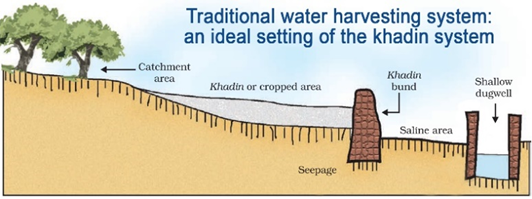
- Advantages of water stored in the ground:
- It does not evaporate but spreads out to recharge wells and provide moisture for vegetation.
- It does not provide breeding grounds for mosquitoes.
- It is relatively protected from contamination by human and animal waste.
- In two decades, Dr. Rajendra Singh (India’s “waterman”) built 8,600 johads and other structures in Rajasthan, bringing water back to 1,000 villages. In 2015, he won the Stockholm Water Prize for contributions to water resource conservation and protection.
COAL AND PETROLEUM (FOSSIL FUELS)
- Coal and petroleum, formed from degraded biomass millions of years ago, are exhaustible resources. Petroleum is estimated to last about 40 years, and coal about 200 years, necessitating alternate sources.
- Fossil fuels contain carbon, hydrogen, nitrogen, and sulphur. Burning them produces CO2, water, oxides of nitrogen, and oxides of sulphur. In insufficient oxygen, carbon monoxide (CO) forms. Oxides of sulphur, nitrogen, and CO are poisonous at high concentrations, and CO2 is a greenhouse gas causing global warming. These resources must be used judiciously.
- Management of coal and petroleum focuses on machine efficiency. Fuel is commonly used in internal combustion engines for transportation. Recent research aims for complete combustion to increase efficiency and reduce air pollution.
AN OVERVIEW OF NATURAL RESOURCE MANAGEMENT
- Sustainable management of natural resources is challenging, requiring consideration of various stakeholders’ interests. Selfish goals lead to misery for many and environmental destruction.
- Beyond laws and regulations, we must tailor requirements to ensure development benefits reach everyone now and for future generations.

Discussion
Comments
Please log in to join the discussion.
Login to commentNo comments yet. Be the first to start the discussion.