
On this page
- Acids, bases, and salts are used in our daily life.
- Sour and bitter tastes of food are due to the presence of acids and bases. Acids are sour in taste, and bases are bitter.
- Natural and synthetic acid–base indicators are used to test whether a substance is an acid or a base.
Natural Indicators
- Litmus
- Red cabbage leaves
- Turmeric
- Coloured petals of some flowers (Hydrangea, Petunia, Geranium)
Litmus Solution
- Litmus solution is a purple dye extracted from lichen (a plant under division Thallophyta). When neutral, its colour is purple.
- Acids change the colour of blue litmus to red, while bases change red litmus to blue.
- A stain of curry on a white cloth turns reddish-brown when soap (basic) is rubbed on it because the curry contains the natural indicator turmeric. If washed with water, it turns yellow again.
Synthetic Indicators
- Methyl orange
- Phenolphthalein
UNDERSTANDING THE CHEMICAL PROPERTIES OF ACIDS & BASES
Acids and Bases in the Laboratory
Put a drop of each solution given below on a watch-glass one by one and test with a drop of different indicators.
- Hydrochloric acid (HCl)
- Calcium hydroxide [Ca(OH)₂]
- Sulphuric acid (H₂SO₄)
- Potassium hydroxide (KOH)
- Nitric acid (HNO₃)
- Magnesium hydroxide [Mg(OH)₂]
- Acetic acid (CH₃COOH)
- Ammonium hydroxide (NH₄OH)
- Sodium hydroxide (NaOH)
Results:
| Sample solution | Red litmus solution | Blue litmus solution | Phenolphthalein solution | Methyl orange solution |
|---|---|---|---|---|
| HCl | No change | Red | Colourless | Pinkish red |
| H₂SO₄ | No change | Red | Colourless | Pinkish red |
| HNO₃ | No change | Red | Colourless | Pinkish red |
| CH₃COOH | No change | Red | Colourless | Pinkish red |
| NaOH | Blue | No change | Red to pink | Remains yellow |
| KOH | Blue | No change | Red to pink | Remains yellow |
| Mg(OH)₂ | Blue | No change | Red to pink | Remains yellow |
| NH₄OH | Blue | No change | Red to pink | Remains yellow |
| Ca(OH)₂ | Blue | No change | Red to pink | Remains yellow |
Olfactory Indicators
These are some substances whose odour changes in acidic or basic media. E.g. onion, clove oil, and vanilla.
Test with Onion:
- Take some finely chopped onions in a plastic bag along with some clean cloth strips. Tie up the bag tightly and leave it overnight in the fridge.
- Take two of these cloth strips and check their odour.
- Put a few drops of dilute HCl solution on one strip and a few drops of dilute NaOH solution on the other.
- Rinse both cloth strips with water and again check their odour. The odour of onion cloth vanishes in NaOH. The odour remains unchanged in HCl.
Test with Vanilla Essence:
- Take some dilute HCl solution in one test tube and dilute NaOH solution in another.
- Add a few drops of dilute vanilla essence to both test tubes and shake well. The odour of vanilla essence vanishes in NaOH. The odour remains unchanged in HCl.
Test with Clove Oil:
- Repeat the same test using clove oil.
- The odour of clove oil vanishes in NaOH. The odour remains unchanged in HCl.
How do Acids & Bases React with Metals?
Reaction of Acids with Metal:
- Set the apparatus as shown in the figure.
- Take 5 mL dilute sulphuric acid in a test tube and add some zinc granules.
- Hydrogen gas bubbles form on the surface of zinc granules. Pass this gas through soap solution. Soap bubbles filled with hydrogen are formed.
- Take a burning candle near a gas-filled bubble. Hydrogen burns with a pop sound.

- Repeat this using HCl, HNO₃, and CH₃COOH.
- Bubbles come out vigorously with strong acids.
- Zinc also reacts with weak acids like acetic acid, but gas is formed slowly.
- When an acid reacts with a metal, the metal displaces hydrogen atoms from the acid as hydrogen gas and forms a compound called salt.
- However, such reactions are not possible with all metals.
How do Metal Carbonates and Metal Hydrogencarbonates React with Acids?
- Take 0.5 g of sodium carbonate (Na₂CO₃) in test tube A and 0.5 g of sodium hydrogencarbonate (NaHCO₃) in test tube B. Add 2 mL dilute HCl to both the test tubes.
- CO₂ gas is produced in both test tubes.
- Test tube A:
- Test tube B:
- Pass CO₂ through lime water (calcium hydroxide).

- On passing excess CO₂:
- Limestone, chalk, and marble are different forms of calcium carbonate. All metal carbonates and hydrogen carbonates react with acids to give corresponding salt, CO₂, and water.
How do Acids and Bases React with Each Other?
- Take 2 mL dilute NaOH solution in a test tube and add two drops of phenolphthalein solution.
- The solution becomes pink colour.
- To this, add dilute HCl solution drop by drop. The pink colour changes and disappears.
- Now add a few drops of NaOH to the above mixture. The pink colour of phenolphthalein reappears.
- The effect of a base is nullified by an acid and vice-versa.
- The reaction between an acid and a base to give a salt and water is called neutralisation reaction.
Reaction of Metallic Oxides with Acids
- Take some copper oxide (CuO) in a beaker and add dilute hydrochloric acid slowly while stirring.
- The solution becomes blue-green colour and the copper oxide dissolves. The colour is due to the formation of copper(II) chloride (CuCl₂).
- General reaction between a metal oxide and an acid is:
- Metallic oxides react with acids to give salts and water, like the reaction of a base with an acid. So metallic oxides are basic oxides.
Reaction of a Non-Metallic Oxide with Base
- Calcium hydroxide (base) reacts with carbon dioxide to produce a salt and water.
- This is similar to the reaction between a base and acid. It means non-metallic oxides are acidic in nature.
WHAT DO ALL ACIDS AND ALL BASES HAVE IN COMMON?
All acids have similar chemical properties. For example, all acids generate hydrogen gas on reacting with metals, so hydrogen seems to be common to all acids.
However, not all compounds containing hydrogen are acidic. This can be demonstrated by the following experiment:
- Take solutions of glucose, alcohol, HCl, H₂SO₄, etc.
- Fix two nails on a cork and place it in a 100 mL beaker. Connect the nails to the two terminals of a 6-volt battery through a bulb and a switch.
- Pour some dilute HCl in the beaker and switch on the current. Repeat with dilute H₂SO₄.
- In both cases, the bulb glows, indicating an electric current through the acidic solution by ions.
- Repeat the experiment using glucose and alcohol solutions. The bulb does not glow because glucose and alcohol solutions do not conduct electricity.

Acids contain H⁺ ions as cations and anions (Cl⁻ in HCl, NO₃⁻ in HNO₃, SO₄²⁻ in H₂SO₄, CH₃COO⁻ in CH₃COOH). Acidic properties are due to H⁺(aq) ions in solution.
Repeat the same activity using alkalis such as sodium hydroxide, calcium hydroxide, etc. NaOH and KOH conduct electricity as they dissociate into ions (Na⁺, K⁺, and OH⁻) when dissolved in water, generating electricity through ion movement.
What Happens to an Acid or a Base in a Water Solution?
Acids produce ions only in aqueous solution. This can be demonstrated by the following experiment:
- Take 1g solid NaCl in a clean, dry test tube.
- Add some concentrated sulphuric acid.
- HCl gas comes out of the delivery tube. [In a very humid climate, pass the HCl gas through a guard tube containing calcium chloride to dry the gas.]
- When HCl gas is tested with wet blue litmus paper, it turns red. With dry litmus paper, no colour change occurs.
- This indicates that dry HCl gas (absence of water) cannot produce H⁺ ions, so it does not behave as an acid.
- HCl solution (presence of water) can produce H⁺ ions and behaves as an acid.

- H⁺ ions cannot exist alone. They exist after combining with water molecules, forming H⁺(aq) or hydronium ion (H₃O⁺).
Action of Base with Water:
- Bases generate hydroxide (OH⁻) ions in water.
- Not all bases dissolve in water. An alkali is a base that dissolves in water. They are soapy, bitter, and corrosive. Never taste or touch them as they cause harm.
- NaOH, KOH, Mg(OH)₂, NH₄OH, etc., are alkalis.

Neutralisation Reaction:
Mixing of Acid or Base with Water:
This process is highly exothermic. For example:
- Take 10 mL water in a beaker. Add a few drops of concentrated H₂SO₄ and swirl the beaker slowly.
- Touch the base of the beaker. It is hot, indicating an exothermic reaction.
- Repeat this activity with sodium hydroxide pellets. It is also an exothermic reaction.

Mixing concentrated nitric acid or sulphuric acid with water must be done carefully. Add the acid slowly to water with constant stirring to avoid excessive local heating, which may cause the mixture to splash out and cause burns. The glass container may also break.
Mixing an acid or base with water results in a decrease in the concentration of ions (H₃O⁺/OH⁻) per unit volume. This process is called dilution, and the acid or base is said to be diluted.
HOW STRONG ARE ACID OR BASE SOLUTIONS?
- The amount of H⁺ ions present in a solution can be measured by using a universal indicator. It is a mixture of several indicators. It shows different colours at different concentrations of hydrogen ions.
- A scale for measuring H⁺ ion concentration in a solution is called pH scale (p = ‘potenz’ in German = power).
- pH is measured from 0 (very acidic) to 14 (very alkaline).
- Higher the H⁺ ion concentration, lower is the pH value.
- pH of a neutral solution is 7.
- Values less than 7 represent an acidic solution.
- Values more than 7 represent an alkaline solution.
- pH value from 7 to 14 represents an increase in OH⁻ ion concentration, i.e., increase in the strength of alkali.
- Generally, paper impregnated with the universal indicator is used for measuring pH.

pH values of various solutions:
| Solution | Colour of pH paper | Approximate pH value | Nature of substance |
|---|---|---|---|
| Saliva (before meal) | Green | 6.8 – 7.4 | Slightly acidic to basic |
| Saliva (after meal) | Yellow green | 5.8 | Acidic |
| Lemon juice | Orange | 2.2 | Acidic |
| Colourless aerated drink | Yellow | 4.0 | Acidic |
| Carrot juice | Yellow green | 6.0 | Acidic |
| Coffee | Yellow | 4.5 | Acidic |
| Tomato juice | Yellow | 4.3 | Acidic |
| Tap water | Green | 6 – 8.5 | Varied |
| 1M NaOH | Dark blue | 14 | Basic |
| 1M HCl | Red | 0 | Acidic |
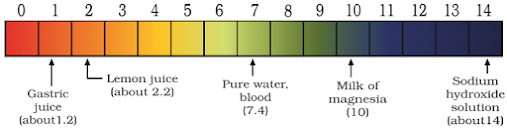
- The strength of acids and bases depends on the number of H⁺ ions and OH⁻ ions produced, respectively. For example, 1 molar hydrochloric acid and 1 molar acetic acid (same concentration) produce different amounts of H⁺ ions.
- Strong acids: Produce more H⁺ ions. E.g., HCl, H₂SO₄.
- Weak acids: Produce less H⁺ ions. E.g., CH₃COOH.
- Strong bases: Produce more OH⁻ ions. E.g., NaOH, KOH.
- Weak bases: Produce less OH⁻ ions. E.g., NH₄OH, Ca(OH)₂.
Importance of pH in Everyday Life
Plants and animals are pH sensitive. They can survive only in a narrow range of pH change.
Our body works at the pH range of 7.0 to 7.8.
When pH of rainwater is less than 5.6, it is called acid rain. When it flows into rivers, it lowers the pH of river water, adversely affecting the survival of aquatic life.
What is the pH of the soil in your backyard?
To find out the pH for healthy growth of a plant, collect the soil from various places and check their pH as given below:
- Put about 2 g soil in a test tube and add 5 mL water.
- Shake the contents of the test tube.
- Filter the contents and collect the filtrate in a test tube.
- Check the pH of filtrate using universal indicator paper.
Ideal soil pH for the growth of plants = 6 to 7.
pH in our digestive system
- The stomach produces hydrochloric acid.
- During indigestion, the stomach produces too much acid and causes pain and irritation.
- To get rid of pain, bases called antacids are used. They neutralize the excess acid. E.g., Magnesium hydroxide (Milk of magnesia), a mild base.
pH change as the cause of tooth decay
- Tooth enamel is made up of calcium hydroxyapatite (a crystalline form of calcium phosphate). It is the hardest substance in the body and does not dissolve in water.
- Bacteria in the mouth produce acids by degradation of sugar and food particles. Thus, enamel is corroded at a pH below 5.5, causing tooth decay.
- Using toothpaste (basic) can neutralize the excess acid and prevent tooth decay.
Self-defence by organisms through chemical warfare
- Bee stings leave formic acid, which causes pain and irritation. Applying a mild base like baking soda on the stung area gives relief.
- Stinging hair of nettle leaves injects methanoic acid, causing burning pain. A traditional remedy is rubbing the area with the leaf of the dock plant.
Some naturally occurring acids:
| Natural source | Acid | Natural source | Acid |
|---|---|---|---|
| Vinegar | Acetic acid | Sour milk (Curd) | Lactic acid |
| Orange | Citric acid | Lemon | Citric acid |
| Tamarind | Tartaric acid | Ant sting | Methanoic acid |
| Tomato | Oxalic acid | Nettle sting | Methanoic acid |
Acids in other planets: The atmosphere of Venus is made up of thick white and yellowish clouds of sulphuric acid.
MORE ABOUT SALTS
Family of Salts
Salts having same positive or negative radicals belong to a family. E.g. NaCl & Na2SO4 belong to family of sodium salts. NaCl & KCl belong to the family of chloride salts.
| Salts & their Chemical formulae | Formed from which Acids & bases? |
|---|---|
| Potassium sulphate (K₂SO₄) | H₂SO₄ & KOH |
| Sodium sulphate (Na₂SO₄) | H₂SO₄ & NaOH |
| Calcium sulphate (CaSO₄) | H₂SO₄ & CaCO₃ |
| Magnesium sulphate (MgSO₄) | H₂SO₄ & Mg(OH)₂ |
| Copper sulphate (CuSO₄) | H₂SO₄ & Cu(OH)₂ |
| Sodium chloride (NaCl) | HCl & NaOH |
| Sodium nitrate (NaNO₃) | HNO₃ & NaOH |
| Sodium carbonate (Na₂CO₃) | H₂CO₃ & NaOH |
| Ammonium chloride (NH₄Cl) | HCl & NH₄OH |
pH of Salts
- Salts of a strong acid & a strong base are neutral (pH = 7).
- Salts of a strong acid and weak base are acidic (pH < 7).
- Salts of a strong base and weak acid are basic (pH > 7).
- pH of some salt samples (soluble in distilled water) and the acid & base used to form the salts are given below:
| Salt | pH | Acid used | Base used |
|---|---|---|---|
| Sodium chloride | 7 | HCl | NaOH |
| Potassium nitrate | 7 | HNO₃ | KOH |
| Aluminium chloride | 7 | HCl | Al(OH)₃ |
| Zinc sulphate | 7 | H₂SO₄ | Zn(OH)₂ |
| Copper sulphate | < 7 | H₂SO₄ | Cu(OH)₂ |
| Sodium acetate | > 7 | CH₃COOH | NaOH |
| Sodium carbonate | > 7 | H₂CO₃ | NaOH |
| Sodium hydrogen carbonate | > 7 | H₂CO₃ | NaOH |
Chemicals from Common Salt
- Common salt (sodium chloride, NaCl) is a neutral salt formed by the reaction of HCl & NaOH solution.
- NaCl is separated from seawater containing many salts.
- Deposits of large crystals of solid salt are also found in several parts. These are often brown due to impurities. This is called rock salt.
- There are beds of rock salt formed when seas of bygone ages dried up. Rock salt is mined like coal.
- Common salt is used in food. It is also a raw material to make sodium hydroxide, baking soda, washing soda, bleaching powder etc.
1. Sodium hydroxide (NaOH)
- When electricity is passed through an aqueous solution of sodium chloride (brine), it decomposes to form sodium hydroxide. It is called the chlor-alkali process because of the products formed– chlor for chlorine and alkali for sodium hydroxide.
- Chlorine gas is given off at the anode, and hydrogen gas at the cathode. NaOH solution is formed near the cathode.
- All three products are useful.
- Uses of NaOH: De-greasing metals, soaps & detergents, paper making, artificial fibres etc.
- Uses of Cl2: For water treatment, in swimming pools, PVC, disinfectants, CFCs, pesticides etc.
- Uses of H2: Fuels, margarine, ammonia for fertilisers.

2. Bleaching powder (CaOCl2)
- It is manufactured by using chlorine produced during the electrolysis of brine.
- Chlorine acts on dry slaked lime to give bleaching powder.
- Actual composition of CaOCl2 is quite complex.
- Uses of Bleaching powder:
- For bleaching cotton & linen in the textile industry.
- For bleaching wood pulp in paper factories.
- For bleaching washed clothes in laundry.
- As an oxidising agent in many chemical industries.
- To make drinking water free from germs.
3. Baking soda
- Chemical name: Sodium hydrogencarbonate (NaHCO3).
- It is produced using sodium chloride.

- It is a mild non-corrosive basic salt.
- When it is heated for cooking, the following reaction occurs.

- Uses of Baking soda:
- To make tasty crispy pakoras, etc.
- It is added for faster cooking.
- To make baking powder (baking soda + mild edible acid such as tartaric acid). When baking powder is heated or mixed in water, the following reaction occurs:

CO2 causes bread or cake to rise making soft and spongy.
- It is an ingredient in antacids. Being alkaline, it neutralises excess acid (acidity) in stomach.
- Used in soda-acid fire extinguishers.
4. Washing soda (Na2CO3.10H2O)
- A basic salt obtained from NaCl.
- Recrystallisation of sodium carbonate → washing soda.
- Uses of washing soda:
- Used in glass, soap and paper industries.
- To manufacture sodium compounds such as borax.
- Used as a cleaning agent for domestic purposes.
- For removing permanent hardness of water.
Are the Crystals of Salts really Dry?
- Heat few copper sulphate crystals in a dry boiling tube.
- Copper sulphate becomes white and some water droplets appear in the boiling tube.
- When 2-3 drops of water are added, copper sulphate crystals restore its blue colour.
- Copper sulphate crystals contain water of crystallisation. When heated the crystals, this water is removed and the salt turns white.

- Water of crystallisation is the fixed number of water molecules present in one formula unit of a salt.
- Five water molecules are present in one formula unit of hydrated copper sulphate (CuSO4.5H2O).
- Similarly, the molecule of Na2CO3.10H2O is wet.
- Gypsum is also a salt possessing water of crystallisation (CaSO4.2H2O).
Plaster of Paris
- On heating gypsum at 373 K, it loses water molecules and becomes a white powder. This is called Plaster of Paris or Calcium sulphate hemihydrate (CaSO4.½H2O).
- Plaster of Paris on mixing with water, it changes to gypsum again giving a hard solid mass.

Only half a water molecule is shown to be attached as water of crystallisation. It is written in this form because two formula units of CaSO4 share one molecule of water.
Uses of Plaster of Paris:
- Used as plaster to support fractured bones.
- To make toys and materials for decoration.
- To make surfaces smooth.
Plaster of Paris gets its name from large gypsum deposits in Montmartre in Paris.
Discussion
Comments
Please log in to join the discussion.
Login to commentNo comments yet. Be the first to start the discussion.