
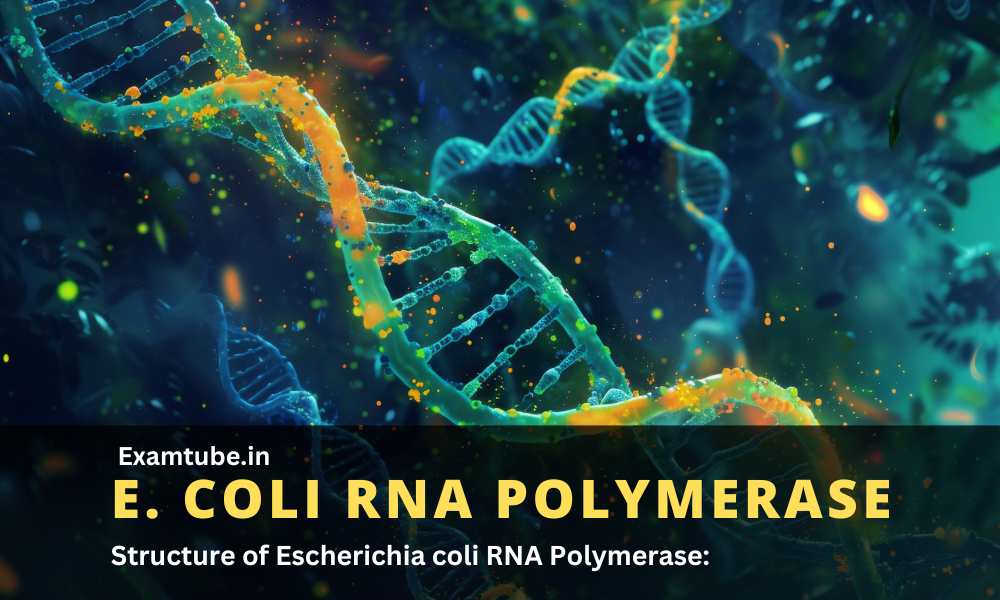
Subunits of E. coli RNA Polymerase:E. coli RNA polymerase has a unique crab claw-like shape, with a cylindrical channel that binds 16 base pairs of DNA.It covers a promoter region of about 60 base pairs, with 16 base pai...
On this page
Subunits of E. coli RNA Polymerase:
- E. coli RNA polymerase has a unique crab claw-like shape, with a cylindrical channel that binds 16 base pairs of DNA.
- It covers a promoter region of about 60 base pairs, with 16 base pairs in the active site where transcription occurs.
- The enzyme requires magnesium ions and has a transcription rate of approximately 40 nucleotides per second at 37°C.
- RNA polymerase enzymes across different organisms share a crab claw-like structure with the active site located at the base of the largest subunits, which are essential for transcription.
Subunits of E. coli RNA Polymerase:
- Beta' (B') Subunit:
- Encoded by the rpoC gene, contains the active center for RNA synthesis, and interacts with DNA and RNA.
- Binds two magnesium ions essential for catalysis and is inhibited by heparin in vitro.
- Beta (B) Subunit:
- Encoded by the rpoB gene, contains elements for interacting with DNA and RNA.
- Targeted by antibiotics like Rifampicin and Streptolydigins that inhibit different stages of transcription.
- Alpha Subunits:
- Consist of N-terminal and C-terminal domains (CTD), with roles in enzyme assembly and interactions with promoter DNA and regulatory factors.
- Can be modified by bacteriophage T4, affecting binding efficiency.
- Omega Subunit:
- Smallest subunit, crucial for the assembly and stability of the RNA polymerase complex.
- Sigma Factor:
- Associates with the core enzyme to form the holoenzyme, directing RNA polymerase to specific promoter regions for transcription initiation.
- Detaches after initiation, allowing the core enzyme to elongate the RNA transcript.
Related Facts:
- Bacterial and yeast RNA polymerases share similar structures and organization.
- Antibiotics like Actinomycin D can block transcription in both E. coli and yeast due to their structural similarities.
- Archaeal RNA polymerase is similar to both bacterial RNA polymerase and eukaryotic RNA polymerases, particularly eukaryotic RNA Polymerase II.
Related posts
More guides connected to this topic
Homologous Chromosomes: Characteristics, Significances
Chromosomes are essential components of the genetic material located in the nucleus of cells. They are thread-like structures that...
Prokaryotic and Eukaryotic RNA Polymerase
Introduction Ribonucleic Acid (RNA) Polymerase (RNAP) enzyme is a multi-subunit enzyme that applies its activity in the catalyzation of...
Eukaryotic and Prokaryotic DNA Polymerase
IntroductionDNA polymerases are a group of enzymes that are used to make copies of DNA templates, essentially used in DNA replication&n...