
On this page
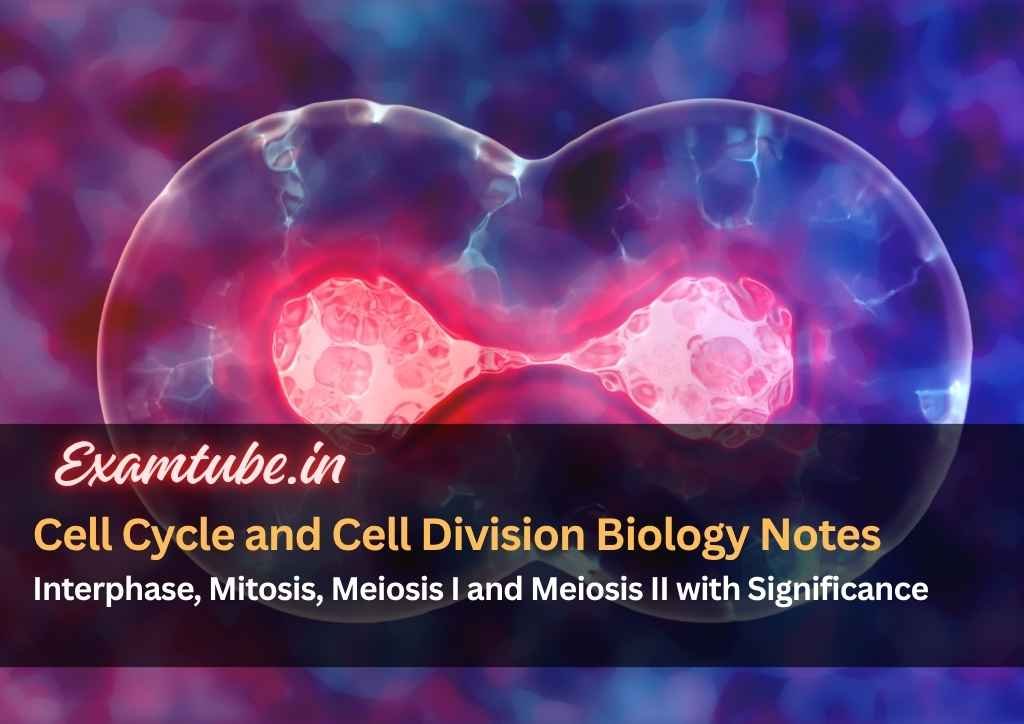
The growth and reproduction of all organisms depend on the division and enlargement of cells. The mechanisms of division and multiplication of cells together constitute cell reproduction.
Cell Cycle
It is the life period of a cell during which a cell synthesizes DNA (replication), grows, and divides into two daughter cells.
Cell growth (cytoplasmic increase) is a continuous process, but DNA synthesis occurs only at a specific stage.
Duration of the cell cycle varies by organism and cell type. For example, a typical eukaryotic cell cycle (e.g., human cell) lasts about 24 hours, while in yeasts, it is 90 minutes.
Phases of Cell Cycle
The cell cycle includes two basic phases: Interphase and M Phase.

1. Interphase (Resting Phase)
It is the phase between two successive M phases, lasting more than 95% of the cell cycle duration. It includes cell growth and DNA synthesis.
Interphase has three sub-phases:
a. G1 Phase (Gap 1 or Antephase):
- First growth phase.
- Interval between mitosis and DNA replication.
- Main events:
- Continuous cell growth.
- Cell becomes metabolically active.
- Prepares machinery for DNA replication.
- Synthesizes RNA and proteins.
b. S Phase (Synthetic):
- DNA replication occurs.
- Amount of DNA per cell doubles, but chromosome number remains unchanged.
- In animal cells, replication begins in the nucleus, and the centriole duplicates in the cytoplasm.
c. G2 Phase (Gap 2):
- Second growth phase.
- Cell growth continues.
- Synthesis of RNA and proteins continues.
- Cell prepares for mitosis.
2. M Phase (Mitosis Phase)
It represents the actual cell division (mitosis), lasting about one hour in the human cell cycle.
M Phase includes karyokinesis (nuclear division) and cytokinesis (division of cytoplasm).
Some cells, like heart cells, do not divide. Others divide occasionally to replace damaged or dead cells.
Cells that do not divide further exit G1 phase and enter an inactive stage called the quiescent stage (G0). These cells remain metabolically active but do not proliferate.
Mitosis
- It is the cell division occurring in somatic cells.
- It is also called equational division as the number of chromosomes in the parent and progeny cells is the same.
- Mitosis is generally seen in diploid cells, but it also occurs in haploid cells of some lower plants and social insects.
- It involves major reorganization of all cell components.
- The karyokinesis of mitosis has four stages: Prophase, Metaphase, Anaphase, and Telophase.

1. Prophase
- It is the longest phase in mitosis, following the S and G2 phases of interphase, where DNA molecules are intertwined.
- Characteristic events:
- Chromosomal materials (chromatin fibers) are untangled and condensed to form mitotic chromosomes, composed of two chromatids attached at the centromere.
- Centrosomes move toward opposite poles, radiating microtubules called asters. The two asters, with spindle fibers, form the mitotic apparatus.
- At the end of prophase, Golgi complexes, endoplasmic reticulum, nucleolus, and nuclear envelope disappear.
2. Metaphase
- The nuclear envelope completely disintegrates, allowing chromosomes to spread through the cytoplasm.
- Chromosome condensation is completed, making them easily observable under a microscope, each with two sister chromatids.
- Chromosomes align at the equator on the metaphase plate.
- Spindle fibers from both poles connect to chromatids via their kinetochores at the centromere.
3. Anaphase
- It is the shortest phase in mitosis.
- The centromere of each chromosome divides longitudinally, forming two daughter chromatids (future daughter nuclei chromosomes).
- As spindle fibers contract, chromatids move from the equator to opposite poles.
4. Telophase
- Chromosomes cluster at opposite poles and uncoil into chromatin fibers.
- A nuclear envelope develops around each chromosome cluster, forming two daughter nuclei.
- Nucleolus, Golgi complex, and ER reappear.
- Spindle fibers disappear.
Cytokinesis
It is the division of cytoplasm to form two daughter cells, starting during telophase.
Cytokinesis in animal cells:
- A cleavage furrow appears in the plasma membrane, gradually deepening to divide the cytoplasm into two.
Cytokinesis in plant cells:
- Due to the cell wall, vesicles from Golgi bodies accumulate at the equator, growing outward to form a cell plate, which separates the daughter cells. The cell plate becomes the middle lamella.
During cytokinesis, organelles like mitochondria and plastids are distributed between daughter cells.
In some organisms, karyokinesis without cytokinesis results in a multinucleate syncytium (e.g., liquid endosperm in coconut).
Significance of Mitosis
- Produces diploid daughter cells with identical genomes.
- Maintains the same chromosome number in somatic cells.
- Supports body growth in multicellular organisms, with mitosis in meristematic tissues enabling continuous plant growth.
- Restores the nucleo-cytoplasmic ratio disrupted by cell growth.
- Facilitates cell repair and replacement (e.g., epidermis, gut lining, blood cells).
Meiosis
- It is the division of diploid germ cells that reduces the chromosome number by half, forming haploid daughter cells (gametes).
- It occurs during gametogenesis and leads to the haploid phase in the life cycle of sexually reproducing organisms.
- Fertilization restores the diploid phase.
Key Features of Meiosis
- Involves two cycles (Meiosis I and Meiosis II) but only a single cycle of DNA replication.
- Involves pairing of homologous chromosomes and recombination between their non-sister chromatids.
- Meiosis I begins after replication of parental chromosomes to form identical sister chromatids at the S phase.
- Four haploid cells are formed at the end of Meiosis II.
| Meiosis I | Meiosis II |
|---|---|
| Prophase I | Prophase II |
| Metaphase I | Metaphase II |
| Anaphase I | Anaphase II |
| Telophase I | Telophase II |
Meiosis I
Prophase I:
It is typically longer and more complex, including five phases based on chromosomal behavior: Leptotene, Zygotene, Pachytene, Diplotene, and Diakinesis.
- a. Leptotene:
- Chromatin fibers become long, slender chromosomes.
- Nucleus enlarges.
- b. Zygotene:
- Chromosomes become more condensed.
- Similar chromosomes pair together (synapsis) via the synaptonemal complex.
- Paired chromosomes are called homologous chromosomes
- Each pair is called a bivalent.
- c. Pachytene:
- A longer phase.
- Bivalent chromosomes split into similar chromatids, forming tetrads.
- Recombination nodules appear, enabling crossing over, leading to genetic recombination.
- Crossing over: Exchange of genetic material between non-sister chromatids of homologous chromosomes, facilitated by the enzyme recombinase.
- Recombination is completed by the end of pachytene.
- d. Diplotene:
- The synaptonemal complex dissolves.
- Recombined homologous chromosomes separate except at chiasmata (X-shaped structures).
- In oocytes of some vertebrates, diplotene lasts months or years.
- e. Diakinesis:
- Terminalization of chiasmata occurs.
- Chromosomes are fully condensed.
- Meiotic spindle fibers prepare homologous chromosomes for separation.
- Nucleolus and nuclear envelope disappear.
Metaphase I:
- Spindle formation is completed.
- Chromosomes align on the equatorial plate.
- Microtubules from the spindle attach to homologous chromosome pairs.
Anaphase I:
- Homologous chromosomes separate, while sister chromatids remain associated at their centromeres.
Telophase I:
- Nuclear membrane and nucleolus reappear, forming two haploid daughter nuclei (diad).
- Cytokinesis may or may not occur.
- A short stage, interkinesis, follows without DNA replication.
Meiosis II
It resembles mitosis and includes:
Prophase II:
- Initiated after cytokinesis.
- Chromosomes become compact.
- Nucleolus and nuclear membrane disappear in both nuclei.
Metaphase II:
- Chromosomes align at the equator.
- Microtubules from opposite spindle poles attach to kinetochores of sister chromatids.
Anaphase II:
- Centromeres of each chromosome split, allowing sister chromatids to move toward opposite poles via microtubule shortening.
Telophase II:
- Chromosomes are enclosed by a nuclear envelope.
- Cytokinesis forms a tetrad of four haploid daughter cells.


Significance of Meiosis
- Conserves chromosome number of each species.
- Causes genetic variation via crossing over, important for evolution.
Related posts
More guides connected to this topic
Plant Growth and Development Biology Notes - Growth Phases, Growth Rates, Differentiation, PGRs, Photoperiodism, Vernalisation and Seed Dormancy
Read notes on plant growth and development, covering meristems, growth phases, differentiation, plant growth regulators, and photoperiodism.
Respiration in Plants Biology Notes - Glycolysis, Fermentation, Krebs Cycle, ETS and Respiratory Quotient
Clear biology notes on cellular respiration in plants, covering glycolysis, fermentation, the Krebs cycle, ETS, and respiratory quotient.
Photosynthesis in Higher Plants Biology Notes - Experiments, Light Reaction, Calvin Cycle, C3 and C4 Pathway and Factors Affecting Photosynthesis
Study photosynthesis in higher plants, including early experiments, light reactions, the Calvin cycle, C3 and C4 pathways, and key factors.
Discussion
Comments
Please log in to join the discussion.
Login to commentNo comments yet. Be the first to start the discussion.