
On this page
The Human Eye
- The eyeball is nearly spherical with a diameter of 2.3 cm.
- The eye is like a camera. It has the following main parts:
- Cornea: A thin transparent bulged membrane on the front of the eyeball. Light enters the eye through the cornea. Most of the refraction for light rays occurs at the outer surface of the cornea.
- Iris: A dark muscular diaphragm behind the cornea. It controls the size of the pupil. The pupil is an aperture to regulate the amount of light entering the eye.
- Lens: It is composed of a fibrous, jelly-like material. It forms an inverted real image of the object on the retina. It can adjust the focal length to focus objects at different distances on the retina.
- Retina: A delicate membrane with many light-sensitive cells. They get activated upon illumination and generate electrical signals (impulses). Signals are sent to the brain via optic nerves. The brain interprets the signals to perceive objects.

- When we enter from bright light to a dim light room, we cannot see objects clearly for some time. Then it becomes clear. In bright light, the iris contracts the pupil so that less light enters the eye. In dim light, the iris relaxes to expand the pupil so that more light enters.
Power of Accommodation
- It is the ability of the eye lens to adjust its focal length by changing its curvature with the help of ciliary muscles.
- When ciliary muscles relax, the lens becomes thin and its focal length increases. This enables distant vision.
- When ciliary muscles contract, the curvature of the lens increases (the lens becomes thicker). So its focal length decreases. This enables nearby vision.
- However, the focal length of the lens cannot be decreased below a minimum limit. That’s why we cannot clearly read or see an image held very close to the eyes.
- Least distance of distinct vision (near point of the eye): It is the minimum distance at which objects can be seen most distinctly without strain. It is 25 cm.
- Far point of the eye: It is the farthest point up to which the eye can see objects clearly. It is infinity.
- A normal eye can clearly see objects between 25 cm and infinity.
- The lens of some people at old age becomes milky and cloudy, causing partial or complete loss of vision. This is called cataract. It can be rectified by cataract surgery.
Advantages of Vision with Two Eyes
- It gives a wider field of view. The horizontal field of view is 150° with one eye and 180° with two eyes.
- It enhances the ability to detect faint objects.
- Some animals (e.g., prey animals) have eyes on opposite sides of the head to give the widest possible field of view.
- Human eyes are located on the front of the head. This reduces the field of view in favor of stereopsis (3-dimensional view). The eyes are located at some distance, so each eye sees a slightly different image. The brain combines these images into one, allowing us to understand whether an object is near or far.
Defects of Vision and Their Correction
- Defects of vision (refractive defects) are caused due to gradual loss of power of accommodation.
- Mainly 3 types: Myopia, Hypermetropia & Presbyopia.
(a) Myopia (Near-Sightedness)
- A person can see nearby objects clearly but cannot see distant objects distinctly.
- A myopic person has the far point nearer than infinity.
- This is caused due to the formation of an image of a distant object in front of the retina.
- Reasons:
- Excessive curvature of the lens.
- Elongation of the eyeball.
- Myopia can be corrected by using a concave lens of suitable power. It brings the image back onto the retina.

(b) Hypermetropia (Far-Sightedness)
- A person can see distant objects clearly but cannot see nearby objects distinctly.
- The near point is farther away from the normal near point (25 cm). Such a person has to keep reading material beyond 25 cm from the eye.
- This is because the light rays from a close object are focused at a point behind the retina.
- Reasons:
- Focal length of the eye lens is too long.
- Eyeball becomes too small.
- This can be corrected by using convex lens (converging lenses) of suitable power. It provides additional focusing required to form the image on the retina.

(c) Presbyopia
- The power of accommodation of the eye decreases with aging. For most people, the near point gradually recedes away. So comfortable and distinct vision of nearby objects is not possible.
- It is due to the gradual weakening of the ciliary muscles and diminishing flexibility of the eye lens.
- Some people may have both myopia & hypermetropia. They require bi-focal lenses. Its upper part is a concave lens for distant vision. The lower part is a convex lens for near vision.
- Refractive defects can also be corrected with contact lenses or through surgery.
Blindness and Eye Donation
- About 35 million people in the developing world are blind.
- About 4.5 million people with corneal blindness can be cured through corneal transplantation. Of these, 60% are children below the age of 12. So, eye donation is important.
- Eye donors can belong to any age group or sex.
- Eyes must be removed within 4-6 hours after death.
- The eye bank team removes the eyes at the home of the deceased or at a hospital. It takes only 10-15 minutes without causing any disfigurement.
- Persons who were infected with or died because of AIDS, Hepatitis B or C, rabies, acute leukemia, tetanus, cholera, meningitis, or encephalitis cannot donate eyes.
- The donated eyes unsuitable for transplantation are used for research & medical education.
- One pair of eyes gives vision to up to 4 corneal blind people.
Refraction of Light through a Prism
- A triangular glass prism has two triangular bases and three rectangular lateral surfaces. These surfaces are inclined to each other. The angle between its two lateral faces is called the angle of the prism.
Refraction of Light through a Triangular Glass Prism
- Fix a white paper on a drawing board using drawing pins. Place a glass prism on it such that it rests on its triangular base. Trace the outline of the prism.
- Draw a straight-line PE inclined to one of the refracting surfaces (AB). Fix two pins, at points P and Q, on the line PE.
- Look for the images of the pins through the other face AC.
- Fix two pins, at points R and S, such that these pins and the images of the pins at P and Q lie on the same straight line.
- Remove the pins and the glass prism.
- The line PE meets the boundary of the prism at point E. Similarly, join and produce the points R and S. Let these lines meet the boundary of the prism at E and F, respectively. Join E and F.
- Draw perpendiculars to the refracting surfaces AB and AC of the prism at points E and F, respectively.
- Mark the angle of incidence (∠i), angle of refraction (∠r), and angle of emergence (∠e).

PE – Incident ray
EF – Refracted ray
FS – Emergent ray
∠A – Angle of the prism
∠i – Angle of incidence
∠r – Angle of refraction
∠e – Angle of emergence
∠D – Angle of deviation
- A light ray is entering from air to glass at the first surface AB. The light ray, on refraction, bends towards the normal. At the second surface AC, the light ray enters from glass to air. Hence it bends away from the normal. Compare the angle of incidence and angle of refraction at each refracting surface of the prism. The peculiar shape of the prism makes the emergent ray bend at an angle to the direction of the incident ray. This angle is called the angle of deviation (∠D).
- When sunlight passes through a small hole, it gives a narrow beam of white light.
- Allow the light beam to fall on the face of a glass prism.
- The prism splits the incident white light into a band of 7 colours. They are Violet, Indigo, Blue, Green, Yellow, Orange, and Red (VIBGYOR).
- The band of the coloured components of a light beam is called its spectrum.
- The splitting of light into its component colours is called dispersion.
- Different colours of light bend at different angles with respect to the incident ray. The red light bends the least while the violet bends the most. Thus, the rays of each colour emerge along different paths and become distinct.

- Isaac Newton was the first to use a glass prism to obtain the solar spectrum. He tried to split the colours of the spectrum of white light further by using another similar prism. However, he did not get any more colours. He then placed a second identical prism in an inverted position with respect to the first prism. The colours of the spectrum passed through the second prism and emerged as a beam of white light from the other side of the second prism. Thus, Newton proposed the idea that the sunlight is made up of 7 colours.

- Any light that gives a spectrum similar to that of sunlight is referred to as white light.
- A rainbow is a natural spectrum. It is always formed in a direction opposite to the Sun. The rain water droplets in the atmosphere act like small prisms. They refract and disperse the incident sunlight, then reflect it internally. It again refracts when it comes out of the raindrop. Due to dispersion and internal reflection, different colours reach the observer’s eye.
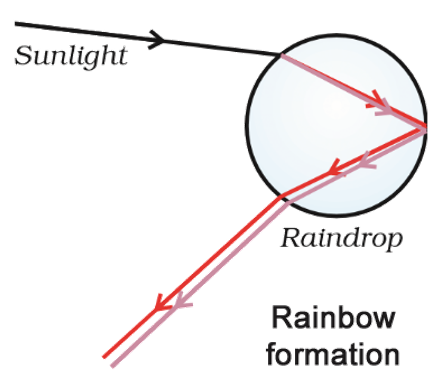
- Rainbows can also be seen when looking at the sky through a waterfall, with the Sun behind us.
Atmospheric Refraction
- If an object is observed through hot air above a fire or radiator, it shows random wavering or flickering.
- The hotter air just above the fire is lighter (less dense) than the cooler air above it. So its refractive index is slightly less than that of the cooler air.
- Here, the physical conditions of the refracting medium (air) are not stationary. So, the apparent position of the object fluctuates (wavering). It is an effect of atmospheric refraction of light.
Twinkling of Stars
- It is due to atmospheric refraction of starlight.
- When starlight enters the atmosphere, it undergoes continuous refraction. It occurs in a medium of gradually changing refractive index.
- The atmosphere bends starlight towards the normal. So, the apparent position of the star is slightly different from its actual position. The star appears slightly higher (above) than its actual position when viewed near the horizon.
- The apparent position of the star is not stationary. It keeps on changing slightly due to varying physical conditions of the atmosphere.
- The stars are very distant. So, they approximate point-sized sources of light. As the ray path of light coming from the star goes on varying slightly, the apparent position of the star fluctuates and the amount of starlight entering the eye flickers (sometimes appears brighter, some other time, fainter). It is the twinkling effect.
- The planets do not twinkle because they are very close to the Earth, and thus seen as extended sources. If a planet is considered as a collection of many point-sized sources of light, the net variation of light entering the eye will be zero. So it nullifies the twinkling effect.

Advance Sunrise and Delayed Sunset
- The Sun is visible to us about 2 minutes before the actual sunrise, and about 2 minutes after the actual sunset because of atmospheric refraction. Actual sunrise means the actual crossing of the horizon by the Sun.
- The time difference between actual sunset and the apparent sunset is about 2 minutes. The apparent flattening of the Sun’s disc at sunrise and sunset is also due to the same phenomenon.

Scattering of Light
- The path of a beam of light passing through a true solution is not visible. But it is visible through a colloidal solution due to scattering of light.
Tyndall Effect
- When a beam of light strikes particles in the atmosphere, the path of the beam becomes visible. The light reaches us, after being reflected diffusely by particles.
- The Tyndall effect is the phenomenon of scattering of light by the colloidal particles or very fine suspension. For example:
- When a beam of sunlight enters a smoke-filled room, the particles become visible due to scattering of light.
- When sunlight passes through a canopy of a dense forest, tiny water droplets in the mist scatter light.
- The colour of the scattered light depends on the size of the scattering particles. Very fine particles scatter mainly blue light while large-sized particles scatter light of longer wavelengths. If the size of particles is larger, the scattered light appears white.
Why is the colour of the clear Sky Blue?
- The size of the molecules and particles in the atmosphere is generally smaller than the wavelength of visible light. So, light of shorter wavelengths at the blue end is more scattered than light of longer wavelengths at the red end.
- The red light has a wavelength about 1.8 times greater than blue light. Thus, when sunlight passes through the atmosphere, the fine particles in air scatter the blue colour more strongly than red. The scattered blue light enters the eyes.
- If the Earth had no atmosphere, there would be no scattering. Then, the sky would have looked dark. The sky appears dark to passengers flying at very high altitudes, as there is no prominent scattering.
- Red is least scattered by fog or smoke. So, it can be seen in the same colour at a distance. Therefore, red colour is used in danger signal lights.
Colour of the Sun at Sunrise & Sunset
The blue colour of the sky and the reddish appearance of the Sun at sunrise and sunset can be understood by a demonstration using the setup given below:

- Here, white light from a strong source (S) passes in the following sequence:
White light → converging lens (L1) → formation of parallel beam of light → transparent glass tank (T) containing 2 L of clear water → circular hole (c) in a cardboard → converging lens (L2) → sharp image of the circular hole forms on a screen (MN).
- Now dissolve 200 g sodium thiosulphate (hypo) in water in the tank. Add 1 - 2 mL conc. H2SO4 to the water.
- Fine microscopic sulphur particles precipitate in 2 - 3 minutes. As a result, blue light can be observed from the three sides of the glass tank. This is due to scattering of short wavelengths by colloidal sulphur particles.
- Observe the colour of the transmitted light from the fourth side of the glass tank facing the circular hole. It is observed at first the orange red colour and then bright crimson red colour on the screen.

- Light from the Sun near the horizon passes through thicker layers of air and a larger distance in the Earth’s atmosphere. So, the blue light and shorter wavelengths are scattered away by the particles. Therefore, only the light of longer wavelengths reaches our eyes. So the Sun appears reddish.
- Light from the Sun overhead travels a relatively shorter distance. At noon, the Sun appears white as only a little of the blue and violet colours are scattered.

Discussion
Comments
Please log in to join the discussion.
Login to commentNo comments yet. Be the first to start the discussion.