
On this page
Important Terms in Genetics
- Genetics: Study of inheritance, heredity, and variation of characters, or the study of genes and chromosomes.
- Inheritance: Transmission of characters from parents to progeny. It is the basis of Heredity.
- Variation: Difference between parents and offspring.
- Character: A heritable feature among parents and offspring. E.g., eye colour.
- Trait: Variants of a character. E.g., brown eye, blue eye.
- Allele: Alternative forms of a gene. E.g., T (tall) and t (dwarf) are two alleles of a gene for the character height.
- Homozygous: The condition in which a chromosome pair carries similar alleles of a gene. Also known as pure line (true breeding). E.g., TT, tt, YY, yy, etc.
- Heterozygous: The condition in which a chromosome pair carries dissimilar alleles of a gene. E.g., Tt, Yy, etc.
- Dominant character: The character which is expressed in heterozygous condition. It is indicated with a capital letter.
- Recessive character: The character which is suppressed in heterozygous condition. It is indicated with a small letter.
- Phenotype: Physical expression of a character.
- Genotype: Genetic constitution of a character.
- Hybrid: An individual produced by the mating of genetically unlike parents.
- Punnett square: A graphical representation to calculate the probability of all genotypes of offspring in a genetic cross.
Mendel’s Laws of Inheritance
- Gregor Mendel is the Father of genetics.
- He conducted hybridization experiments on garden peas (Pisum sativum) for 7 years (1856–1863).
Steps in Making a Cross in Pea
- Selection of 2 pea plants with contrasting characters.
- Emasculation: Removal of anthers of one plant to avoid self-pollination. This is the female parent.
- Pollination: Collection of pollen grains from the male parent and transferring to the female parent.
- Collection & germination of seeds to produce offspring.
Mendel’s Selected Seven Pairs of True Breeding Pea Varieties
- 1. Stem height:
- Dominant: Tall
- Recessive: Dwarf
- 2. Flower colour:
- Dominant: Violet
- Recessive: White
- 3. Flower position:
- Dominant: Axial
- Recessive: Terminal
- 4. Pod shape:
- Dominant: Inflated
- Recessive: Constricted
- 5. Pod colour:
- Dominant: Green
- Recessive: Yellow
- 6. Seed shape:
- Dominant: Round
- Recessive: Wrinkled
- 7. Seed colour:
- Dominant: Yellow
- Recessive: Green

Inheritance of One Gene
Monohybrid Cross
- A cross involving 2 plants differing in one character pair. E.g., Mendel crossed tall and dwarf pea plants to study the inheritance of one gene.

Monohybrid Phenotypic and Genotypic Ratios
- Monohybrid phenotypic ratio: 3 Tall : 1 Dwarf = 3:1
- Monohybrid genotypic ratio:
- 1 Homozygous tall (TT)
- 2 Heterozygous tall (Tt)
- 1 Homozygous dwarf (tt)
- = 1:2:1
- Mendel made similar observations for other pairs of traits. He proposed that some factors were inherited from parent to offspring. Now it is called genes.
- Do not use T for tall and d for dwarf because it is difficult to remember whether T & d are alleles of the same gene or not.
- The F1 (Tt) when self-pollinated, produces gametes T and t in equal proportion. During fertilization, pollen grains of T have a 50% chance to pollinate eggs of T & t. Also, pollen grains of t have a 50% chance to pollinate eggs of T and t.
- 1/4th of the random fertilization leads to TT (¼ TT).
- 1/2 (2/4) of the random fertilization leads to Tt (½ Tt).
- 1/4th of the random fertilization leads to tt (¼ tt).
- Tt x Tt
- Binomial expression = (ax + by)2
- Hence (½ T + ½ t)2 = (½ T + ½ t)(½ T + ½ t) = ¼ TT + ¼ Tt + ¼ Tt + ¼ tt = ¼ TT + ½ Tt + ¼ tt
- Mendel self-pollinated the F2 plants.
- He found that dwarf F2 plants continued to generate dwarf plants in F3 & F4.
- He concluded that the genotype of the dwarfs was homozygous - tt.
Test Cross
- Crossing of an organism with a dominant phenotype to a recessive individual. E.g.,
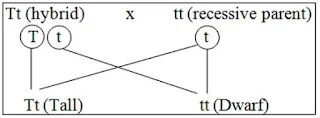
- Hence monohybrid test cross ratio = 1:1
- Test cross is used to find out the unknown genotype of a character. E.g.,

- Mendel conducted a test cross to determine the F2 genotype.
Mendel’s Principles or Laws of Inheritance
1. First Law (Law of Dominance):
- Characters are controlled by discrete units called factors.
- Factors occur in pairs.
- In a dissimilar pair of factors, one member of the pair dominates (dominant) the other (recessive).
2. Second Law (Law of Segregation):
- “During gamete formation, the factors (alleles) of a character pair present in parents segregate from each other such that a gamete receives only one of the 2 factors”.
- Homozygous parent produces similar gametes.
- Heterozygous parent produces two kinds of gametes.
Inheritance of Two Genes
Dihybrid Cross
- It is a cross between two parents differing in 2 pairs of contrasting characters.
- E.g., cross between a pea plant with homozygous round-shaped & yellow-coloured seeds (RRYY) and wrinkled-shaped & green-coloured seeds (rryy).

- On observing the F2, Mendel found that yellow and green colour segregated in a 3:1 ratio.
- Round & wrinkled seed shape also segregated in a 3:1 ratio.
- Dihybrid Phenotypic ratio: 9 Round yellow : 3 Round green : 3 Wrinkled yellow : 1 Wrinkled green = 9:3:3:1
- The ratio of 9:3:3:1 can be derived as a combination series of 3 yellow : 1 green, with 3 round : 1 wrinkled.
i.e., (3:1)(3:1) = 9:3:3:1
- Dihybrid genotypic ratio: 1:2:1:2:4:2:1:2:1
- RRYY = 1
- RRYy = 2
- RrYY = 2
- RrYy = 4
- RRyy = 1
- Rryy = 2
- rrYY = 1
- rrYy = 2
- rryy = 1
Mendel’s 3rd Law: Law of Independent Assortment
- It is based on the results of dihybrid crosses.
- It states that “When two pairs of traits are combined in a hybrid, segregation of one pair of characters is independent of the other pair of characters”.
The Concept of Dominance
- Every gene contains information to express a particular trait.
- In heterozygotes, there are 2 types of alleles:
- Unmodified (normal or functioning) allele: It is generally dominant and represents the original phenotype.
- Modified allele: It is generally recessive.
- E.g., consider a gene that contains information for producing an enzyme. The normal allele of that gene produces a normal enzyme. The modified allele is responsible for the production of:
- Normal/less efficient enzyme, or
- A non-functional enzyme, or
- No enzyme at all.
- In the first case: The modified allele will produce the same phenotype as the unmodified allele. Thus, the modified allele is equivalent to the unmodified allele.
- In the 2nd and 3rd cases: The phenotype will depend only on the functioning of the unmodified allele. Thus, the modified allele becomes recessive.
1. Incomplete Dominance
- It is an inheritance in which heterozygous offspring show an intermediate character between two parental characteristics.
- E.g., flower colour in snapdragon (dog flower or Antirrhinum sp.) and Mirabilis jalapa (4’O clock plant).

- Here, a cross between homozygous red & white produces a pink flowered plant. Thus, phenotypic & genotypic ratios are the same.
- Phenotypic ratio: 1 Red : 2 Pink : 1 White (1:2:1)
- Genotypic ratio: 1 (RR) : 2 (Rr) : 1 (rr)
- This means that R was not completely dominant over r.
- Pea plants also show incomplete dominance in other traits.
2. Co-dominance
- It is the inheritance in which both alleles of a gene are expressed in a hybrid.
- E.g., ABO blood grouping in humans.
- ABO blood groups are controlled by the gene I.
- This gene controls the production of sugar polymers (antigens) that protrude from the plasma membrane of RBC.
- The gene I has three alleles: IA, IB, & i.
- IA and IB produce a slightly different form of the sugar, while allele i doesn’t produce any sugar.
| Alleles from parent 1 | Alleles from parent 2 | Genotype of offspring | Blood types (phenotype) |
|---|---|---|---|
| IA | IA | IAIA | A |
| IA | IB | IAIB | AB |
| IA | i | IAi | A |
| IB | IA | IAIB | AB |
| IB | IB | IBIB | B |
| IB | i | IBi | B |
| i | i | ii | O |
- When IA and IB are present together, they both express their own types of sugars. This is due to co-dominance.
3. Multiple Allelism
- It is the presence of more than two alleles of a gene to govern the same character.
- E.g., ABO blood grouping (3 alleles: IA, IB, & i).
- In an individual, only two alleles are present. Multiple alleles can be found only in a population.
4. Polygenic Inheritance
- It is the inheritance in which some traits are controlled by several genes (multiple genes).
- E.g., human skin colour, human height, etc.
- It considers the influence of the environment.
- In a polygenic trait, the phenotype reflects the contribution of each allele, i.e., the effect of each allele is additive.
- Human skin colour:
- Assume that 3 genes A, B, C control human skin colour.
- The dominant forms A, B, & C are responsible for dark skin colour, and recessive forms a, b, & c for light skin colour.
- Genotype with all the dominant alleles (AABBCC) gives the darkest skin colour.
- Genotype with all the recessive alleles (aabbcc) gives the lightest skin colour.
- Therefore, a genotype with 3 dominant alleles and 3 recessive alleles gives an intermediate skin colour.
- Thus, the number of each type of allele determines the darkness or lightness of the skin.
5. Pleiotropy
- Here, a single gene exhibits multiple phenotypic expressions. Such a gene is called a pleiotropic gene.
- In most cases, the mechanism of pleiotropy is the effect of a gene on metabolic pathways which contributes towards different phenotypes.
- E.g., starch synthesis in pea, sickle cell anaemia, phenylketonuria, etc.
- In phenylketonuria & sickle cell anaemia, the mutant gene has many phenotypic effects. E.g., phenylketonuria causes mental retardation, reduction in hair and skin pigmentation.
- Starch synthesis in pea plant:
- Starch is synthesized effectively by the BB gene. Therefore, large starch grains are produced.
- bb has lesser efficiency in starch synthesis and produces smaller starch grains.
- Starch grain size also shows incomplete dominance.

Chromosomal Theory of Inheritance
- Mendel’s work remained unrecognized till 1900 because:
- Communication was not easy.
- His mathematical approach was new and unacceptable.
- The concept of genes (factors) as stable and discrete units could not explain the continuous variation seen in nature.
- He could not give physical proof for the existence of factors.
- In 1900, de Vries, Correns, & von Tschermak independently rediscovered Mendel’s results.
Chromosomal Theory of Inheritance (1902)
- Proposed by Walter Sutton & Theodore Boveri.
- They said that pairing & separation of a pair of chromosomes lead to segregation of a pair of factors they carried.
- Sutton united chromosomal segregation with Mendelian principles and called it the chromosomal theory of inheritance. It states that:
- Chromosomes are vehicles of heredity.
- Two identical chromosomes form a homologous pair.
- Homologous pair segregates during gamete formation.
- Independent pairs segregate independently of each other.
- Genes (factors) are present on chromosomes. Hence genes and chromosomes show similar behaviours.


- Thomas Hunt Morgan proved the chromosomal theory of inheritance using fruit flies (Drosophila melanogaster).
- It is a suitable material for genetic study because:
- They can grow on simple synthetic medium.
- Short generation time (life cycle: 12-14 days).
- Breeding can be done throughout the year.
- Hundreds of progenies per mating.
- Male and female flies are easily distinguishable. E.g., the male is smaller than the female.
- It has many types of hereditary variations that can be seen with low-power microscopes.
Linkage and Recombination
- Linkage is the physical association of two or more genes on a chromosome. They do not show independent assortment.
- Recombination is the generation of non-parental gene combinations. It occurs due to independent assortment or crossing over.
- Morgan carried out several dihybrid crosses in Drosophila to study sex-linked genes. E.g.:
- Cross 1: Yellow-bodied, white-eyed females × Brown-bodied, red-eyed males (wild type).
- Cross 2: White-eyed, miniature-winged × Red-eyed, large-winged (wild type).
- Morgan intercrossed their F1 progeny. He found that:
- The two genes did not segregate independently, and the F2 ratio deviated from the 9:3:3:1 ratio.
- Genes were located on the X chromosome.
- When two genes were situated on the same chromosome, the proportion of parental gene combinations was much higher than the non-parental type. This is due to linkage.
- Genes of white eye & yellow body were very tightly linked and showed only 1.3% recombination.
- Genes of white eye & miniature wing were loosely linked and showed 37.2% recombination.
- Tightly linked genes show low recombination. Loosely linked genes show high recombination.

- Alfred Sturtevant used the recombination frequency between gene pairs for measuring the distance between genes and ‘mapped’ their position on the chromosome.
- Genetic maps are used as a starting point in the sequencing of genomes. E.g., Human Genome Project.
- The chromosomes that are involved in sex determination are called sex chromosomes (allosomes).
- They include X & Y chromosomes.
- Autosomes are chromosomes other than sex chromosomes.
- The number of autosomes is the same in males and females.
- Henking (1891) studied spermatogenesis in some insects and observed that 50% of sperm received a nuclear structure after spermatogenesis, and the other 50% did not receive it. Henking called this structure the X body (now called the X-chromosome).
Mechanism of Sex Determination
- XX-XO mechanism: Male is heterogametic, i.e., XO (gametes with X and gametes without X), and female is homogametic, i.e., XX (all gametes are with X-chromosomes). E.g., many insects such as grasshoppers.
- XX-XY mechanism: Male is heterogametic (X & Y), and female is homogametic (X only). E.g., humans & Drosophila.
- ZZ-ZW mechanism: Male is homogametic (ZZ), and female is heterogametic (Z & W). E.g., birds.
XX-XO & XX-XY mechanisms show male heterogamety.
ZZ-ZW mechanism shows female heterogamety.
Sex Determination in Humans (XX-XY Type)
- Humans have 23 pairs of chromosomes (22 pairs of autosomes and 1 pair of sex chromosomes).
- A pair of X-chromosomes (XX) is present in the female, whereas X and Y chromosomes are present in the male.
- During spermatogenesis, males produce 2 types of gametes: 50% with X-chromosome and 50% with Y-chromosome.
- Females produce only ovum with an X-chromosome.
- There is an equal probability of fertilization of the ovum with the sperm carrying either X or Y chromosome.

- The sperm determines whether the offspring is male or female.
Sex Determination in Honeybee
- It is based on the number of sets of chromosomes an individual receives.
- A fertilised egg develops as a female (queen or worker).
- An unfertilised egg develops as a male (drone). This is called parthenogenesis.
- Therefore, the females are diploid (32 chromosomes), and males are haploid (16 chromosomes). This is called a haplodiploid sex determination system.
- In this system, the males produce sperms by mitosis. They do not have a father and thus cannot have sons, but have a grandfather and can have grandsons.

Mutation
- It is a sudden heritable change in DNA sequences resulting in changes in the genotype and the phenotype of an organism.
- Mutation is of 2 types:
- Point mutation: The mutation due to a change (substitution) in a single base pair of DNA. E.g., sickle cell anemia.
- Frame-shift mutation: It is the deletion or insertion of base pairs resulting in the shifting of DNA sequences.
- Loss (deletion) or gain (insertion/duplication) of a DNA segment causes chromosomal abnormalities (aberrations).
- Chromosomal aberrations are seen in cancer cells.
- The agents which induce mutation are called mutagens. They include:
- Physical mutagens: UV radiation, α, β, γ rays, X-rays, etc.
- Chemical mutagens: Mustard gas, phenol, formalin, etc.
Pedigree Analysis
- In humans, control crosses are not possible. So the study of family history about inheritance is used.
- Such an analysis of genetic traits in several generations of a family is called pedigree analysis.
- The representation or chart showing family history is called a family tree (pedigree).
- In human genetics, a pedigree study is utilized to trace the inheritance of a specific trait, abnormality, or disease.
Symbols Used in Pedigree Analysis

- Genetic Disorders are the disorders due to change in genes or chromosomes.
- 2 types: Mendelian disorders & Chromosomal disorders.
1. Mendelian Disorders
- It is caused by alteration or mutation in a single gene.
- E.g., Haemophilia, Colour Blindness, Sickle-Cell Anaemia, Phenylketonuria, Thalassemia, Cystic Fibrosis, etc.
- The pattern of inheritance of Mendelian disorders can be traced in a family by pedigree analysis.
- Mendelian disorders may be dominant or recessive.
- Pedigree analysis helps to understand whether the trait is dominant or recessive.

Pedigree analysis of (A) Autosomal dominant trait (E.g., Myotonic dystrophy) and (B) Autosomal recessive trait (E.g., Sickle-cell anaemia)
Haemophilia (Royal Disease)
- It is a sex-linked (X-linked) recessive disease.
- In this, a protein involved in blood clotting is affected.
- A simple cut results in non-stop bleeding.
- The disease is controlled by 2 alleles, H & h.
- H is the normal allele, and h is responsible for haemophilia.
- Genotypes and phenotypes:
- XHXH: Normal female
- XHXh: Heterozygous female (carrier). She may transmit the disease to sons.
- XhXh: Haemophilic female
- XHY: Normal male
- XhY: Haemophilic male
- In females, haemophilia is very rare because it happens only when the mother is at least a carrier and the father is haemophilic (unviable in the later stage of life).
- Queen Victoria was a carrier of haemophilia. So her family pedigree shows many haemophilic descendants.
Colour Blindness
- It is a sex-linked (X-linked) recessive disorder due to a defect in either the red or green cone of the eye.
- It results in failure to discriminate between red and green colour.
- It is due to a mutation in some genes in the X chromosome.
- It occurs in 8% of males and only about 0.4% of females. This is because the genes are X-linked.
- The normal allele is dominant (C). The recessive allele (c) causes colour blindness.
- The son of a heterozygous woman (carrier, XCXc) has a 50% chance of being colour blind.
- A daughter will be colour blind only when her mother is at least a carrier and her father is colour blind (XcY).
Sickle-Cell Anaemia
- This is an autosome-linked recessive disease.
- It can be transmitted from parents to the offspring when both the partners are carriers (heterozygous) for the gene.
- The disease is controlled by a pair of alleles, HbA and HbS.
- Genotypes and phenotypes:
- Homozygous dominant (HbAHbA): Normal
- Heterozygous (HbAHbS): Carrier; sickle-cell trait
- Homozygous recessive (HbSHbS): Affected
- The defect is caused by the substitution of Glutamic acid (Glu) by Valine (Val) at the sixth position of the β-globin chain of haemoglobin (Hb).

- This is due to the single base substitution at the sixth codon of the β-globin gene from GAG to GUG.
- The mutant Hb molecule undergoes polymerization under low oxygen tension, causing the change in the shape of the RBC from a biconcave disc to an elongated sickle-like structure.
- Sickle-cell anaemia is a qualitative problem (synthesizes incorrectly functioning globin).
Phenylketonuria
- An inborn error of metabolism.
- An autosomal recessive disease.
- It is due to a mutation of a gene that codes for the enzyme phenylalanine hydroxylase. This enzyme converts the amino acid phenylalanine into tyrosine.
- The affected individual lacks this enzyme. As a result, phenylalanine accumulates and converts into phenyl pyruvic acid and other derivatives.
- They accumulate in the brain, resulting in mental retardation. These are also excreted through urine because of poor absorption by the kidney.
Thalassemia
- An autosome-linked recessive blood disease.
- It is transmitted from unaffected carrier (heterozygous) parents to offspring.
- It is due to mutation or deletion.
- It results in reduced synthesis of α or β globin chains of haemoglobin. It forms abnormal haemoglobin and causes anaemia.
- Based on the chain affected, thalassemia is of 2 types:
- α Thalassemia: Here, production of the α globin chain is affected. It is controlled by two closely linked genes HBA1 & HBA2 on chromosome 16 of each parent. Mutation or deletion of one or more of the four genes causes the disease. The more genes affected, the fewer α globin molecules produced.
- β Thalassemia: Here, production of the β globin chain is affected. It is controlled by a single gene HBB on chromosome 11 of each parent. Mutation of one or both genes causes the disease.
- Thalassemia is a quantitative problem (synthesizes very few globin molecules).
2. Chromosomal Disorders
- They are caused due to the absence, excess, or abnormal arrangement of one or more chromosomes.
- 2 types:
- Aneuploidy: The gain or loss of chromosomes due to the failure of segregation of chromatids during cell division.
- Polyploidy (Euploidy): It is an increase in a whole set of chromosomes due to the failure of cytokinesis after the telophase stage of cell division. This is very rare in humans but often seen in plants.
Examples for Chromosomal Disorders
Down’s Syndrome
- It is the presence of an additional copy of chromosome number 21 (trisomy of 21).
- Genetic constitution: 45 A + XX or 45 A + XY (i.e., 47 chromosomes).
- Features:
- They are short-statured with a small round head.
- Broad flat face.
- Furrowed big tongue and partially open mouth.
- Many “loops” on fingertips.
- Broad palm with a characteristic palm simian crease.
- Retarded physical, psychomotor, and mental development.
- Congenital heart disease.
Klinefelter’s Syndrome
- It is the presence of an additional copy of the X-chromosome in males (trisomy).
- Genetic constitution: 44 A + XXY (i.e., 47 chromosomes).
- Features:
- Overall masculine development. However, feminine development is also expressed, e.g., development of breasts (Gynaecomastia).
- Sterile.
- Mentally retarded.
Turner’s Syndrome
- This is the absence of one X chromosome in females (monosomy).
- Genetic constitution: 44 A + X0 (i.e., 45 chromosomes).
- Features:
- Sterile, ovaries are rudimentary.
- Lack of other secondary sexual characteristics.
- Dwarf.
- Mentally retarded.
Related posts
More guides connected to this topic
Biodiversity and Conservation Biology Notes - Levels, Patterns, Loss, Conservation, Hotspots and Protected Areas
Learn about biodiversity levels, patterns, loss, conservation strategies, hotspots and protected areas, with examples from India.
Microbes in Human Welfare Biology Notes - Household, Industrial, Sewage Treatment, Biogas, Biocontrol and Biofertilizers
Explore how microbes are used in household products, food fermentation, industrial processes, sewage treatment, biogas, biocontrol and biofe...
Human Health and Diseases Biology Notes - Common Diseases, Immunity, AIDS, Cancer, Drugs and Adolescence
Overview of common diseases, immune system basics, AIDS, cancer, drug effects and health considerations for adolescents.

Discussion
Comments
Please log in to join the discussion.
Login to commentNo comments yet. Be the first to start the discussion.