

On this page
Classification Systems
Aristotle's Classification
- Aristotle was the earliest to attempt a more scientific basis for classification of organisms.
- He classified plants to trees, shrubs & herbs and animals into 2 groups: those with red blood & without red blood.
Linnaeus's Two-Kingdom Classification
- Linnaeus (1758) classified organisms into Two Kingdoms: Kingdom Plantae & Kingdom Animalia.
Drawbacks of 2-Kingdom Classification
- Prokaryotes and eukaryotes were both included under 'Plants'.
- Unicellular and multicellular organisms were grouped together.
- Didn't differentiate between heterotrophic fungi and autotrophic green plants.
Five Kingdom Classification
- Proposed by R.H. Whittaker (1969)
- Includes Monera, Protista, Fungi, Plantae & Animalia
- Based on cell structure, thallus organization, mode of nutrition, reproduction and phylogenetic relationships
- Three-domain system: Divides Kingdom Monera into two domains. Eukaryotic kingdoms are included in third domain (six-kingdom classification).
| Characteristics of the Five Kingdoms | |||||
|---|---|---|---|---|---|
| Characters | Monera | Protista | Fungi | Plantae | Animalia |
| Cell type | Prokaryotic | Eukaryotic | Eukaryotic | Eukaryotic | Eukaryotic |
| Cell wall | Non-cellulosic (polysaccharide + amino acid) | Present in some | Present (Chitin & polysaccharides) | Present (Cellulose) | Absent |
| Nuclear membrane | Absent | Present | Present | Present | Present |
| Body organization | Cellular | Cellular | Multicellular, loose tissue | Tissue/organ | Tissue/organ/organ system |
| Mode of nutrition | Autotrophic (photosynthetic & chemosynthetic) and heterotrophic (saprophyte/parasite) | Autotrophic (photosynthetic) and heterotrophic | Heterotrophic (saprophytic or parasitic) | Autotrophic (photosynthetic) | Heterotrophic (holozoic, saprophytic etc.) |
1. Kingdom Monera (Bacteria)
- Bacteria are the most abundant microorganisms.
- Hundreds of bacteria are present in a handful of soil.
- They also live in extreme habitats such as hot springs, deserts, snow, and deep oceans. Many are parasites.
- Based on shape, bacteria are of four types: Coccus (spherical), Bacillus (rod-shaped), Vibrio (comma-shaped), and Spirillum (spiral).
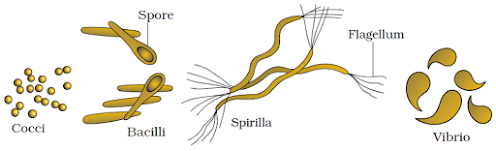
- Some bacteria are autotrophic (synthesize food from inorganic substrates). The majority are heterotrophs (depend on other organisms or dead organic matter for food).
I. Archaebacteria
- They live in the harshest habitats such as extreme salty areas (halophiles), hot springs (thermoacidophiles), and marshy areas (methanogens).
- Archaebacteria have a different cell wall structure for their survival in extreme conditions.
- Methanogens are present in the guts of ruminant animals (cows, buffaloes, etc.). They produce methane (biogas) from the dung of these animals.
II. Eubacteria (‘True Bacteria’)
- They have a rigid cell wall and a flagellum (if motile).
- They include autotrophs (photosynthetic and chemosynthetic) and heterotrophs.
a. Photosynthetic Autotrophs (e.g., Cyanobacteria)
- They have chlorophyll a similar to green plants.
- Cyanobacteria (blue-green algae) are unicellular, colonial, or filamentous, marine, or terrestrial algae.
- The colonies are generally surrounded by a gelatinous sheath.
- They often form blooms in polluted water bodies.
- Some of them fix atmospheric nitrogen in specialized cells (heterocysts). E.g., Nostoc and Anabaena.

b. Chemosynthetic Autotrophs
- They oxidize inorganic substances such as nitrates, nitrites, and ammonia and use the released energy for ATP production.
- They help in recycling nutrients like nitrogen, phosphorus, iron, and sulfur.
c. Heterotrophic Bacteria
- They are the most abundant in nature.
- The majority are important decomposers.
Impacts of Heterotrophic Bacteria on Human Affairs:
- They are used to make curd from milk.
- Production of antibiotics.
- Fixing nitrogen in legume roots, etc.
- Some are pathogens causing diseases, e.g., cholera, typhoid, tetanus, and citrus canker.
Reproduction in Bacteria
- Bacteria reproduce mainly by fission.
- Under unfavorable conditions, they produce spores.
- They also reproduce by a sort of sexual reproduction (DNA transfer from one bacterium to another).

- Mycoplasmas are organisms without a cell wall. They are the smallest living cells. They can survive without oxygen. Many are pathogenic in animals and plants.
Kingdom Protista
- It includes single-celled eukaryotes.
- The cell contains a well-defined nucleus and other membrane-bound organelles. Some have flagella or cilia.
- Protists are primarily aquatic.
- It is a link with plants, animals, and fungi.
- They reproduce asexually and sexually (cell fusion and senescence formation).
- Protista includes Chrysophytes, Dinoflagellates, Euglenoids, Slime moulds, and Protozoans.
I. Chrysophytes
- Found in fresh water and marine environments.
- Microscopic and float passively in water currents (plankton).
- Most of them are photosynthetic.
- It includes diatoms and golden algae (desmids).
- Diatoms: They have siliceous cell walls forming two thin overlapping shells, which fit together as in a soap box. The cell wall deposit of diatoms over billions of years in their habitat is known as ‘diatomaceous earth’. This is used in polishing, filtration of oils and syrups.
- Diatoms are the chief ‘producers’ in the oceans.
II. Dinoflagellates
- Mostly marine and photosynthetic.
- They appear yellow, green, brown, blue, or red based on the main pigments present in their cells.
- The cell wall has stiff cellulose plates on the outer surface.
- Most of them have two flagella; one lies longitudinally and the other transversely in a furrow between the wall plates.
- Red dinoflagellates (e.g., Gonyaulax) undergo rapid multiplication so that the sea appears red (red tides). They release toxins that kill marine animals like fishes.
III. Euglenoids
- Mainly freshwater organisms found in stagnant water.
- Instead of a cell wall, they have a protein-rich layer called pellicle. It makes their body flexible.
- They have two flagella, a short and a long one.
- They are photosynthetic in the presence of sunlight. In the absence of sunlight, they behave like heterotrophs by predating on smaller organisms.
- The pigments are identical to those in higher plants.
- E.g., Euglena.
IV. Slime Moulds
- They are saprophytic protists.
- The body moves along decaying twigs and leaves engulfing organic material.
- Under suitable conditions, they form an aggregation called plasmodium. It may spread over several feet.
- Under unfavorable conditions, plasmodium differentiates and forms fruiting bodies bearing spores at their tips. Spores have true walls. They are highly resistant and survive for many years. Spores are dispersed by air.
V. Protozoans
- They are heterotrophs (predators or parasites).
- They are the primitive relatives of animals.
- There are four major groups of protozoans:
- Amoeboid protozoans: They live in freshwater, seawater, or moist soil. They move and capture prey by putting out pseudopodia (false feet). E.g., Amoeba. Marine forms have silica shells on their surface. Some are parasites. E.g., Entamoeba.
- Flagellated protozoans: They are free-living or parasitic. They have flagella. The parasitic forms cause diseases like sleeping sickness. E.g., Trypanosoma.
- Ciliated protozoans: They are aquatic, actively moving organisms using thousands of cilia. They have a cavity (gullet) that opens to the outside. By the movement of cilia, water with food enters the gullet. E.g., Paramecium.
- Sporozoans: They have an infectious spore-like stage in their life cycle. E.g., Plasmodium (malarial parasite).
Kingdom Fungi
- It is a unique kingdom of heterotrophic organisms.
- Fungi are cosmopolitan.
- They grow in warm and humid places.
- E.g., mould on bread & rotten fruits, mushroom, toadstools.
- White spots on mustard leaves are due to a parasitic fungus.
- Some fungi are the source of antibiotics, e.g., Penicillium.
- Some unicellular fungi (e.g., yeast) are used to make bread and beer.
- Other fungi cause diseases in plants and animals, e.g., wheat rust-causing Puccinia.
- Except yeasts, fungi are filamentous. Their bodies consist of thread-like structures called hyphae.
- The network of hyphae is known as mycelium.
- Hyphae are of two types:
- Coenocytic hyphae: They are continuous tubes filled with multinucleated cytoplasm.
- Sep hyphae: They have septae or cross walls.
- Fungal cell wall is made of chitin & polysaccharides.
- Most fungi are saprophytes (absorb soluble organic matter from dead substrates). Some are parasites.
- Some live as symbionts, e.g., lichens (fungi + algae), mycorrhiza (fungi + roots of higher plants).
Reproduction
- Vegetative propagation: By fragmentation, fission, & budding.
- Asexual reproduction: By spores such as conidia, sporangiospores, and zoospores.
- Sexual reproduction: By oospores, ascospores, and basidiospores. They are produced in distinct structures called fruiting bodies.
- The sexual cycle involves three steps:
- Plasmogamy: Fusion of protoplasm between two motile or non-motile gametes.
- Karyogamy: Fusion of two nuclei.
- Meiosis: In zygote to give haploid spores.
- When a fungus reproduces sexually, two haploid hyphae of compatible mating types come together and fuse.
- In some fungi, the fusion of two haploid cells immediately results in diploid cells (2n).
- In ascomycetes and basidiomycetes, a dikaryotic stage or dikaryophase (n + n, i.e., two nuclei per cell) occurs. Such a condition is called a dikaryon. Later, parental nuclei fuse, and the cells become diploid.
- The fungi form fruiting bodies in which reduction division occurs, leading to formation of haploid spores.
Classes of Fungi
- Based on morphology of mycelium, mode of spore formation, & fruiting bodies, fungi are classified into:
- Phycomycetes
- Ascomycetes
- Basidiomycetes
- Deuteromycetes
I. Phycomycetes (Lower Fungi)
- They occur in aquatic habitats and on decaying wood in moist and damp places or as obligate parasites on plants.
- The mycelium is aseptate and coenocytic.
- Asexual reproduction: By motile zoospores or by non-motile aplanospores. These are produced in sporangium.
- Sexual reproduction: Zygospores are formed by fusion of two gametes. These gametes are isogamous (similar in morphology) or anisogamous or oogamous (dissimilar).
- E.g., Mucor, Rhizopus (bread mould), and Albugo (parasitic fungi on mustard).
II. Ascomycetes (Sac-Fungi)
- They are unicellular (e.g., yeast, Saccharomyces) or multicellular (e.g., Penicillium).
- Mycelium is branched and septate.
- They are saprophytic, decomposers, parasitic, or coprophilous (growing on dung).
- Asexual reproduction: By conidia produced exogenously on the special mycelium called conidiophores. Conidia germinate to produce mycelium.
- Sexual reproduction: By ascospores produced endogenously in sac-like asci (sing. ascus). The asci are arranged to form fruiting bodies called ascocarps.
- E.g., Aspergillus, Claviceps, and Neurospora.
- Neurospora is used in biochemical and genetic work.
- Morels & truffles are edible.
III. Basidiomycetes
- Includes mushrooms, bracket fungi, or puffballs.
- They grow in soil, on logs and tree stumps, and in living plant bodies as parasites (e.g., rusts and smuts).
- The mycelium is branched and septate.
- The asexual spores are generally not found, but vegetative reproduction by fragmentation is common.
- The sex organs are absent, but plasmogamy occurs by fusion of two vegetative or somatic cells of different strains or genotypes. The resultant structure is dikaryotic, which gives rise to basidium. Karyogamy and meiosis take place in basidium, producing four basidiospores exogenously. Basidia are arranged in fruiting bodies (basidiocarps).
- E.g., Agaricus (mushroom), Ustilago (smut), and Puccinia (rust fungus).
IV. Deuteromycetes
- Commonly known as imperfect fungi because only their asexual or vegetative phases are known.
- When perfect (sexual) stages were discovered, they were often moved to ascomycetes or basidiomycetes.
- It is also possible that asexual and vegetative stage have been given one name under deuteromycetes, and the sexual stage another name under another class. When linkages were established, the fungi were correctly identified and moved out of deuteromycetes.
- They reproduce only by asexual spores (conidia).
- The mycelium is septate and branched.
- Some are saprophytes or parasites. Majority are decomposers of litter and help in mineral cycling.
- E.g., Alternaria, Colletotrichum, and Trichoderma.
Kingdom Plantae (Plant Kingdom)
- Plants are eukaryotic chlorophyll-containing organisms with cellulosic cell wall.
- Some are partial heterotrophs (e.g., insectivorous plants like bladderwort and Venus flytrap) or parasites (e.g., Cuscuta).
- Plantae includes algae, bryophytes, pteridophytes, gymnosperms, and angiosperms.
- Life cycle of plants has two phases: diploid sporophytic and haploid gametophytic. These phases alternate with each other. This is called alternation of generation.
- Among different plant groups, length of the haploid and diploid phases is varied. Also, these phases are free living or dependent on others.
Kingdom Animalia (Animal Kingdom)
- Animals are multicellular, heterotrophic, eukaryotic organisms without cell wall.
- They directly or indirectly depend on plants for food.
- They digest their food in an internal cavity and store food reserves as glycogen or fat. Their mode of nutrition is holozoic (by ingestion of food).
- They have a definite growth pattern and grow into adults that have a definite shape and size.
- Higher forms show sensory and neuromotor mechanism.
- Most of them are capable of locomotion.
- The sexual reproduction is by copulation of male and female followed by embryological development.
Viruses, Viroids, Prions and Lichens
- In the five-kingdom classification, acellular organisms (viruses, viroids, and prions) and lichens are not mentioned.
- Viruses are non-cellular and not truly ‘living’. So they are not included in five-kingdom classification.
- Viruses have an inert crystalline structure outside the living cell.
- Viruses are obligate parasites.
- When they infect a cell, they take over the machinery of the host cell to replicate themselves, killing the host.
- Louis Pasteur gave the name virus (means venom or poisonous fluid).
- D.J. Ivanowsky (1892) discovered virus. He recognized certain microbes that cause mosaic disease of tobacco. They were smaller than bacteria because they passed through bacteria-proof filters.
- M.W. Beijerinek (1898) demonstrated that the extract of the infected tobacco plants cause infection in healthy plants and called the fluid as Contagium vivum fluidum (infectious living fluid).
- W.M. Stanley (1935) showed that viruses could be crystallized and crystals consist largely of proteins.
- A virus is a nucleoprotein, i.e., it has a protein coat (capsid) and genetic material (RNA or DNA).
- The genetic material is infectious.
- No virus contains both RNA and DNA.
- Generally, plant viruses have single stranded RNA. Animal viruses have either single or double stranded RNA or double stranded DNA. Bacteriophages (viruses that infect bacteria) usually have double stranded DNA.
- The capsid made of small subunits (capsomeres) protects nucleic acid. Capsomeres are arranged in helical or polyhedral geometric forms.

- Viruses cause diseases like mumps, small pox, herpes, influenza, and AIDS. In plants, the symptoms can be mosaic formation, leaf rolling and curling, yellowing and vein clearing, dwarfing, and stunted growth.
- Viroid: It is an infectious agent with a free low molecular weight RNA and no protein coat. These are smaller than viruses. It is discovered by T.O. Diener (1971). He found that it caused potato spindle tuber disease.
- Prions: These are abnormally folded protein that cause some infectious neurological diseases. These are similar in size to viruses. They cause bovine spongiform encephalopathy (BSE) or mad cow disease in cattle and its analogous variant Cr-Jacob disease (CJD) in humans.
Lichens
- Lichens are symbiotic associations (mutually useful associations) between algae and fungi.
- The algal component is called phycobiont (autotrophic) and fungal component is mycobiont (heterotrophic).
- Algae prepare food for fungi and fungi provide shelter and absorb mineral nutrients and water for its partner.
- Lichens are very good pollution indicators. They do not grow in polluted areas.
Related posts
More guides connected to this topic

Plant Growth and Development Biology Notes - Growth Phases, Growth Rates, Differentiation, PGRs, Photoperiodism, Vernalisation and Seed Dormancy
Read notes on plant growth and development, covering meristems, growth phases, differentiation, plant growth regulators, and photoperiodism.

Respiration in Plants Biology Notes - Glycolysis, Fermentation, Krebs Cycle, ETS and Respiratory Quotient
Clear biology notes on cellular respiration in plants, covering glycolysis, fermentation, the Krebs cycle, ETS, and respiratory quotient.
Photosynthesis in Higher Plants Biology Notes - Experiments, Light Reaction, Calvin Cycle, C3 and C4 Pathway and Factors Affecting Photosynthesis
Study photosynthesis in higher plants, including early experiments, light reactions, the Calvin cycle, C3 and C4 pathways, and key factors.

Discussion
Comments
Please log in to join the discussion.
Login to commentNo comments yet. Be the first to start the discussion.